
Activity 3: Appling Weller’s ideas to teaching.
1. Exploring the ideas behind the virtual world Second Life.
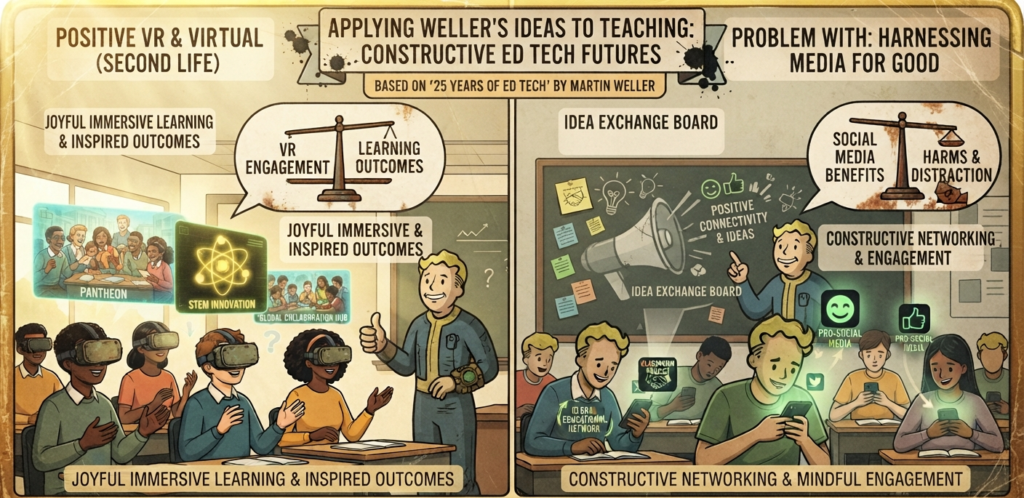
While reading Weller’s book, 25 years of Ed Tech, I was especially intrigued at the section discussing the ideas behind the virtual world of Second Life. Weller explored this game because it is a great example of the potential benefits of VR, specifically in the area of open learning. He points out that when the game was released it carried with it a profound promise to revolutionize educational opportunities. This is because it provided people with a space to explore a digital classroom, effectively emulating the experience that students in the real world would have. However, while Second Life provides an entertaining experience, Weller questions the overall value it provided when delivering a lesson; albeit his point seems to be in regards to general education. Weller does go on to say that in specific contexts, such as medicine or engineering, that VR can provide a useful mechanism for simulation; even if that potential has yet to fully be realized.
As a teacher, having explored the use of VR learning, I think that his point about virtual worlds is very interesting and correctly highlights the pros and cons of the technology. In my experience, when I explored the use of VR in a classroom, I found that the initial impact on students was very effective specifically in bring to life the content that we were engaging with. However, when I compared the results of student learning with other cohorts, I didn’t notice any significant difference in the learning outcomes when I taught the same units later without the VR addition. So should learning be defined simply by the end results? No, I think learning is a process of discovery. Does this mean that VR shouldn’t have a place in the classroom? Well, in today’s current context I would say while we shouldn’t dismiss VR simply because it hasn’t yet demonstrated superior learning outcomes there are logistical issues that prevent its realistic implication. The technology is just not ready yet, but if I asked all the students I’ve taught: What do you remember most about our classroom? I would be confident that the kids that experienced VR would remember that experience as a meaningful part of their education.
2. Exploring the problem with Social Media.
I found the section where Weller explores social media particularly interesting because it demonstrates just how quickly technology can change from its educational use into something fundamentally different. Weller explores social media, particularly Twitter, reflecting on how the technology was exciting in the beginning because it allowed educators to build effective networks of communication. I can see how this innovation could have been genuinely appealing in gathering collective educational ideas quickly in a large network because the conversations would include many new people. The problem is however that the harms of social media have increasingly become problematic enough to a point where they mostly overshadow any of the intended benefits. Weller does articulate that social media can have pros and cons, but this is where I feel his analysis doesn’t go far enough because the weight of the pros and cons are not equal and within certain contexts, especially for teenagers, social media can be actually harmful, as is evident in classroom settings. There is substantial evidence to demonstrate that social media is a problem for student learning because the attention it demands interferes with the learning process (Pyhältö et al., 2025). Looking from an even larger view, social media has also been a large problem educationally for society because it allows misinformation to permeate almost all layers of online conversations on its platforms (OECD, 2024). I think if Weller was to revise his chapter on social media, he might see just how problematic it has become for educational purposes and be more cautious when evaluating its benefits and harms.
References
Pyhältö, K., Rekola, H., Salovuori, S., Kosola, S., & Anttila, H. (2025). The relationship between academic achievement and off-task social media and smartphone usage: Evidence from a systematic literature review.
OECD. (2024). PISA 2022 results (Volume V): Learning strategies and attitudes for life. OECD Publishing. https://doi.org/10.1787/c2e44201-en
Weller, M. (2020). 25 years of ed tech. Athabasca University Press.
Image made with Gemini
AI Use Statement: AI was used to help locate relevant sources, brainstorm ideas, and organize my thoughts. I also used it to discuss my ideas and improve the grammar of the final reflection. The analysis, writing, and personal experiences presented are my own.
Be First to Comment