
By Vince Ruffolo
Masters of Arts in Education and Technology, Royal Roads University
LRNT523 – Foundations of Learning and Technologies
Instructor: Elizabeth Childs
October 28th, 2026
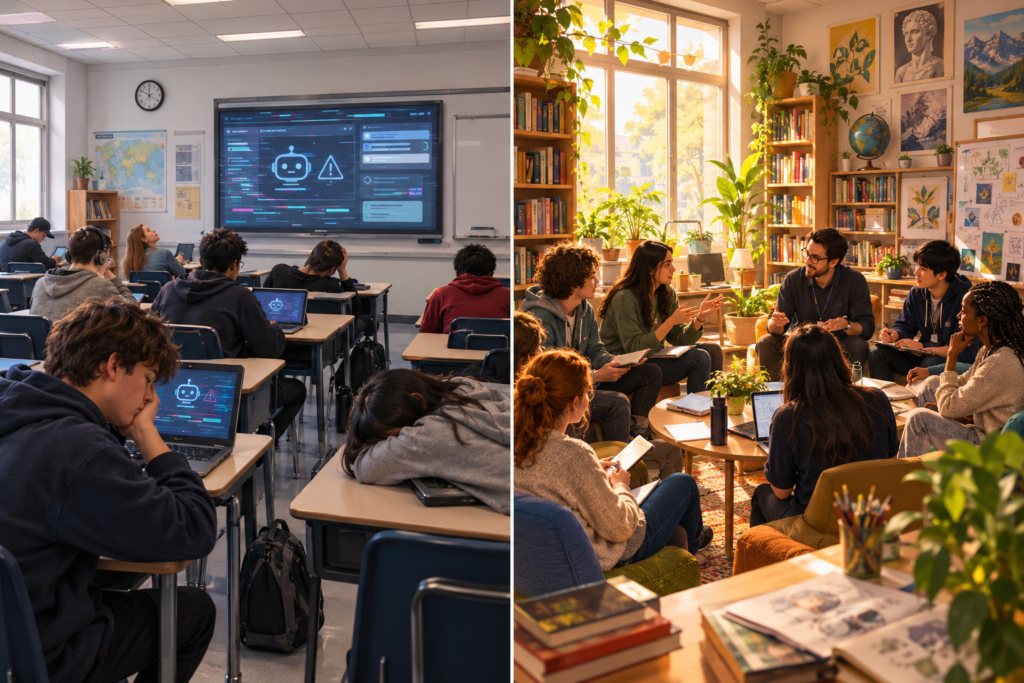
OpenAI. (2026). Two classrooms in 2035: [AI-generated image]. ChatGPT.
By the year 2035, it is possible that artificial intelligence (AI) may have profoundly transformed not only the economy but our education systems as well. In order to identify how students will experience this profound change, we will consider two high school English classes. One is using an educational AI to help students explore literature, develop ideas and assess their learning in ways other than traditional assignments. The other is a classroom of students who are disengaged from a curriculum that seems no longer relevant to them. These two classrooms are both shaped by the proliferation of AI and will raise important questions about the purpose of education in the 21st century. This is because while AI itself is not a problem for education, the ways in which it can be used to achieve educational goals highlight the major flaw in current approaches to education, in that education tends to focus on learning that prepares students for employment (OECD, 2025). If schools value learning for its economic utility more than for its intrinsic value to individual development, then how will education flourish in a post-AI world where human skills are less in demand? As many of the routine tasks that have in the past provided economic value to society are being taken over by AI, schools must ensure that independent thinking, critical judgment, creativity and personal development are valued for their contribution to human development as well as for their economic usefulness (Gmyrek et al., 2025).
The bell rings in my high school English classroom. It is 9 a.m. in 2035 at the private school I work at, and students are filling up the room. There is a sense of enthusiasm as the students continue their personalized learning programs which they have developed together around the Edgar Allan Poe unit we have begun working on. The students open their computers and use the AI educational assistant which helps them to interpret literary texts, challenge conventional thinking, and develop their critical thinking skills. Traditional marks have now disappeared because written assignments are no longer the primary means of demonstrating student learning. Written work is still valuable as a way to develop students’ ideas, but now teachers assess the thinking of students in different ways to make sure they have actually learned something because AI can generate essays, summarize texts, and construct arguments, so a completed written assignment is not sufficient evidence of student learning. Instead, in the 2035 classroom my students use their personal AI assistants to explore concepts, reason through problems, and evaluate interpretations. They track their own progress and design digital posters to demonstrate their learning via extensive presentations where they explain their ideas and processes. Meanwhile, just down the road, in a public school classroom, there is a different feel. There the room is only half full and the remaining students are no longer interested in the school’s curriculum. Most spend time on their personal devices and ignore the teacher lecturing about the day’s subject. The school is chronically underfunded and the students there have limited opportunities to use the new, powerful educational AI tools.
While these two classrooms seem quite different, they both have something in common, in that they have been radically shaped by the proliferation of AI in society. It is likely that by 2035 the use of AI will have been expanded in education to support many aspects of learning. In literature, for example, AI might enable students to explore in-depth ideas behind the author’s work, it could help them to question the assumptions on which they base their views or help them to challenge conventional ideas. Rather than students having to complete the same assignments or work at the same pace as other students, they could use an AI educational assistant to build personal learning programs which provide instant feedback. Classroom learning could be tailored to students individual interests and needs, however in order to achieve these benefits of AI, students will need to learn how to effectively interact with it. Walter (2024) understood this as he emphasized the need for students to be educated in AI literacy, prompt engineering, and critical thinking so that they can effectively interact with AI, as opposed to just accepting the output from it. Lee and Low (2024) similarly argue that generative AI should be integrated into education in ways that promote critical thinking. These arguments support the possibility that AI could help students explore literature, question assumptions, and develop their own interpretations.
However, while AI could potentially be an excellent learning tool, I would also argue that providing students with AI tools does not necessarily mean that they will automatically benefit from them. When learning with the aid of AI, there is no guarantee that students will achieve meaningful learning because there is a risk that students could become dependent on AI to interpret texts, develop critical thinking, and accept the answers that it provides without further thought or investigation. Moreover, the way that AI is introduced, who has access to it, and what educational goals it is used to achieve will determine if it will support meaningful learning or further exacerbate existing inequalities in education. These aspects of AI in education were explored by Macgilchrist et al. (2020) and Selwyn et al. (2020), as their work suggests that the effects of AI will depend not only on technological developments, but also on the decisions schools and policymakers make about how it is used and what education should achieve. They explore alternative futures for education and technology, emphasizing the choices involved in shaping them. Macgilchrist et al. (2020) write that “each future history means decisions have been taken about which technologies, institutions, funding lines, research, pedagogies, relations, designs, etc, to prioritise” (p. 87). Aboodi (2025) also examines the risk of outsourcing critical thinking to AI, highlighting the possibility that people may rely on AI to do their thinking rather than developing their own judgment. He explains that “outsourcing critical thinking to AI could be as simple as asking an AI chatbot a question that calls for critical thinking and relying on the answer without considering the matter on one’s own” (p. 629). This point is important because students can complete an assignment using AI without necessarily understanding the context of the material or having developed the skills that the assignment is intended to teach (Aboodi, 2025; Fischer et al., 2024). For example, a student studying an Edgar Allan Poe story might accept an AI-generated interpretation without evaluating its evidence or considering alternative explanations causing the student to produce work that is not meaningful evidence of their learning.
In addition to the question of how AI can best support meaningful learning, the widespread use of AI also brings up a larger issue with regards to the purpose of education; this is one area where our current career-focused education model is lacking. A major concern about the classroom of 2035 is: what will happen to the relationship between education and work when AI starts to change that relationship? When education is viewed, in part, as an asset that pays off in terms of job prospects, as we see today, a post-AI world could see fewer people valuing spending years in a classroom. To highlight this problem, I introduced in my 2035 scenario a guaranteed basic income (GBI) provided to assist citizens who are dealing with the possible widespread unemployment potentially resulting from the use of AI in the economy. This thought experiment helps to illustrate the potential impact a decoupling of education and employment could have on public funding of schools. Selwyn et al. (2020) also explored similar speculative scenarios to examine how digital technologies could reshape schools and the people within them. Their work supports my approach of using a 2035 scenario to explore how changes in technology and the economy might challenge existing assumptions about the purpose of education.
It is important to note that the technology itself does not determine which outcome occurs; rather, that the outcome depends on how schools and policymakers choose to implement and fund the technology. Therefore, such a decoupling and subsequent lack of funding could potentially mean that the benefits of AI in education are unlikely to benefit all students equally. Instead, there could be a significant risk of a two-tier educational system where public schools in particular may become chronically underfunded. This concept is supported by Singh and Maughan (2014) who examined the benefits and limitations of educational technology according to people’s economic and social circumstances. Their imagined scenarios illustrated how some learners could gain access to expensive educational opportunities and advanced technologies, while others potentially faced significant constraints allowing better-resourced schools to provide more personalized learning, while underfunded schools struggled to offer students the same opportunities.
AI is here and changing our world. By 2035, underfunding in public schools could contribute to a cycle of declining educational quality and student disengagement, further weakening public confidence in the value of education. However, such an outcome is not inevitable. It is important that education evolves to meet the needs of this change, or it will risk becoming increasingly irrelevant or reproduce even greater student inequalities than already exist. Instead of trying to make AI work within education’s current framework or to spending resources on better detecting its use, schools should instead rethink the purpose of education and shift the focus to assessing students’ ability to think independently, use critical thinking skills, and develop personally (Aboodi, 2025; Lee & Low, 2024; Roberts, 2023). This shift must take place so that all students can experience the benefits of AI and not just those in the wealthiest of schools.
References
Aboodi, R. (2025). The worrisome potential of outsourcing critical thinking to artificial intelligence. Educational Theory, 75(4), 626–645. https://doi.org/10.1111/edth.70037
Fischer, I., Sweeney, S., Lucas, M., & Gupta, N. (2024). Making sense of generative AI for assessments: Contrasting student claims and assessor evaluations. The International Journal of Management Education, 22(3), Article 101081. https://doi.org/10.1016/j.ijme.2024.101081
Gmyrek, P., Berg, J., Kamiński, K., Konopczyński, F., Ładna, A., Nafradi, B., Rosłaniec, K., & Troszyński, M. (2025). Generative AI and jobs: A 2025 update. International Labour Organization. https://doi.org/10.54394/QFBQ1907
Lee, C. C., & Low, M. Y. H. (2024). Using genAI in education: The case for critical thinking. Frontiers in Artificial Intelligence, 7, Article 1452131. https://doi.org/10.3389/frai.2024.1452131
Macgilchrist, F., Allert, H., & Bruch, A. (2020). Students and society in the 2020s: Three future ‘histories’ of education and technology. Learning, Media and Technology, 45(1), 76–89. https://doi.org/10.1080/17439884.2019.1656235
OECD. (2025). Education for human flourishing: A conceptual framework. OECD Publishing. https://doi.org/10.1787/73d7cb96-en
Roberts, J. S. (2023, July 14). Decolonizing AI ethics: Indigenous AI reflections. Accel.AI.
Selwyn, N., Pangrazio, L., Nemorin, S., & Perrotta, C. (2020). What might the school of 2030 be like? An exercise in social science fiction. Learning, Media and Technology, 45(1), 90–106. https://doi.org/10.1080/17439884.2020.1694944
Singh, S. S., & Maughan, T. (2014, June 22). The future of ed tech is here, it’s just not evenly distributed. Futures Exchange.
Walter, Y. (2024). Embracing the future of artificial intelligence in the classroom: The relevance of AI literacy, prompt engineering, and critical thinking in modern education. International Journal of Educational Technology in Higher Education, 21, Article 15. https://doi.org/10.1186/s41239-024-00448-3
AI Use Statement
AI Use Before Assignment 3
For this assignment, I will use AI to help in structuring my thoughts and critically analyze the readings. The AI I commonly use is ChatGPT and it can be useful in investigating the implications of the scenarios I create because it can help to stress test my ideas. I will use AI to help explain complex arguments in the readings and to see how sources I am using relate to one another. AI is useful in locating applicable sources and completing grammar checks. I will ensure that any sources suggested by the AI are checked and I will verify that the publications exist, that the authorship and publication details have been confirmed. I will read the original publications before citing them. I will also make comparisons between AI generated summaries and the actual readings, as I will be careful not to take the AI outputs for granted. I will not use AI to brainstorm my central ideas as I already have a good idea about the direction that I want to build this paper in. My arguments and conclusions will be my own.
AI Use After Assignment 3
AI was useful during my work on this paper as it helped me to develop and refine my ideas and arguments. I found that during the exploration of the readings I would communicate my ideas with the AI and explore the relationship between the artificial intelligence’s interpretations of the readings and my own. This was useful because the AI helped me to locate the weak points in my reasoning and build on my existing ideas, which was very helpful as it caused me to engage further with the ideas proposed by the authors. AI was also helpful in linking my thought experiment arguments and ideas with the academic literature. This helped to refine and better clarify the supporting arguments with my thesis. In addition I used ChatGPT to find awkward phrasing, grammatical errors, and ways to make my writing clearer and more concise. As I reflect on my use of AI after completing my paper, it became clear to me that the paper topic I chose was perhaps rather large for the proposed assignment. I was interested in exploring the ideas and relationship between economic viability and education, which sometimes felt too broad in scope. However AI did help me to manage the points and make the paper more manageable by helping me to focus on the specifics of the ideas I was exploring.
Leave a Comment