Virtual Reality Learning: Introducing Mel Slater
By Vince Ruffolo
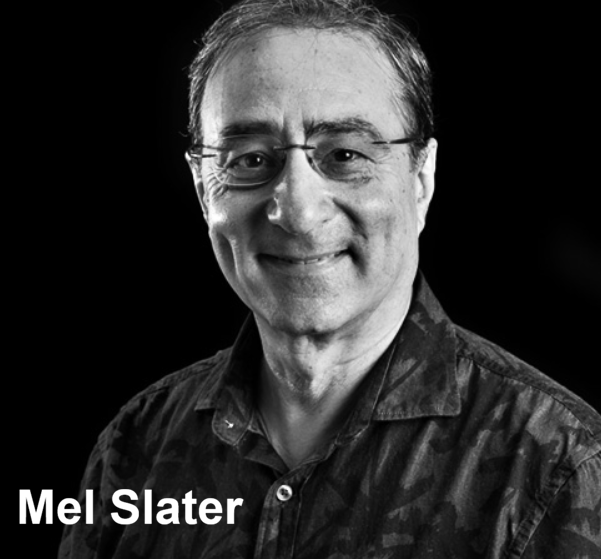
Mel Slater. Source: ICREA.
My interest in virtual reality technology has led me to Mel Slater who is a foundational figure in VR research. VR has the ability to simulate real world experiences and allows its users to explore environments that they would otherwise not have access to. Due to this incredible potential, it seems promising that this type of technology could revolutionize educational experiences. The work Slater has done since the late 1980’s has focused on users interactions and reactions within entirely computer generated worlds. His research helped create realistic simulation models that would allow professionals to accurately practice real skills in a safe space. These models have directly benefited fields such as medicine, healthcare, and emergency response. (Slater & Sanchez-Vives, 2016)
Mel Slater began his career at the University College London and later moved to the University of Barcelona’s Event Lab where he worked publishing several papers. (ICREA, 2016) At the University of Barcelona, Slater’s work focused on the psychological feeling of truly being inside a virtual environment and the experience of feeling that a virtual body is your own. Moreover, his research made important contributions to the study of embodiment, which shows that the human brain can relate to a virtual body much in the same way it does a physical one. (Slater et al., 2009)
I have become increasingly interested in VR and its practicality in being a genuinely valuable educational tool. Having used VR on several occasions, I believe that it has enormous educational potential because of the incredible immersion that it provides. Slater’s research is going to be pivotal in helping to realize this potential because he demonstrates that effective learning in immersive simulations is not only possible, but that these virtual simulations have similar impacts on the human brain as real world experiences, even when people know they are experiencing a virtual reality.
References
Slater, M., Perez-Marcos, D., Ehrsson, H. H., & Sanchez-Vives, M. V. (2009). Inducing illusory ownership of a virtual body. Frontiers in Neuroscience, 3(2), 214–220.
Slater, M. (2009). Place illusion and plausibility can lead to realistic behaviour in immersive virtual environments. Philosophical Transactions of the Royal Society B: Biological Sciences, 364(1535), 3549–3557.
Slater, M., & Sanchez-Vives, M. V. (2016). Enhancing our lives with immersive virtual reality. Frontiers in Robotics and AI, 3, Article 74.
ICREA. (2016). Slater, Mel. ICREA Memoir 2016.
Relevant Links
Meet the Brains – Mel Slater: Virtual Environments in Psychology and Cognitive Neuroscience (Institute of Neurosciences UB, YouTube): https://www.youtube.com/watch?v=oSWrtyBVH2A&t=6s
Mel Slater’s publications are listed at http://publicationslist.org/melslater
AI Transparency Statement
AI was used during this assignment to help brainstorm and identify a researcher who is foundational to the understanding of virtual reality. All links, authors and academic sources were investigated independently and verified for accuracy.
Be First to Comment