



Personal communications with my seven network participants uncovered three trends that align with established change management models and theories:
1. Leaders must be passionate, engaging and committed to change.
2. Leaders must prioritize change as a team activity.
3. Leaders must spend time planning and preparing for change.
Leaders Must Be Passionate, Engaging and Committed to Change
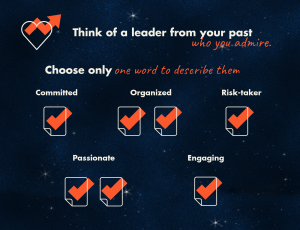
Kuipers et al. (2014) describe leadership as “an important driver of change” (p. 23). When asked to choose one word to describe a change leader from their past whom they admired, 57 per cent of network respondents contributed ideas around passion, commitment and an ability to engage the team. Weiner (2009) agrees that building organizational readiness for change requires that leaders engage participants in sharing a commitment to implementing change and in believing that they will succeed. By inspiring a shared vision, participants gain clarity on how their commitment will contribute to achieving successful change outcomes (Graetz, 2000).
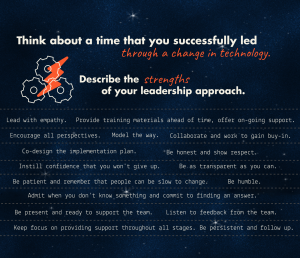
When developing organizational readiness for change, Jaskyte (2004) found that leaders must motivate their teams to commit to change by supporting the development of shared values and practices that support innovation. Themes of leading with passion, commitment, and engaging the team again emerged when participants described strengths in their leadership approach, such as: model the way, instill confidence that you won’t give up, and be present and ready to support the team. These leadership approaches demonstrate passion for the proposed change and a commitment to engaging in following it through to success.
Along with being passionate, engaged and committed to change, network participants agree that collaboration is a key success determinant when leading through change.
Leaders Must Prioritize Change as a Team Activity
Al-Haddad and Kotnour (2015) state that strong collaboration by all stakeholders can support successful outcomes when leading through change by encouraging teams to participate and become active contributors. When reflecting on the strengths they adopted during a successful change they led, participants shared examples of behaviours that support collaboration. Responses including encouraging all perspectives, co-designing the implementation plan, working to gain buy in through collaboration, listening to feedback, being persistent and following up, all encourage the team to share their perspectives. As Weiner (2009) found, when participants value the proposed change, they exhibit high efficacy are more likely to demonstrate behaviours required to support the change initiative.
Part of supporting their teams to participate actively requires that leaders also demonstrate commitment by effectively planning and preparing for change.
Leaders Must Spend Time Planning and Preparing for Change
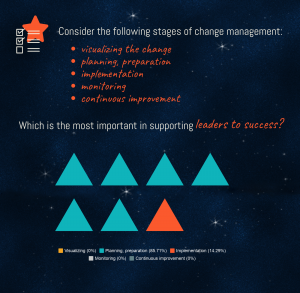
Planning and preparation are common components in the examples shared in Al-Haddad and Kotnour’s (2015) exploration of successful change models. Six of seven network respondents agree that planning and preparation are important considerations when leading through change. Examples of leadership strengths that network participants have successfully leveraged to support them through change that relate to planning and preparation include: provide training materials ahead of time, keep focus on providing support throughout all stages, and be as transparent as you can.
When reflecting back on leaders they admire, 29 per cent of participants described organization as a key success factor. One network participant contributed an idea that change leaders must be patient and remember that people can be slow to change. Another shared a best practice was to admit when you don’t know something and commit to finding an answer. Both responses highlight that today’s ever-shifting environment demands that change leaders must also engage change methods which also continuously evolve (Al-Haddad & Kotnour, 2015) and plan and prepare to flex their approach when the environment shifts.
Conclusion
In 2000, Graetz stated that implementing change successfully is the primary task that all leaders of face. Al-Haddad and Kotnour (2015) share that “change leaders are people with creative visions, who are able to foresee a new reality and how to get to it” (p. 239). Leading with passion and commitment helps to engage participation in the change process and works to develop a shared vision of success.
Using a collaborative approach also engages teams, especially when, as one participant shared, leaders lead with empathy. When change leaders design strategies with an empathetic approach, participants are encouraged to view the change through different perspectives, permitting openness and creative exploration (Mattelmäki, Vaajakallio, & Koskinen, 2014).
In today’s ever-changing environment, change leaders must plan and prepare not only for a successful implementation, but to make on-going changes in their approach when the environment shifts. By leading the team with a focus on being prepared for these shifts, a leader establishes change as an opportunity to continually strive for an established shared vision of success.
References
Al-Haddad, S., & Kotnour, T. (2015). Integrating the organizational change literature: a model for successful change. Journal of Organizational Change Management, 28(2), 234-262.
Graetz, F. (2000). Strategic change leadership. Management decision, 38(8), 550-564.
Jaskyte, K. (2004). Transformational leadership, organizational culture, and innovativeness in nonprofit organizations. Nonprofit Management and Leadership, 15(2), 153-168.
Kuipers, B. S., Higgs, M., Kickert, W., Tummers, L., Grandia, J., & Van der Voet, J. (2014). The management of change in public organizations: A literature review. Public administration, 92(1), 1-20.
Mattelmäki, T., Vaajakallio, K., & Koskinen, I. (2014). What Happened to Empathic Design?. Design issues, 30(1), 67-77.
Weiner, B. J. (2009). A theory of organizational readiness for change. Implementation science, 4(1), 67.
Hi Karen,
Excellent work here. I really enjoyed your graphic, and how you (in a visually appealing way) mixed up the ways you represented content in words as well as statistics. I grappled with what tool to use, and from the look of this Picktochart may have more options than Venngage (which I used).
It is interesting the extent to which you stress the need for those involved in the change process to feel they can contribute. How often though is this the case? So often in my experience it’s top down, and the decisions for how it will be implemented are made before the change implementation process begins. The rigidity (Dron’s hard and soft technologies also come to mind) of the design for change handcuffs the process. This also seems to really translate to how we as designers desire to involve learners in how the learning is designed, and want to be empathetic to their needs. As you mention, a lot of forethought and planning as well as passion and openness of leaders is required.
I’ve been interested recently by the degree to which tech companies have open communication on how changes are implemented. A lot of the SCRUM and other agile methodologies can really promote that degree of ‘buy in’ by staff, which as you mention can really aid in the degree to which staff engage and participate in the change process.