The structure set for the content of the symposium consisted of three tracks. The first one is named The Lay of the Land Track, and covered digital learning environments, networks, and communities, and featured sessions by professionals, experts and academics. The second track, Work in Digital Learning – Stories from the Field Track included professionals of digital learning. And the third one included presentations by near-to-completion students and is called End in Mind Track focusing on content and process, allowing the new-to-program students to have a feel of what is to come lighting up pathways that otherwise might remain unnoticed.
The lay of the land track
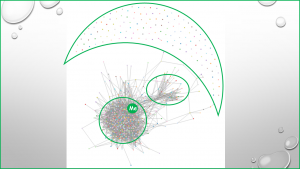
In his topic Intentional Messiness of Online Communities, Cormier, D. (2017) explained how the learning ecosystem is formed. On a Cartesian plain the left side of the x axis points toward work alone, while the right side aims to work with others; the upper side of the y axis points to open action, and the opposite side aims to directed action. The first quadrant, between work alone and open action is considered as the starting point of all other possibilities, and represents the consumption of a resource [answer a question]; from there the progression can go downwards to the second quadrant between work alone and directed action, e.g. participate in a course [introduction to a field]. Or it can go to the third quadrant on the right between open action and work with others, e.g. participate in Rhizomatic learning [exploration of a field]. The progression can also go from the second to the third quadrant, and from either can go to the fourth quadrant between work with others and directed action, e.g. mentor new learners [support others]. Rhizomatic learning consists of thinking that what is learned can expand in several directions similar to the rhizomes of a plant leading the learner to further learn more about the same and other aspects. It is that continuation resulting from the openness which increases the participative collaboration, and such tendency shall flourish as long as society understands that “the key is the understanding of the collective needs” (Cronin, 2017). “Openness is changing schemes in every field” (Cronin, 2017), and the Canadian Forces are not the exception as per the Future Navy Training Systems Strategy that Legassie, R. (2017), Lieutenant Coronel, presented and commented on the changes in the management systems, the upgrade of the fleet, and the way communication must occur to be expedite and punctual: how, what, to whom, and so forth. Amongst the biggest changes Legassie mentioned are regarding synthetic learning, simulation, flexible learning spaces [ubiquitous learning], and the flipped classroom concept which consists in everyone teaching the content as opposed to the PowerPoint lectures, a modality followed by the so-called PPT rangers, the old-guard instructors. The validation of the learning is performed in various ways: via the learners’ superiors, through observation, and through reports. The following sentence summarizes the change perfectly: “Teach with technology and through technology instead of teaching about technology” (Legassie, 2017), and he added: “This would be a much better use of tax-payers’ money.” On closing his topic he stressed that openness is being utilized always subject to security restrictions. Now, considering a community other than the military, Roland vanOostveen presented the topic Development of a Fully Online Learning Community model, and just like Cormier, he also turned to a Cartesian plain to describe his model simplifying the reference using the cardinal points of a compass to guide us through the model. On the north are specified tasks, on the south open-ended strategies, on the east learner-managed, and on the west teacher-controlled; the northwest represents instructor-led often text-based instructions, the east contains content controlled by the instructor while learner-controlled learning [e.g. case-based learning], the southwest represents resource-and-discussion-based instructor-mediated learning, and the southeast is self-directed and collaborative learning. The latter being the desired path to follow.
Work in digital learning – stories from the field track
Technology is, besides an on-going innovative ingredient, a key feature to maximize the students’ learning outcome of the School of Medicine at the University of British Columbia. In his presentation titled Leading Instructional Designers, Gary Rosborough (2017) referred to the use of simulators and mannequins as part of the instruction contributing to real-life situations for the students to practice. In order to achieve as much realism as possible professional actresses and actors playing the role of patients are interviewed by the learners, and later become the virtual patients represented by simulators and dummies. “Simulation of a virtual patient’s death is included from the third year of studies once the student has had clinical exposure to such events, before it would be traumatizing for the learner” (Rosborough, 2017). Technology also serves to revamp programs, such as the project presented by Carolyn Levy (2017) for which she titled her session Higher Education in Flux—what’s an Instructional Designer to do. The use of open technology helped both to redesign more than one hundred programs, and to work with 23 teams on site and remotely to achieve the goal of raising the success rate from 84% to the 95% range. “Two tools that have been extensively utilized amongst the teams are Padlet and Google Docs” (Levy, 2017). The project is in progress and it is scheduled to last three years in total. And speaking of periods of time, the concept of openness is not necessarily a novelty since for almost one hundred years Open School BC has been operating. Riddel (2017) commented that the foundations for their educational model stem from the analyze-design-develop-implement-evaluate model (ADDIE) and the successive approximation model (SAM) which are supported by Vygotsky’s theory of proximal development. Vygotsky’s theory sustains that the learner will always strive to go beyond the cognitive boundary set by conventional instruction. Open School BC is not funded, it recovers its costs through the sales of products and services provided by the people at Open School BC. As old as Open School BC might seem its openness make it fit for today’s challenge, and eLearning is one just as Vivian Frossman (2017) mentioned during her session: “eLearning is everywhere and in many different ways” (Frossman, 2017). Elaborating further she predicts: “the future is cloud-based computing” (Forssman, 2017). Thus it would be no surprise to have cloud-based instruction as well. She also discussed that Royal Roads University has been preparing its faculty to teach in an online community, and stressed how important it is to always be protected while in the open. Her peek into the future is that in ten years from now or less the use of virtual reality in education will thrive, digital media will proliferate, simulation will be commonplace, and the old way will continue to be challenged.
End in Mind Track
It might come naturally for students nearing the final stage of the MALAT program but for starters it might as well be shocking. After this track’s presentations it starts to make sense because the picture is now complete. The MALAT program is geared by technology thus since the beginning the learners encounter technological challenges or familiarities depending on the background of each case. In his session Keith Webster shared a small sample of what is to come. Webster (2017) described superficially what Feedly and WordPress are, and the importance each one has for the program. Moreover, the characteristics of these resources shall make a big difference provided the student takes full advantage of their features. And then there are the presentations by the near-to complete students which allow those new onboard to have a glimpse of what they will be doing in two year. Lillian Chumbley is researching on the Impact of Online Learning Development Strategies on Persons with Cognitive Challenges which is centred on individuals diagnosed with the fetal alcohol spectrum disorder (FASD). Listening to her was revealing because one can sense the enthusiasm that drives her into researching deeper and deeper. After the struggles she shared she comes to the final recommendation: “Trust in the methodology” (Chumbley, 2017). Yet another near-to-complete student contributed with a presentation on Simulation Training for Police Officers dealing with Persons in Crisis (PIC). Yvonne Armstrong explained the situations and consequences there can be, and at any moment a police officer must intervene in such a case. To make things worse someone suffering that sort of condition is usually afraid of the police, thus things usually unfold negatively (Armstrong, 2017). Among the resources being used to train police personnel are simulations, and Armstrong pointed out that those simulations shall avoid failure because failure sticks strongly to long-time memory, which causes the opposite effect than the training. Valuable recommendations to the new-to-program: trust yourself, trust the process, trust the program, and be selfish with your time (Armstrong, 2017). And last but not least, Elizabeth Childs presented the MALAT Exit Pathways: options and process. There is a great benefit in getting the mind early started in identifying any idea or initiative that might be a viable matter for further research. Childs (2017) explained that there are three pathways to exit the MALAT program: thesis, research paper, and digital learning consult project, all of which focus on positive outcomes for the individual, Royal Roads University, and the community.
References
Armstrong, Y. (2017, April). Police Training and Persons in Crisis. Paper presented in the Virtual Symposium of the 2017 MALAT Program at Royal Roads University, Victoria, BC, Canada.
Childs, E. (2017, April). MALAT Exit Pathways. Paper presented in the Virtual Symposium of the 2017 MALAT Program at Royal Roads University, Victoria, BC, Canada.
Chumbley, L. (2017, April). The Impact of Online Learning Development Strategies on Persons with Cognitive Challenges. Paper presented in the Virtual Symposium of the 2017 MALAT Program at Royal Roads University, Victoria, BC, Canada.
Cormier, D. (2017, April). Intentional Messiness of Online Communities. Paper presented in the Virtual Symposium of the 2017 MALAT Program at Royal Roads University, Victoria, BC, Canada.
Cronin, C. (2017, April). Choose Open. Paper presented in the Virtual Symposium of the 2017 MALAT Program at Royal Roads University, Victoria, BC, Canada.
Forssman, V. (2017, April). Centre for Teaching of Education and Technology. Paper presented in the Virtual Symposium of the 2017 MALAT Program at Royal Roads University, Victoria, BC, Canada.
Legassie, R. (2017, April). Future Naval Training Systems Strategy. Paper presented in the Virtual Symposium of the 2017 MALAT Program at Royal Roads University, Victoria, BC, Canada.
Levy, C. (2017, April). Higher Education in Flux: what’s an instructional designer to do. Paper presented in the Virtual Symposium of the 2017 MALAT Program at Royal Roads University, Victoria, BC, Canada.
Riddel, J. (2017, April). Open School BC. Paper presented in the Virtual Symposium of the 2017 MALAT Program at Royal Roads University, Victoria, BC, Canada.
Rosborough, G. (2017, April). Leading Instructional Designers. Paper presented in the Virtual Symposium of the 2017 MALAT Program at Royal Roads University, Victoria, BC, Canada.
vanOostveen, R. (2017, April). Fully Online Learning Community Model. Paper presented in the Virtual Symposium of the 2017 MALAT Program at Royal Roads University, Victoria, BC, Canada.
Webster, K. (2017, April). WordPress & Feedly. Paper presented in the Virtual Symposium of the 2017 MALAT Program at Royal Roads University, Victoria, BC, Canada.