LRNT527 – U1 a3 – Choosing a Design Challenge

First Come, First Serve… Not Always

The excitement of starting a new course and tackling the first activity caused, strangely, an absence of ideas on what to choose to work on.  The first idea that came to mind was to build something to help students decide what to study when preparing their admission process to a university.  I wanted to work on the idea at my son’s university (Centre for Digital Media, n. d.) but the initiative ended up not making much sense since the CDM is a highly specialized graduate school that offers a unique program.

The Centre for Digital Media is a multidisciplinary graduate institution partnered by the University of British Columbia, Simon Fraser University, Emily Carr University of Art, and British Columbia Institute of Technology.

The second idea that seemed better than the first had to do with the networking students in a master’s program are expected to build.  Having the opportunity to learn in advance, thanks to my son, that networking is not practiced in an organised manner but mostly casually among the CDM’s students, I made an appointment to see the CDM’s director Dr. Richard Smith to explore the possibilities of the idea sharing it with him.

One idea leads to another

Even though Dr. Smith agreed on the fact that the students should be more diligent regarding their gathering of networking information, he stated that did not represent as big an issue for him or the university and suggested we go back to my first idea.  He then talked about a different scope for the idea stressing the importance that helping students make sure they made the right choice has not only for them, but also for the universities and parents of the students.

The Academic Quadrangle Gardens at Simon Fraser University.

Furthermore, he specified that during the second year of college the larger number of changes occur because many students did not chose their areas properly.  The impacts of these changes are diverse.  Time is the first one because the students will need more time to complete their program, which also affects the university since graduation is what counts for their stats.  There are also costs involved in these changes.  In some cases the parents are supporting their studies, and in other the students must extend their loans’ terms.  And regarding costs, the university also incurs in having faculty, materials and facilities available for the enrolled students.

Redirecting the research

Irving K. Barber Learning Centre at University of British Columbia.

Dr. Smith suggested me to contact the counselling departments of larger universities, and offered to put me in contact with an acquaintance of his in Simon Fraser University.  I have a telephone conference scheduled for this coming Tuesday to discuss the topic with Kim Hockey, who is the director of Student Affairs.

University of British Columbia Bookstore.

The road to find the information source is taking longer than expected, and I hope it will be worthwhile because the outcome’s value will benefit more than one segment of the people involved.

So far the empathy method I have been using is the interview, and only as exploratory means to find appropriate grounds for the idea to progress.  There should be interesting information to add to this post in the coming weeks.

Thank you for reading my post,  I will certainly appreciate your feedback.


References

Centre for Digital Media. (n. d.) Retrieved from https://thecdm.ca/

Pictures of UBC and SFU campuses retrieved from the Creative Commons web site.

LRNT526 Research & Activities Log

Here is the log of events and research that took place during the course…

DATE

ACTIVITY

April 13  Complete Unit 1 Activity 1 – team, modality & presentation date selection

Team: May Bahador, Sean Doyle, Jason Keddie, Alfonso MacGregor & Klaus Rimke

Modality:  On line learning  Khan Academy  (*)

Instance:  Khan Academy  Intro to HTML & Intro to CSS  (*)

Link: www.khanacademy.org

Team’s name: “Khan Artists”

Presentation date: Sunday, May 13, changed to May 19, 2018

Begin participation in your team’s chosen modality and instance

COMMENT:  I was a late-arrival to the team, and they all welcomed me nicely.  I had no problem adopting the modality that was already chosen.

(*)  These concepts were clarified with the instructor one month later, a week prior to our team’s presentation date.

April 14 Team members exchanged information and opinions via Google Docs.

COMMENT:  Through the MALAT programme, Google Docs has proven to be of high value to collaborate simultaneously as well as asynchronously.

April 15 Team description of modality chosen submitted.

COMMENT:  The modality of Khan Academy was clearly understood by all the team members.  The instance was not clear as such although we agreed to take a couple of courses to familiarize ourselves with Khan Academy.  We did not think the agreement as the instance until the instructor told us that was it.

April 15 Initial summary of modality & approach to critical inquiry submitted.

COMMENT:  The team collaborated to put together the summary, and it was posted in Klaus Rimke’s blog.  Khan Artists received useful feedback from the instructor which was incorporated in subsequent pieces of work.

April 16 Began work on Assignment 1 Part 1     
April 19 Began work on Assignment 1 Part 2
April 20 Complete Unit 1 Activity 3 – individual blog post

COMMENT:  When I posted this work I was still considering the modality and the instance wrongly.  I was also regarding Khan Academy material an OER, which later was rectified to refer to it as Online Educational Video.

April 29 Submitted Assignment 1 Part 1 | Individual Learning Plan
May 6 Submitted an outline for Assignment 1 Part 4 | Critical Reflective Paper

COMMENT:  The outline mentioned the opportunity that having construction sites in several campuses of a school district represented for applying the students’ learning.  Some clarification was done via e-mail with the instructor, and he approved the idea of localisation as a good proposal to develop.

May 11 Attended DEE GEEs Presentation @ 7:30 PM / PST

COMMENT:  One, if not the most, important contribution the DEE GEEs did to the class was being the first team to present.  Their experience shed some light on the “mystery” of what the instructor was expecting from the class.

May 12 Provided feedback to the DEE GEEs team
May 14 Attended MOOCtastic Presentation @ 7:00 PM / PST

COMMENT:  The MOOCs immersion we had with the MOOCtastic team was extraordinary.  They did an excellent job researching and reporting the outstanding features of the MOOCs.

May 15 Provided feedback to the MOOCtastic team
May 15 Attended TEDdy BEARS Presentation @ 7:30 PM / PST

COMMENT:  The TEDdy BEARS presentation revealed interesting aspects regarding not only the cost, or absence of it, of some educational resources but also the “certify-ability” of them.

May 16 Provided feedback to the TEDdy BEARS team
May 18 Attended AWESOME SAUCE Presentation @ 7:00 PM / PST

COMMENT:  This team’s session included a nice dose of sense of humour which made the presentation extremely enjoyable, without diminishing the interesting information they presented.  The Awesome Sauce team made a clever use of their name playing with words and ideas to convey their content.

May 19 Provided feedback to the AWESOME SAUCE team
May 19 KHAN ARTISTS Presentation @ 7:00 PM / PST

COMMENT:  Being the last team to present represented also a challenge since the audience was already “trained” on what to expect.  There was enough difference in our modality and content in relation to the other presentations that the audience welcomed the novelties with interesting questions and positive feedback.

May 21 Received feedback for the KHAN ARTISTS team
May 22 Submitted summary of reflections and comments on feedback received


LRNT526 U3 a1 – Last Minute Change and Summary

Last Minute Change

While working on Assignment 1 Part 2, I thought I had my presentation well under way since I had exchanged comments back and forth with the instructor, and we both coincided in that Localisation was a good and interesting approach.  It was indeed outlined in the preliminary work of Assignment 1 Part 4, required as a draft for which I received useful feedback.  The term Localisation usually refers to accommodating content to cultural and/or national boundaries (Amiel, Squires, & Orey, 2009, p. 29).  My presentation used Localisation to incorporate local elements that reinforced the learning from the Khan Academy’s videos selected as the instance for the assignment.

Assignment 1, part 2: Khan Artists presentation. Selected modality: Khan Academy. Chosen instance: Intro to HTML & Intro to CSS (Bahador et al., 2018).

And speaking of instance, during our team sessions, a doubt appeared concerning what the terms instance, issue, and aspect mentioned in the directions meant.  We could take the usual meaning of those words but they seemed to be used interchangeably, which caused some confusion to the team.  We needed to be on the safe side because our team’s video was still to be produced and the clock was ticking.

The instructor’s clarification came as a much needed directive:  All team members must work on one and the same instance.  This did not affect my colleagues’ work but, in my case, I was doing the Localisation of a supplementary Geometry resource to the Khan Academy online educational videos, so I had to shift the focus to the instance of the Introductory courses to HTML (Hyper Text Markup Language) and CSS (Cascading Style Sheets) (Khan Academy, 2018).  In the end it worked out fine, although the extra time the change required could have been used to do some final fine-tuning.

Summary

The teams’ selections provided a diverse set of presentations allowing the audience to gain some insights to a variety of modalities.  Among these were the Massive Open Online Curses (MOOCs) which, honoring their name, are widely dispersed throughout 196 countries and across multiple networks.  Their content offerings cover a vast range of topics, and being open and online have helped them gain popularity among both universities and individual learners alike (Adamopoulos, 2013).  Coursera and edX belong in this category, and their specific weight in the trend comes from large universities and organisations including them in their staff development options (Daniel, 2012; Noer, 2012).

Another modality was the curated video library represented by Lynda.com.  This case’s story precisely depicts what being in the right place at the right time is, besides posessing the knowledge people needs to learn at hand.  Having started with the topic of how to develop a web site, triggered by the absence of accessible resources in the market, Lynda.com then grew not only adding topics but also going through uncertainty, both financially and technologically speaking (Porter, 2015).

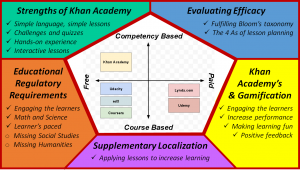
To summarise the sampling, the infographic Khan Artists prepared illustrates how the modalities selected by the teams fit in the grid comparing competency versus course based, and paid versus free options.

Assignment 1, part 2: Infographic of Khan Artists presentation (Bahador et al., 2018).

It is interesting to see that Khan Academy’s online educational videos contrast with the rest by being competency oriented, which corresponds completely to the origin of these tutorials: Sal Khan aimed to help his niece to become competent on specific topics (Bhatt et al., 2014).

Conclusion

The vastness of resources available in the education field is impressive.  One of the best approaches an educator may take is to be open considering as many resources as feasible to give the students access to learning.  Such variety of options might as well help solve the need of differentiated instruction, which at times can be challenging for the teacher.

References

Adamopoulos, P. (2013). What makes a great MOOC? An interdisciplinary analysis of student retention in online courses.Retrieved April 12, 2018 from http://pages.stern.nyu.edu/~padamopo/What%20makes%20a%20great%20MOOC.pdf

Amiel, T., Squires, J., & Orey, M. (2009). Four strategies for designing instruction for diverse cultures: Context and localization of learning objects. Educational Technology 49(6). 28-34. Retrieved from http://www.jstor.org/stable/44429738

Bahador, M., Doyle, S., Keddie, J., MacGregor, A., & Rimke, K. (2018, May). Khan artists. Presentation prepared in fulfilment of the part 2 of assignment 1 of the LRNT526 course, MALAT programme of Royal Roads University, Victoria, CA.

Bhatt, Grozdev, Hackney, Love-Davis, Stankiewicz, & Walters. (2014). Student case study: Khan Academy. Retrieved from http://fletcher.tufts.edu/~/media/Fletcher/MIB/pdfs/B236%20Student%20Case%20Studies/Khan%20Academy%202014.pdf

Daniel, J. (2012). Making sense of MOOCs: Musings in a maze of myth, paradox and possibility. The Journal of Interactive Media in Education. Retrieved from https://www-jime.open.ac.uk/articles/10.5334/2012-18/

Khan Academy. (2018). Retrieved from https://www.khanacademy.org/

Noer, M. (2012). One man, one computer, 10 million students: How Khan Academy is reinventing education. Forbes. 1-8. Retrieved from http://www.prisim.com/wp-content/uploads/2013/12/One-Man-One-Computer-10-Million
-Students-How-Khan-Academy-Is-Reinventing-Education-Forbes.pdf

Porter, J. (2015). From near failure to a $1.5 billion sale: The epic story of Lynda.com. Fast Company.  Retrieved May 30, 2018, from https://www.fastcompany.com/3045404/from-near-failure-to-a-15-billion-sale-the-epic-story-of-lyndacom