Reflecting time…
We are about to start a trip. The open road is ahead, and all the details have been carefully scheduled… adventure awaits. It is until distance has been traveled that images are reflected on the rear view mirror in our minds. Something similar happened with the course. Before it started, I had some idea of what it could be about but, similar to traveling, things can change along the way just like the instructor said. Reflecting upon what has not occurred yet would be foretelling, predicting, guessing… some business people call it planning, but that belongs to a different course. So now that LRNT527 Creating Digital Resources is coming to an end, I share some reflections about the road behind me.

The course…
There is no doubt Creating Digital Resources is an exciting title that got me, and probably many of my peers, imagining all sorts of scaffolds and artifacts to be of help in the instructional field. On the first Collaborate session we were asked to be ready to grab resources from our toolboxes, which made me feel like looking through the rear view mirror of the MALAT program recalling where I have been and what I have learned. We might also need new resources to effectively deal with the assignments and activities. Our cohort has been fantastic at providing support in many regards, and sharing tips about tools and technology has been very much appreciated from all and by all colleagues.

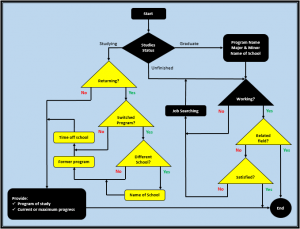
Creating one digital learning resource (DLR) is a task larger than the course! For that reason, actually the three assignments given during the nine-week course are, in reality, one big assignment with three checkpoints distributed in the school calendar. The entire course dealt with one intention that accompanied me through the five design thinking principles of empathize, define, ideate, prototype, and test (Morris & Warman, 2015). Through these principles my learning was enriched thanks to input and feedback from third parties, peers, and teacher. Furthermore, while visiting each principle my intention shifted as it was confronted with reality and practical issues, thus shaping and re-defining the initial intention provided a scope that could yield a conceptual model or a prototype doable within the time frame allowed.
The experience…
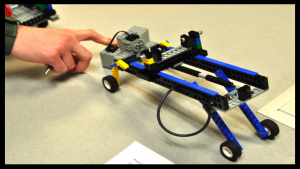
Ironically, repeating a creative process from scratch -due to an accident in which all previous work was lost- can have the benefit of improving the final result the second time around. This actually happened to a classmate. Having to do the work again may not be the nicest way to reflect, but facing such adversity provokes reflection to occur. The mind is forced to review previous facts and experiences, thus promoting clarity with respect to values, identity, emotions, motives and goals (Gardner as cited by Castelli, 2016) all of which lead to better thinking, data gathering, setting goals, and visualization of success. In the end, the final product got better.
A similar effect happened when I had to re-define the intention of my work twice. Not that my work was lost but going back to the drawing board, so to speak, and repeating the steps for the re-defined idea at a fast pace to avoid lagging behind, made me reflect on past actions to do it better the next time.
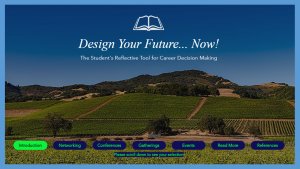
The feeling was positive because of several reasons. The first reason: I was getting comfortable with the new idea. I had to change things on my first and second ideas, thus changing the frame allowed me to find new perspectives to explore, and it worked (Seelig, 2013).
The second reason, I encountered true value and benefits for the users of the prototype I was building. Looking at what my DLR could offer from the perspective of the youngsters I had in mind, and remembering my experience when I was their age gave the idea its true dimension (Seelig, 2103).
Third, I was learning and developing a web site for the first time, and seeing it work actually and getting positive feedback from users that tried it was very fulfilling. Testing the prototype with users simulating their decision-making process could actually be helped by the DLR, provided an appropriate testing context according to what Seelig stated: “Prototype as if you know you’re right, but test as if you know you’re wrong” (2013).
And last but not least, I enjoyed the whole process although I must admit there were stressing moments along the journey, just like the obstacles and sharp turns on any trip route.
Thank you for stopping by and giving feedback.
References
Castelli, P. A. (2016). Reflective leadership review: A framework for improving organisational performance. The Journal of Management Development, 35(2), 217-236. Retrieved from https://ezproxy.royalroads.ca/login?url=https://search-proquest-com.ezproxy.royalroads.ca/docview/1767544220?accountid=8056
Mac Gregor, A. (2018). Design your future… now! An assignment submitted in partial fulfillment of the requirements of the course LRNT527 – Creating Digital Resources. MALAT Program. Royal Roads University, Victoria, BC, Canada. Retrieved from https://a4macgregor.wixsite.com/test
Morris, H., & Warman, G. (2015). Using design thinking in higher education. EDUCAUSE Review. Retrieved from https://er.educause.edu/articles/2015/1/using-design-thinking-in-higher-education
Seelig, T. (2013). How reframing a problem unlocks innovation. Retrieved from https://www.fastcodesign.com/1672354/how-reframing-a-problem-unlocks-innovation