Looking back at how information technology has evolved during the last three decades some general aspects stand out: Devices shrink; all seems computer-related; print is optional; mobile devices are everywhere; and all kinds of data are available through a screen.
Children seem to be born already knowing how to deal with technology. Retrieved from Creative Commons, 2017.
The last point gets this blog started since hardly a day goes by without one looking at a screen. The Guardian’s article about children’s screen time questions initiatives for guidelines to moderate the exposure of children to digital screens (Etchells et al., 2017). The questioning targets the lack of support to sustain the claims of impacts on human behaviour and development upon which the initiatives are based.
Technology has been a tremendous enabler for humankind long enough to the extent that -should the hazards be true, there should be plenty of cases reported on health damages like those claimed by the initiatives’ supporters. In the absence of such evidences I am inclined to think that the alarming arguments should be softened until there is substantiated proof, which coincides with the authors’ position.
Besides, having a career in Information Technology and working in the field for a number of years, should allow me to attest the harmless nature of digital technology. But considering that I first came in contact with mobile devices as a young adult, I do not qualify as a survivor of the perils claimed by the authors’ opponents.
In order to complement my pseudo-late entrance to the mobile device arena, I resort to another article titled “Seven fears and the science of how mobile technologies may be influencing adolescents in the digital age”, George and Odgers (2015) after researching the seven fears of their research concluded: 1. Online mirrors offline; and 2. The individual’s characteristics offline predict the individual’s ventures online.
The combination of the two articles lead me to conclude that, on one hand in order to say that mobile devices are harmful to children scientific proof shall be stated (e.g. neurology studies). And on the other, the characteristics of a person dictate to a great extent what the conduct of the online avatar will be. Which points to the very origin: the family, because it is in the family where the core values of the individual are created and developed.
In sum, taking care of values the family instils them in the child, thus he or she shall become a balanced responsible individual. Granting the neurological studies prove no harm, the child will surpass the mobile devices challenge to further grow into adulthood, and have an exciting and fulfilling life increasingly driven by technology. Make it so.
References
Etchells, P., et al. (2017). Screen time guidelines should be built on evidence, not hype. The Guardian. January 6, 2017.
George, M.J., and Odgers, C.L. (2015). Seven fears and the science of how mobile technologies may be influencing adolescents in the digital age. Perspect Psychol Sci. 2015 Nov; 10(6): 832–851. doi: 10.1177/1745691615596788
Co-written by Jason Keddie, Alfonso MacGregor, Fiona Prince, Klaus Rimke, and Gavin Sturgeon.
Activity 7 of the course LRNT523, Foundations of Learning and Technologies, at Royal Roads University asked students to read articles by Richard E. Clark, and Robert B. Kozma. We were then tasked as a group to find four documents that challenge the analysis presented by either Clark or Kozma and subsequently critique and question the claims made by those authors.
According to the Oxford Dictionary (n.d.), ‘Influence’ is defined as “the capacity to have an effect on the character, development, or behavior of someone or something”. Clark (1994) confidently proclaimed that media will never influence learning since “they are not directly responsible for motivating learning” yet his argument seems to miss the nuance of the meaning of ‘influence’ as the following articles reveal.
Bergeron (2015) asserts that media causes motivation while Clark (1994) contends that media does not cause motivation. Bergeron (2015) begins the overview section of the paper by stating that “the purpose of this paper is to provide a brief overview of how media can be effectively used to motivate” (p. 18). There is a consistent narrative throughout the paper that media are driving improvements in motivation and learning. For example, Bergeron (2015) states that “observation of students’ engagement during the unit of work suggests that the use of media tools…did effectively motivate students” (p. 23). This contrasts with Clark’s (1994) position that “media do not influence learning or motivation” (p. 1). Appropriate use of instructional methods, not media, according to Clark (1994), cause motivation and learning.
Bergeron (2015) also separates media into technical and non-technical categories, defining technical as mostly audio and video while defining non-technical as mostly writings, drawings, or images. According to Bergeron (2015), teachers should familiarize themselves with technical media because it is more effective with today’s learners. Bergeron (2015) does not adequately support the assertion that technical media is superior to non-technical media, and this concept would also contrast with Clark’s (1994) position since Clark believes that media do not influence motivation, which would mean that one form of media cannot influence motivation more than another form of media if neither form of media influences motivation.
Bergeron (2015) focused on the idea that media drives learning and motivation, but to a lesser extent comments on the instructional methods employed with the media. Bergeron (2015) details observing increased motivation and learning with the use of media, but according to Clark these increases in motivation and learning are due to changes in instructional method and not media.
Reading Bergeron’s paper while keeping Clarks assertions in mind, it is easy to see all the instructional methods employed that may be the actual cause of the purported increases in motivation and learning.
In this article, Bennett (2016) outlines three concepts that would improve literacy and earning power of adult learners as discussed at the MIT Media Lab by researchers, adult learning experts, and entrepreneurs. These concepts were: Read Out Loud (literacy improvement), Express Me (mobile learning during commutes), and Citizen Tutoring (provide mentoring opportunities from senior tutors). Each of these concepts incorporates the use of technology media to deliver intuitive and accessible information to adult learners while circumventing barriers of language and time.
By providing an atmosphere of accessibility and inclusivity, the media in Bennett’s article had a profound influential effect on the development of the learner and is in stark contrast to Clark’s argument. For example, Read Out Loud “allows the user to scan any book and view the text in English and any other language side-by-side” (Bennett, 2016) which enabled the parent to read along with their kids; thus, “parents are able to engage in this important part of their children’s education and play the role of teacher, while engaging in learning themselves” (Bennett, 2016). Not only does the children’s literacy improve with this media tool; the adults’ does, too.Improved literacy gives the adult learners additional options to select information integral to employment opportunities and provides “autonomy over improving general skills as well as increasing earning potential” (Bennett, 2016). When a technology provides the motivation to directly impact a person’s ability and desire to learn, develop, and improve their self-worth, that in itself is influence; perhaps Clark will revisit this concept.
In order to explore if the media through which content is delivered to learners influences the outcome, Kao et al. (2016) divided a group of 40 fourth-grade students in two groups, and provided them with the exact same reading material. All students received an e-book; what marked the difference was that one set of books were of low interactivity while the other set was of high interactivity. High interactivity consisted of having three advanced features that responded to the reader: “guidance”, “prompt”, and “feedback”.
The conclusions of the authors point toward the positive effects that interactivity has as a complement to reading material. This finding is supported by other researchers, such as Ciampa, Grant, and Lewin (as cited in Kao et al., 2016) who stated that motivation and engagement in readers are increased with illustrations, animations, and narrations when those features are congruent with the storyline and content of the e-book.
When Clark (1994) wrote that media will never influence learning, did he foresee the invention of the following media and technology, and their use in education? Miller (2017) claims that these seven tech innovations are drastically changing the way people learn because they support experiential learning–learning by doing. In keeping with our team’s focus on ‘influence’, we agree that these innovations do influence learning when thoughtfully included in the instructional design.
3D Printing
3D-printers are now affordable and easy to use right of the box. One application is to introduce learners to the basics of engineering through hands-on, problem-solving activities.
Gamification
Clear in game rules, objectives and competition in video games such as Minecraft (Educational Edition) increase learner engagement in subjects from history to reading comprehension.
Virtual reality
Interactive virtual reality platforms in classes, such as Biology (imagine dissection without the mess), Engineering, and Architecture allow students to learn through simulations and renderings; Google expeditions has made virtual travel a reality bringing the wonders of the world to a much greater audience.
MOOCS
Massive open online courses have increased accessibility to learning, allowing anyone with an internet connection to attend classes, even graduate studies. MOOCS are being used in both online and blended delivery models.
Skype
Even though it is a technology originating in 2003, Skype has become a popular media for connecting learners with teachers and tutors , especially for language learning services.
Big Data and custom learning
Algorithms and data tracking are used to guide the development of blended learning programs and give students the ability to customize their learning experience. This has been proven to reduce the dropout rate and increase comprehension. (Now that’s influence!)
IPads and Chromebooks A popular piece of tech that has and is immersed in the schools allowing teachers to facilitate rather than manage the learning of the students.
Clark may see these technical innovations as tools that could be replaced by other tools and methods; however, we must consider whether other tools and methods would provide the same level of engagement, motivation, and timeliness for learners.
The resource I chose to share with you this time is Adobe Captivate. A disclaimer upfront: Although I have not used the resource, the information I found in the advertising video caught my attention due to the alignment with aspects mentioned in our discussions. Adobe Captivate is a new software that offers leading edge capabilities to deal with: E-learning design, content creation, online learning, interactive learning, soft skills training, application simulations, high definition demos, and assessment modules.
Adobe blocks represent an ancient building material with outstanding characteristics such as its thermal performance as well as its aesthetic appearance. Retrieved from Creative Commons, 2017.
The software is capable of performing tasks like programming and fully-responsive courses, managing a concept Adobe calls Fluid Boxes which allow handling: Objects, texts, videos, images, maps, buttons, shapes and iframes to accommodate any kind of content in any kind of digital device. It also features Typekit integration to access a font library in the cloud to guarantee texts are always displayed adequately, as well as Adobe Stock integration and Asset Store from where to access an immense variety of cut-out images, themes, interactions, scenarios, games and 75,000 free more assets to choose from augmenting the value of what can be obtained through the use of the software.
Adobe Captivate also offers the possibility of clicking a button to Save as Responsive previous presentations and contents, which would be like injecting new life into resources already created with other tools because Adobe claims those old materials would become mobile ready –since I have not used the product I cannot provide details and results of such an experience, but it sounds really interesting. So far the impression I get from what Adobe says, their newly released product honours its name for it actually seems to have many, if not all the components we have been talking about in our classes and discussions. In case Adobe Captivate fulfils its promise as easy as it claims taking just minutes, several people in the cohort including me will be adobe-captivated.
For Activity 6 we decided to look at bicycle manufacturing, particularly, producing bike frames from natural materials, bamboo and wood. Since we are both avid bike enthusiasts, this seemed like the perfect topic to pursue. For this activity, we both shared in researching bike frame design and manufacturing information and chose to split our writing on the topic between wooden (Keith) and bamboo (Alfonso).
Riding bicycles and building them are two very different things. While riding the bicycle is all about enjoying the ride or getting the most out of it for transport, amusement, and competition; manufacturing a bicycle requires paying attention to specifications, and being aware that any error may spoil the final experience or in the worst case, be a safety hazard. This knowledge makes building a bicycle a more serious undertaking than simply riding one.
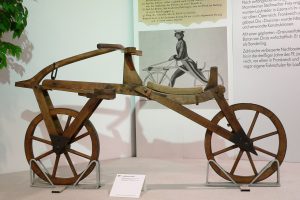
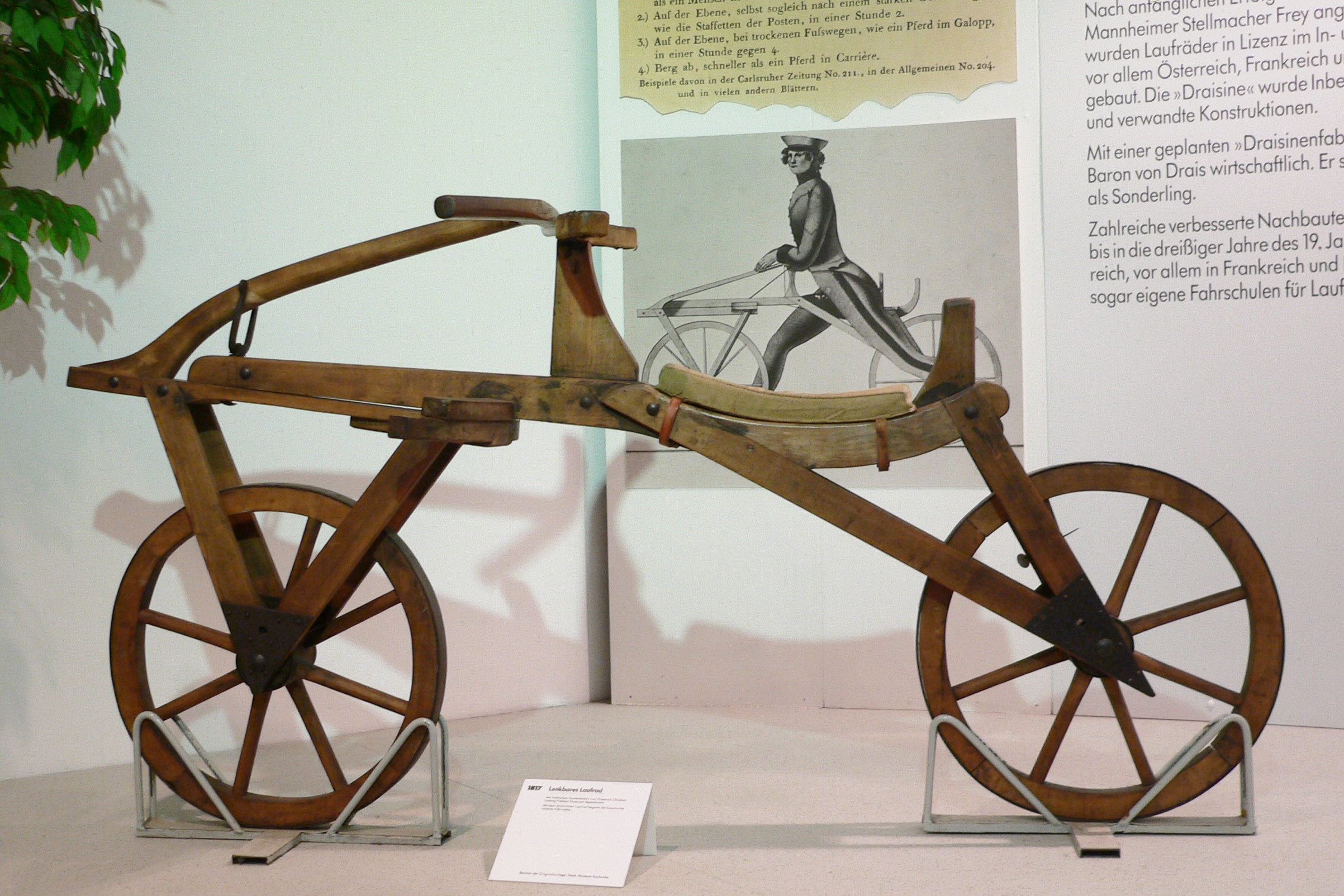
In initial attempts at building bicycles, wood was used as the main component. In Germany on June 12, 1817, Karl Drais invented the precursor to the bicycle, later named “The Draisine” (see Figure 1), he was able to travel 8 miles in less than an hour. Its appearance somewhat resembles the bicycle as we know it today (Hadland and Lessing, 2014) although the Draisine was propelled by the rider placing their feet on the ground.
Figure 1. Draisine by Karl Drais
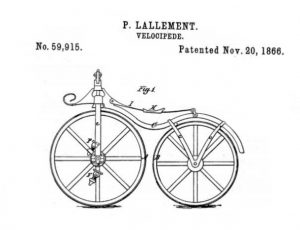
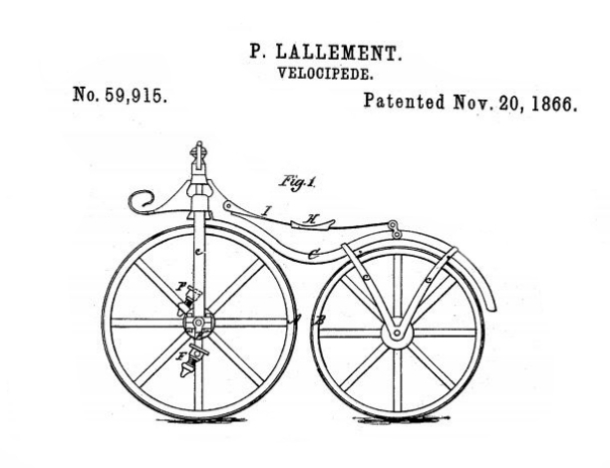
It wasn’t until November of 1866 that the pedals first appeared on rudimentary bikes, but they were attached to the front wheel as per the patented design of French US immigrant Pierre Lallement (Hadland and Lessing, 2014). Even though those early designs incorporated some metal parts, the frames were made of wood. These became known as “Velocipedes” (see Figure 2).
Figure 2. Velocipede by Pierre Lallement
WOODEN BIKES:
There is plenty of information online about bikes and their history, design, and manufacturing. There is also an interesting trend, or counter trend depending on how you think about it, of wood bicycle frame and even wheel manufacturing. Since the first bikes, or precursors of bikes, rolled out of craftsman inventors shops in North America and Europe, there has been a steady progression in design and manufacturing that make use of every more exotic materials and manufacturing processes often with the goal of cost reduction, uniformity of product, and mass sales. However the return to wood being used for frame construction, we find bikes, at least some of them, have come full circle.
On YouTube there are quite a lot of videos available documenting the recent rise in wooden bicycles, though I could not find any that were purely instructional in nature. I did however find interviews with the creators of these modern marvels of old tech. If one watches closely, many hints as to how modern wooden bicycles are made can be gleaned from the interviews and tours of shops. What I learned in particular is that in order to manufacture frames using wood, you can’t simply cut designed from solid pieces of wood, the frames have to be built using laminates of various grains and types of wood. The reason for this is because wood is highly variable in its qualities even within the same species. In order to build a well functioning wooden bike frame, the various grains of wood and properties of strength must be considered in order to create a bike frame that is laterally strong and able to bear the load of the rider efficiently.
In the videos we see that the manufacturing of modern wooden bicycles requires both the tools of old and new manufacturing techniques and products. In order to design and build a wooden frame, craftsman must devote considerable time and effort to the laminating and shaping of their frame designs. This process can be greatly sped up using CNC technology and power tools, but the final finishing touches, the work that makes frames beautiful, must be done by hand using tools we’ve developed for woodworking over the centuries. The one invention of just the past decade or so has been the improvements in glue technology, a key ingredient when laminating wood. Without this improvement perhaps wooden bikes would still be a relic of the past.
In order to build a wooden framed bike, one must have lots of knowledge of bike frame design. The internet does provide some handy info on bike frame designs, chiefly from high end bike bike companies that share plans and schematics of the frames they produce. Such things as tube lengths, head angles, stand over height, wheelbase, etc., is readily available on their websites. However, one could simply copy the geometry of any standard steel, aluminum, or carbon framed bike they currently own.
When it comes to working with wood however, the abundant information related to bikes online is insufficient. In order to work with wood, to choose the right types, to select the right grains, and ultimately produce a thing of beauty, anyone wishing to build their own wooden bike must have hands-on experience with and an artist’s understanding of wood and its properties. In one video, Ken Wheeler (2012), the owner of Renovo tells the story of failed hires saying that first he hired cabinet makers to work for him, but they could not produce the frames and in the end he had to hire artists to do the frame finishing procedures. One step in frame design that I found interesting and potentially the most difficult to achieve was that frames are hollowed out. This in itself may not seem like a daunting task, but given the effect thickness has on tube strength, lots of trial and error would likely have to go into getting this step right.
I have been involved in the biking industry for years, from building bikes from parts at a pro shop in Germany, redesigning a component on Rockshox forks, to designing mountain bike parks in China. When it comes to bikes, I practically live through them. I have also tried my hand at frame design and am an avid enthusiast of frame design evolution over the years. Still, this background is not enough for me to make use of the information available online. The construction of wooden bikes is simply too much of an art, years of learning, and craftsmanship. However, I grew up around wooden boat builders and come from 4 generations of wooden fishing and sail boat manufacture. Though I am no boat builder, I do have quite a bit of knowledge taught to me by my father and grandfather in regards to manufacturing with wood, and I am familiar with many wood working tools. My brother builds model airplanes and has an engineering business and has in his possession a CNC machine. Were I to embark upon building my own wooden bike, I am sure I could make use of my prior knowledge of bicycles and wood, skills working with wood, and my brother’s high tech equipment.
In regards to teaching other how to design a frame, I believe the internet offers plenty of useful information. As far as constructing wooden bike frames, I believe the internet wouldn’t be so useful. There are just too many steps in the process and too many considerations involved to adequately teach anyone using online resources. In addition, in order to build a wooden bike, prospective builders must understand wood. I think anyone who currently builds musical instruments from wood, builds airplanes from wood, or builds boats from wood and can ride a bike could set out to make their own bike if they used the information available online… and had a 1000 hours to spend on their first one (Thompson, 2015).
BAMBOO BIKES:
The information on bamboo bicycles in the Internet is also plentiful, and although the work to build a bamboo bicycle might require some tools the degree of sophistication does not compare to what we see in the case of the wooden bicycle frame. To begin with, bamboo has some natural advantages over wood from the raw materials standpoint. Since wood comes in logs or sheets the parts to build the frame need to be laminated, composed, and hollowed, while bamboo already comes in tubular hollow canes from the bamboo trees requiring only to be selected by dimensions and appearance.
The video tutorials available range from home-made do-it-yourself versions to tutorials filmed during workshops that guide the learner through the process. Provided that you have a garage or similar space at hand that can be used as a workshop, there still might be some set-up required in order to start working. Some usual tools of the sort anyone has would be handy but there are a few tools and materials that would have to come from the hardware store because improvisation is not recommended; for instance, the joints of the bamboo canes with the other parts like the headset tube, seat-post tube, the bottom bracket sleeve, and the dropouts need to be cut and filed at an angle to meet properly with the rest of the frame thus not just any saw or drill bit will do… and then there is the epoxy resin that is required to mix with carbon fibre, hemp, fiberglass, or a similar material that will provide extra strength needed to hold the joints of the frame (Nyampong, 2013).
If available, Kevin Braddock (2011) suggests the reutilisation of the parts of the frame mentioned above from another bicycle. In such a case, and assuming the geometry of the previous frame is adequate, it shall be traced on a wood board to use as template. Each piece that will be reused shall be secured in place to the board with a jig. Then cut the tubes apart, and clean the paintwork with a wire brush.
Nonetheless in contrast with wood, bamboo canes (or tubes) do not require to be laminated nor hollowed since its natural shape already serves the needs of the bicycle frame. Instead they require a preservation treatment on the inner side of the bamboo which is much simpler than hollowing the laminated pieces that would form the wood frame. That said, in addition to being a ubiquitous material, bamboo makes this option a feasible solution for any community, particularly in underdeveloped countries that lack transport infrastructure. Such has been the case in Ghana and Congo, besides other countries (Calfee, 2016).
We believe that the information available from the Internet can help a person with some basic familiarity working with tools and intermediate knowledge on bicycles to build their own bamboo frame. It might be necessary to go over the videos more than once in order to make sure the key points are clear, and that is one of the great advantages of having the tutorials online 24/7.
Facilitating the learning to others can be done with the information we found online. Some videos are more detailed than others, so pre-selecting the support material would be a must. Craig Calfee (2016), who also offers do-it-yourself kits, and Container Collective Yoga and Bikes (2017) are just two examples of the courses offering available in the web.
Container Collective Yoga and Bikes, 2017. Building a bamboo bike. Posted by: Container Collective Yoga and Bikes. Retrieved from: https://www.youtube.com/watch?v=uuNpt57kCI8
Wheeler, K., 2012. Why hand-crafted, high-tech wooden bikes give a better ride. Posted by: Karen Dirksen on June 11, 2012. Retrieved from: https://www.youtube.com/watch?v=TBC7NEJwZ5U