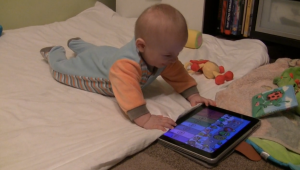
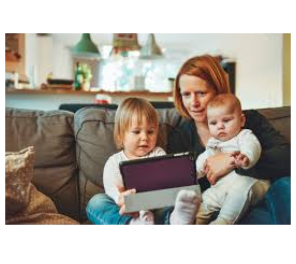
Aiming at the youngest segments of society is exciting because these segments have the largest time horizon ahead of them, which might provide the research outcomes with a longer useful life. For practical means however, the younger a generation is the less information available there is, thus increasing the challenge to find support for the claims the study requires.
The concept of generations groups people born within a time span –usually from 15 to 20 years– identifying characteristics that differentiate their generation from previous ones. The sociology of generations has reached the point where a global concept of generations applies (Edmunds & Turner, 2005, December), particularly as a result of the way electronic communications technology has brought people together around the globe. Edmunds and Turner (2005) also referred to the change of century marking the era of international generations which became united through printed media, and afterwards transformed the concept into global generations via instant broadcasts that take place worldwide.
As it usually happens in many regards, generation groups are referred to by names that condense their features to distinguish each group from the rest. For instance, Robinson (2018) provides a timeline including ten generations of which the two most recent ones are the Generation Alpha, which goes from 2013 to 2025 and, preceding that, the iGen or GenZ –also called Centennials– goes from 1995 to 2012. The author clarified that the classification used corresponds to Western Cultural Generations, and that Asian and European cultures might have their own generational definitions (Robinson, 2018).
The topic of my paper focuses on pre-school children from 3 to 5 years of age, exploring their developmental characteristics to identify ways to help them cope better with their transition from home to formal school.
I consider the Generational Theory an adequate framework for my research paper, because there might be aspects in recent generations that could present new possibilities either for further study, or for innovative ways of learning.
I kindly appreciate your time and your comments.
References
Edmunds, J., & Turner, B.S., (2005, December). Global generations: social change in the twentieth century. The British Journal of Sociology, 56(4), 559-577. Retrieved from https://onlinelibrary.wiley.com/doi/pdf/10.1111/j.1468-4446.2005.00083.x
Robinson, M.T., (2018). The generations: What generation are you? Retrieved December 3, 2018, from https://www.careerplanner.com/Career-Articles/Generations.cfm
The human brain reaches its full volume development during the individual’s adolescence stage. Nonetheless, it is from 18 months to 6 years of age that the largest mass increase takes place in the brain representing around 75% of its total growth (Baltes, Reuter-Lorenz, & Rösler, 2006).
I believe there is a window of opportunity that can serve to help little children transition from home to school while, at the same time, shall foster parents and educators to take a greater and positive advantage of technology.
The expected outcome of my research leads me to include the following areas to provide the study with solid grounds from where to build the supporting structure for the desired product:
Children’s upbringing
Formal education
Homeschooling
Neuroscience
Pedagogy
Psychology
Video game design
Considering the diversity of contributions and stakeholders the research shall encompass, I think the dissemination can be better achieved through the publication of an article in academic and professional journals related to the fields involved.
Visualizing the output of what I am yet to create has brought my ideas under a different light which is something unanticipated, at least in my case. New perspectives start to appear which are not necessarily changing the target of the initial thoughts, but rather suggesting there may be more potential to the original ideas than merely being the substance of a degree paper.
References
Baltes, P., Reuter-Lorenz, P., & Rösler, F. (2006). Lifespan development and the brain: The perspective of biocultural co-constructivism. Cambridge: Cambridge University Press. (2006). Retrieved from https://royalroads.on.worldcat.org/search?queryString=neuronal+development+and+cognitive+learning#/oclc/144618357
Pictures retrieved from the Creative Commons website.
The readings of Unit 1 provided such a vast list of elements that selecting the top five was a hard task. Dunlap and Lowenthal (2018) guided I my selection as I found combinations that made sense. The link LRNT528 U1 A1 5 TIPS Infographic shows the combined tips corresponding to Dunlap and Lowenthal’s themes.
Access and Motivation (Salmon, 2018) / Cheerleading (Bull, 2013).
Making sure the way in is trouble-free for all is a must. Authentic enthusiasm should be the first motivator the audience perceive, which will foster students to look forward to the next session (Salmon, 2018).
A positive standpoint makes the teacher the searchlight for helping students maintain the right course of action (Bull, 2013).
These aspects align with the clarity and relevance Dunlap and Lowenthal refer to when designing effective online content (2018).
Be Present at the Course Site (Boettcher, 2013) / Suggestions for Improvement (Boettcher, 2013).
Setting clearly the teacher’s availability to the class is key, as well as making it happen (Boettcher, 2013).
An early feedback from learners helps ensure students are finding their way correctly (Boettcher, 2013).
Being present and supportive of the learning community coincides with Dunlap and Lowenthal (2018) fundamental aspects for achieving an effective online facilitation.
Team Building (Salmon, 2018) / Respect Diverse Talents and Ways of Learning (Dunlap & Lowenthal, 2018).
Acknowledging the variety of features poured into the learning community will enrich and benefit all participants (Dunlap & Lowenthal, 2018), and working in teams will allow them to learn from each other in every way (Salmon, 2018; Dunlap & Lowenthal, 2018).
Additionally, the mix of talents represents win-win characteristics Dunlap and Lowenthal (2018) cover in the theme of supporting student success.
Co-learner (Boettcher, 2013; Bull, 2013)/ Include Individual Experiences as well as Small Groups and Large Groups (Boettcher, 2013).
Students appreciate instructor’s transparency in learning along with them throughout the course (Bull, 2013) because this lets them know their teacher aims to be better, which motivates them to strive further.
Besides group collaboration, sharing work experiences can illustrate the theory with reality bringing teachings closer to daily life (Bull, 2013).
Improving continuously as an instructor is among the important factors regarding online course design and facilitation (Dunlap & Lowenthal, 2018).
Plan a Good Closing and Wrap-Up Activity for the Course (Boettcher, 2013).
A roadmap from the beginning allows students to know where they are making sure they progress along as well (Boettcher, 2013).
The closing stage represents an opportunity to make a lasting impression to support the students’ success (Dunlap & Lowenthal, 2018).
Conclusion
Motivated students trust their teacher sensing her/him near regardless of remote instruction, they eagerly make suggestions to ease starting the new class. Furthermore, fostering diversity creates opportunities to share and learn including the teacher who, additionally, is learning along too.
References
All graphic material sourced from Creative Commons.
Boettcher, J. V. (2013). Ten best practices for teaching online. Retrieved from https://www.saddleback.edu/uploads /goe/ten_best_practices_for_teaching_online.pdf
Bull, B. (2013). Eight roles of an effective online teacher. Retrieved from https://www.facultyfocus.com/articles /online-education/eight-roles-of-an-effective-online-teacher/
Dunlap, J. C., & Lowenthal, P. R. (2018). Online educators’ recommendations for teaching online: Crowdsourcing in action. Retrieved from https://scholar.google.com/scholar_url?url=https://www.learntechlib .org/p/183573/article_183573.pdf&hl=en&sa=T&oi=gsb-gga&ct=res&cd=0&d=9495255957241473891 &ei=yjyfW5rOMs2xygSQsqeACA&scisig=AAGBfm0rFw4fV2pCc_r2MzSo6uFOrXHl8g
Salmon, G. (2018). The five-stage model. Retrieved from https://www.gillysalmon.com/five-stage-model.html
Starting the LRNT528 course, Facilitating in Digital Learning Environments, made me weigh what we have gone through in the MALAT program so far. Things are looking more complete as we come to the last two courses of the program’s schedule.
We have seen what is relevant to different learning environments and dealt with research and academic writing. We have had interesting team works and discussions about foundations of learning, did some design and innovating in learning environments, explored the importance of being a change agent in digital learning, as well as inquired about contemporary issues to finally experienced the design and creation of digital learning resources.
Now it is time for us to learn and practice how to make the outcomes of the resources we gathered in our toolbox accessible to us and our learners. There is an etymological relationship between the words “easy” and “fácil” (Spanish), which converge in the cognate word facilitate/facilitar. The meaning of the word represents the challenge a good facilitator must accomplish: make things easy -for the learner.
Learning from the first team
The Core Four of Personalized Learning (Johns & Wolking, 2018) brought some old directives into a new perspective. While in the public education system I was frequently asked to include differentiated instruction, as well as to allow the students to progress at their own pace. Furthermore, the practice of centres was enforced since early stages even prior to the formal grades, thus my Pre-Kindergarten students and I had our share of the modality.
Setting the classroom for the core four elements can be beneficial given the school has the resources required. This was the make or break component because the school district expected the directive to succeed without providing for it. Each teacher had to look for ways to achieve the setup, and plan and prepare the lessons accordingly. The extent to which I was able to experience the approach was fun and engaging for the students, while also fun and, at the same time, demanding for the teachers. The balance was positive for the students although a bit frustrating for the teachers because we knew we could have accomplished more.
We are about to start a trip. The open road is ahead, and all the details have been carefully scheduled… adventure awaits. It is until distance has been traveled that images are reflected on the rear view mirror in our minds. Something similar happened with the course. Before it started, I had some idea of what it could be about but, similar to traveling, things can change along the way just like the instructor said. Reflecting upon what has not occurred yet would be foretelling, predicting, guessing… some business people call it planning, but that belongs to a different course. So now that LRNT527 Creating Digital Resources is coming to an end, I share some reflections about the road behind me.
The course…
There is no doubt Creating Digital Resources is an exciting title that got me, and probably many of my peers, imagining all sorts of scaffolds and artifacts to be of help in the instructional field. On the first Collaborate session we were asked to be ready to grab resources from our toolboxes, which made me feel like looking through the rear view mirror of the MALAT program recalling where I have been and what I have learned. We might also need new resources to effectively deal with the assignments and activities. Our cohort has been fantastic at providing support in many regards, and sharing tips about tools and technology has been very much appreciated from all and by all colleagues.
A prototype simulates the operational features of the conceptual model being designed. The final product might differ from the displayed model.
Creating one digital learning resource (DLR) is a task larger than the course! For that reason, actually the three assignments given during the nine-week course are, in reality, one big assignment with three checkpoints distributed in the school calendar. The entire course dealt with one intention that accompanied me through the five design thinking principles of empathize, define, ideate, prototype, and test (Morris & Warman, 2015). Through these principles my learning was enriched thanks to input and feedback from third parties, peers, and teacher. Furthermore, while visiting each principle my intention shifted as it was confronted with reality and practical issues, thus shaping and re-defining the initial intention provided a scope that could yield a conceptual model or a prototype doable within the time frame allowed.
The experience…
Ironically, repeating a creative process from scratch -due to an accident in which all previous work was lost- can have the benefit of improving the final result the second time around. This actually happened to a classmate. Having to do the work again may not be the nicest way to reflect, but facing such adversity provokes reflection to occur. The mind is forced to review previous facts and experiences, thus promoting clarity with respect to values, identity, emotions, motives and goals (Gardner as cited by Castelli, 2016) all of which lead to better thinking, data gathering, setting goals, and visualization of success. In the end, the final product got better.
A similar effect happened when I had to re-define the intention of my work twice. Not that my work was lost but going back to the drawing board, so to speak, and repeating the steps for the re-defined idea at a fast pace to avoid lagging behind, made me reflect on past actions to do it better the next time.
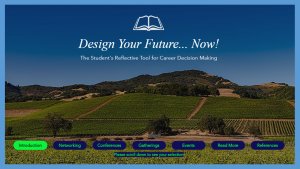
Digital Learning Resource: Design Your Future… Now!, sounded “dyfen” is a web site developed with WIX, which provides young students access to third-party websites on networking, conferences, gatherings, and events (Mac Gregor, 2018).
The feeling was positive because of several reasons. The first reason: I was getting comfortable with the new idea. I had to change things on my first and second ideas, thus changing the frame allowed me to find new perspectives to explore, and it worked (Seelig, 2013).
The second reason, I encountered true value and benefits for the users of the prototype I was building. Looking at what my DLR could offer from the perspective of the youngsters I had in mind, and remembering my experience when I was their age gave the idea its true dimension (Seelig, 2103).
Third, I was learning and developing a web site for the first time, and seeing it work actually and getting positive feedback from users that tried it was very fulfilling. Testing the prototype with users simulating their decision-making process could actually be helped by the DLR, provided an appropriate testing context according to what Seelig stated: “Prototype as if you know you’re right, but test as if you know you’re wrong” (2013).
And last but not least, I enjoyed the whole process although I must admit there were stressing moments along the journey, just like the obstacles and sharp turns on any trip route.
Thank you for stopping by and giving feedback.
References
Castelli, P. A. (2016). Reflective leadership review: A framework for improving organisational performance. The Journal of Management Development, 35(2), 217-236. Retrieved from https://ezproxy.royalroads.ca/login?url=https://search-proquest-com.ezproxy.royalroads.ca/docview/1767544220?accountid=8056
Mac Gregor, A. (2018). Design your future… now! An assignment submitted in partial fulfillment of the requirements of the course LRNT527 – Creating Digital Resources. MALAT Program. Royal Roads University, Victoria, BC, Canada. Retrieved from https://a4macgregor.wixsite.com/test
Morris, H., & Warman, G. (2015). Using design thinking in higher education. EDUCAUSE Review. Retrieved from https://er.educause.edu/articles/2015/1/using-design-thinking-in-higher-education
The development of a project includes small “moments of truth” along its path. Such moments represent the little tests any idea is subject to as it evolves into the selected model that would go into the subsequent phases, and so it goes from Empathize to Define, then to Ideate, Prototype, and finally to Test phase (Warman, 2015).
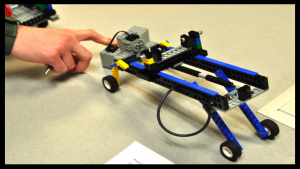
Constant iteration of building, testing, failing, fixing, re-testing, until it finally works… and yet some aspects can still be improved… it is an on-going process (Creative Commons, 2018).
The further into the development cycle the tougher the testing gets for the model, so by the time we share our prototype to be tested by others we expect it to have a decent performance at least regarding the basic features according to the “original” concept. However, the concept frequently mutates as the ideas meet reality. When it comes to prototyping, as Morris and Warman put it, “Showing is better than telling” (Warman, 2015).
Feedback is always welcome
I have received diverse feedback from various stand points about my digital resource. People in the communications and video production fields recommended me to maintain uniformity in the backgrounds of the screens the web site employs. By the same token, they suggest I try to present the legends of buttons using fonts and colours that are easily legible (which I think I did), thus I shall look for more “universal” options to please a wider spectrum of tastes.
DYFN -“dyfen”- is the prototype of a web site designed to help high school, freshmen, and sophomore students to explore options for them to study what best suits their aspirations (Mac Gregor, 2018).
From a different perspective, individuals in the age group to which the web site is aimed commented that the concept appears to be of great help. Some of them are new in the country, thus the options the web site presents for them to explore (namely networking, conferences, gathering, and events) resulted interesting and, indeed, encouraged them to browse through the direct links. Furthermore, some students mentioned they clicked on secondary links (what would be indirect links) which turned out to be beneficial too.
These comments shall be considered to complement the feedback I will receive from Team 1, contributing to improve the next version of the web site.
The Collaborate Effect
Working with Team 6 -which includes May Bahador, Jason Keddie, and Klaus Rimke- we decided to use Assignment 2’s rubric as our evaluation criteria (Royal Roads University, 2018). The rubric assesses the following aspects of a Digital Learning Resource (DLR):
Design of DLR – Learning theories and instructional principles in accordance to context and learning goals (Leacock, 2007), and its adequacy to the age group or audience (Evans, 2014). Organization of contents (Akpinar, 2009), and clarity (Hadjerrouit, 2010) of required activities.
DLR’s interactivity – A student-centered approach is expected (Anderson, 2008; Hadjerrouit, 2010). Ease of use and friendliness of terminology contribute to a positive learning experience (Akpinar, 2009).
DLR’s technology – Technological means and simple instructions for its use foster understanding of the tool and its contents, as well as interaction among users.
DLR’s formatting and presentation – The contents are mechanically correct (Akpinar, 2009); the navigation within the tool flows without obstructions (Akpinar, 2009). All required attributions are properly noted and visible.
Thank you for stopping by and commenting on my work.
References
Akpinar, Y. (2009). validation of a learning object Review Instrument: Relationship between Ratings of learning objects and Actual learning outcomes. International Journal of Doctoral Studies, 4, 291-302.
Anderson, T. (2008). Chapter 2: Towards a theory of online learning. In T. Anderson (Ed.), The theory and practice of online learning (2nd ed., pp. 45-74). Edmonton: AU Press.
Creative Commons (2018). Picture retrieved from https://www.google.com/search?site=imghp&tbs=sur:fmc&tbm=isch&q=testing+prototype&chips=q:testing+prototype,g_1:prototyping&sa=X&ved=0ahUKEwiuvseRiObcAhV1FzQIHf9LDlIQ4lYIKSgD&biw=1366&bih=662&dpr=1#imgrc=YRWXbc_41Vzt3M:
Evans, R. (2014). Cooking up cauldron content: Recipes for video tutorials. Computers in Libraries, 34(7), 11-5.
Hadjerrouit, S. (2010). A conceptual framework for using and evaluating web-based learning resources in school education. Journal of Information Technology Education, 9, 53-79.
Leacock, T. L., & Nesbit, J. C. (2007). A framework for evaluating the quality of multimedia learning resources. Educational Technology & Society, 10(2) 44-59.
Mac Gregor, A. (2018). Design your future… now! An assignment submitted in partial fulfillment of the requirements of the course LRNT527 – Creating Digital Resources. MALAT Program. Royal Roads University, Victoria, BC, Canada. Retrieved from https://a4macgregor.wixsite.com/test
Warman, G. (2015). Using design thinking in higher education. EDUCAUSE Review. Retrieved from https://er.educause.edu/articles/2015/1/using-design-thinking-in-higher-education
The digital learning resource consists of a web site in which the student finds information about some of the existing resources available in the Internet, as well as motivational content that aims at encouraging both, the use of such tools on one hand, and the personal reflection on past experiences and current situation of the individual in order to confirm or decide the path the person truly wants to follow.
Learning Goals
The web site will provide the students with a framework to reflect on what the students have accomplished so far, as well as prompts to assess past experiences in a reflective manner. With that insight the students will be motivated and better prepared to make an informed decision about their immediate future.
Intended Audience
The primary audience for this digital learning resource are students finishing high school and about to begin college studies, or students in their freshman or sophomore years. A secondary audience for the tool considers teachers, counselors, and parents lending a guiding hand at youngsters in the challenging process of making an important decision.
Rationale
The digital resource will be available online, and its use shall be promoted among the intended audiences. The counseling service the schools and universities offer the students represent an important point of contact with the primary audience, since the moment students reach out for vocational orientation means they are interested and ready to discover possibilities for taking their studies further. The content of the digital resource will include a brief reading aimed at motivating the student and establishing rapport, which will foster future visits to the web site. The links the digital resource will present to the student will facilitate information ranging from networking to a broad variety of events, as well as diverse training sessions.
Tools
The prototype of the digital resource will be built using the WIX.com which is available for download online at no cost. The basic operational features will be covered with this tool; should additional functionality be necessary, then other digital resources might be necessary to complement the development.
Assessment Plan
The nature of this digital resource does not call for an assessment component since it is designed for personal reflection. However, those supporting the student facing a decision-making situation should be able to notice the benefits the student derived from using the digital resource, as well as further utilization of additional sources of information triggered by this tool directly or indirectly.
The learning interactions schemed by Anderson follow (Anderson, 2016, p. 36):
Student – Student
Student – Content
Student – Teacher (* and counselors & parents for simplicity)
Teacher (*) – Teacher (*)
Teacher (*) – Content
Content – Content
The first three are key to the digital resource due to the student being the main character, which categorize the tool as a student-centered digital resource. Furthermore, the second interaction, Student – Content, deserves additional attention because the nature of the digital resource will make it to serve as the “bridge” that will provide the student access to multiple routes to diverse information.
The digital resource coincides with the constructivists’ point of view with regard to the learners learning more effectively when the contextual substance and its meaning are of value to the learner due to their authenticity (Anderson, 2016, p. 38). When using the digital resource the student will actively inquire by clicking the links and options to navigate the content, which will allow the user to look for the information that matches the student’s interests.
Elaborating on the ideas of Siemens about the existence of knowledge and learning outside the human being, Anderson stated that: “A goal of connectivist learning is to create new connections, regardless of formal education systems, to expand upon and build learning networks” (Anderson, 2016, p. 43). The nature of the digital resource alignes with these ideas since the intended results for the student include the building of contact networks, in addition to the reflective analysis and informed decision-making.
The use of the digital resource will put the student in one or more of the three contexts that Drone and Anderson (2014) derived from social networks and interactions within formal learning (Anderson, 2016, p. 44), namely group, networks, and sets. These contexts can be briefly defined as follows:
Group – is the equivalent of a class in the traditional instructional setting, although now including the online version of it not only face-to-face;
Network – more fluid than groups, these aggregations expand or contract through time and may exist beyond the formal learning environment that started them;
Sets – are created by shared interest thus having the affinity as fuel that keeps the companionship going, progressing toward mutual benefits.
Instructions for Use
The access to the digital resource will be done in the usual way when entering any web site: just clicking on the URL will open the Home page of the site. Once there the user will see the name of the sections -in which the content is organised- on the lower part of the screen: Home; LinkedIn; SIGGRAPH; Meetup; Eventbrite; and More.
Plan for Use
The digital resource will be open for use by anyone. This resource will represent a tool for schools’ counselors, teachers, and parents when guiding young adults and adolescents in search of information that helps them identify their passion. It is with a reflective analysis that the students will come in contact with their deep interests, those that will keep them going through challenges and time.
References
Anderson, T. (2016). Theories for learning with emerging technologies. In G. Veletsianos (Ed.), Emergence and innovation in digital learning: Foundations and applications (pp. 35 – 50). Edmonton, AB: AU Press.
Generally speaking, getting together may not be a new thing for any student, but attending a particular session which provides insights related to the student’s interests deserves additional attention. One of the two key aspects of such a gathering is the topics covered, much of the session might be captured by the student’s memory due to the highly interesting content it entails, although taking notes ensures the relevant details are jotted down for later use. The people to meet there is the second key aspect, and on this regard taking notes will not do because of the dynamics of the event.
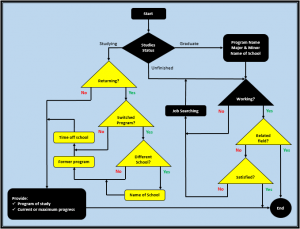
Providing the student with a digital resource that helps them building a contacts network was the goal I set to attain in the beginning. Research showed there are a number of means that partially deal with the task, and the scope I was considering included a two-way traffic of data. I was planning to capture student data that usually remain unregistered (see Figure 1), in order to provide universities and companies with missing information. Knowing aspects like time spent off-school; switching programs; returning to the same or different school would allow the universities to take new and proactive measures which will benefit the students, as well as students’ parents and tutors, the universities themselves, and even companies needing to fill vacant posts.
Figure 1. Identification of “missing” pieces of information (in yellow) that serve to better track the student’s journey to a fulfilling future.
The metamorphosis of this project has been unprecedented. From a two-way application to a network-recording tool to an awareness-tool, having diverse input along the way from young adults, students, and senior teachers while researching options and support.
The digital resource I decided to build includes components that already exist. My proposal is to provide a springboard from where to create awareness in any given student about the existence of those components. The information obtained through the use of the digital resource can be relevant enough to help the student make better decisions that will shape the student’s future.
Being the proposal a digital resource there are authors that considered computerized means just like vehicles to convey instruction (Clark as cited by Ally, 2008), while others sustained that the medium has an impact on learning (Kozma as cited by Ally, 2008) because computers’ features allow for real-life and simulations to be more effective on the learner.
I expect my proposal to align with Kozma’s standpoint since it will invite the student to access specific information on the web, as well as foster the student’s curiosity to further investigate options that somehow connect with the student’s goals and motivations.
That is what the start of my project has turned out to be, and the reason for that is the need of making contacts to obtain input for the project. It has taken me longer to complete the Empathize phase but, along the way, the definition of the project has shifted for the better. Journey-mapping has been of great help to appreciate how the standpoints of the people I have interviewed so far contrast among one another (Warman, 2015). Asking myself the key questions mentioned by the same authors served to frame the necessity I wanted to address. Two questions in one come first in order to identify the user and what is the objective of the project. Then, the second question deals with the reason for carrying on the project which sustains its objective, helps broaden the scope but… the last question brings it back into perspective by reflecting on things that prevent me from achieving the goal. Thus it becomes an iteration between the second and third questions so that the effort is “right-sized” for the allotted time frame (Warman, 2015).
Additionally, the core of the project should remain people-centered and anchored on the point of view (POV) which either remains as initially set, or is adjusted as the process goes on (d.school, 2016). Sharing the POV with the interviewees enables multiple benefits among which are: Validating the POV, creating possibilities by asking how might we (HMW) questions, and guiding the innovation effort within what is feasible.
References
Stanford University Institute of Design. (2016). Bootcamp Bootleg. Retrieved from http://dschool-old.stanford.edu/wp-content/uploads/2013/10/METHODCARDS-v3-slim.pdf
Warman, G. (2015). Using design thinking in higher education. EDUCAUSE Review. Retrieved from https://er.educause.edu/articles/2015/1/using-design-thinking-in-higher-education
The excitement of starting a new course and tackling the first activity caused, strangely, an absence of ideas on what to choose to work on. The first idea that came to mind was to build something to help students decide what to study when preparing their admission process to a university. I wanted to work on the idea at my son’s university (Centre for Digital Media, n. d.) but the initiative ended up not making much sense since the CDM is a highly specialized graduate school that offers a unique program.
The Centre for Digital Media is a multidisciplinary graduate institution partnered by the University of British Columbia, Simon Fraser University, Emily Carr University of Art, and British Columbia Institute of Technology.
The second idea that seemed better than the first had to do with the networking students in a master’s program are expected to build. Having the opportunity to learn in advance, thanks to my son, that networking is not practiced in an organised manner but mostly casually among the CDM’s students, I made an appointment to see the CDM’s director Dr. Richard Smith to explore the possibilities of the idea sharing it with him.
One idea leads to another
Even though Dr. Smith agreed on the fact that the students should be more diligent regarding their gathering of networking information, he stated that did not represent as big an issue for him or the university and suggested we go back to my first idea. He then talked about a different scope for the idea stressing the importance that helping students make sure they made the right choice has not only for them, but also for the universities and parents of the students.
The Academic Quadrangle Gardens at Simon Fraser University.
Furthermore, he specified that during the second year of college the larger number of changes occur because many students did not chose their areas properly. The impacts of these changes are diverse. Time is the first one because the students will need more time to complete their program, which also affects the university since graduation is what counts for their stats. There are also costs involved in these changes. In some cases the parents are supporting their studies, and in other the students must extend their loans’ terms. And regarding costs, the university also incurs in having faculty, materials and facilities available for the enrolled students.
Redirecting the research
Irving K. Barber Learning Centre at University of British Columbia.
Dr. Smith suggested me to contact the counselling departments of larger universities, and offered to put me in contact with an acquaintance of his in Simon Fraser University. I have a telephone conference scheduled for this coming Tuesday to discuss the topic with Kim Hockey, who is the director of Student Affairs.
University of British Columbia Bookstore.
The road to find the information source is taking longer than expected, and I hope it will be worthwhile because the outcome’s value will benefit more than one segment of the people involved.
So far the empathy method I have been using is the interview, and only as exploratory means to find appropriate grounds for the idea to progress. There should be interesting information to add to this post in the coming weeks.
Thank you for reading my post, I will certainly appreciate your feedback.
References
Centre for Digital Media. (n. d.) Retrieved from https://thecdm.ca/
Pictures of UBC and SFU campuses retrieved from the Creative Commons web site.







 That is what the start of my project has turned out to be, and the reason for that is the need of making contacts to obtain input for the project. It has taken me longer to complete the Empathize phase but, along the way, the definition of the project has shifted for the better. Journey-mapping has been of great help to appreciate how the standpoints of the people I have interviewed so far contrast among one another (Warman, 2015). Asking myself the key questions mentioned by the same authors served to frame the necessity I wanted to address. Two questions in one come first in order to identify the user and what is the objective of the project. Then, the second question deals with the reason for carrying on the project which sustains its objective, helps broaden the scope but… the last question brings it back into perspective by reflecting on things that prevent me from achieving the goal. Thus it becomes an iteration between the second and third questions so that the effort is “right-sized” for the allotted time frame (Warman, 2015).
 Additionally, the core of the project should remain people-centered and anchored on the point of view (POV) which either remains as initially set, or is adjusted as the process goes on (d.school, 2016). Sharing the POV with the interviewees enables multiple benefits among which are: Validating the POV, creating possibilities by asking how might we (HMW) questions, and guiding the innovation effort within what is feasible.