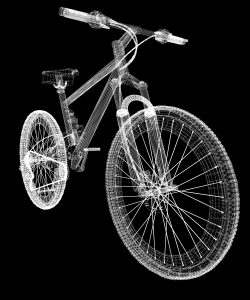
For Activity 6 we decided to look at bicycle manufacturing, particularly, producing bike frames from natural materials, bamboo and wood. Since we are both avid bike enthusiasts, this seemed like the perfect topic to pursue. For this activity, we both shared in researching bike frame design and manufacturing information and chose to split our writing on the topic between wooden (Keith) and bamboo (Alfonso).
Riding bicycles and building them are two very different things. While riding the bicycle is all about enjoying the ride or getting the most out of it for transport, amusement, and competition; manufacturing a bicycle requires paying attention to specifications, and being aware that any error may spoil the final experience or in the worst case, be a safety hazard. This knowledge makes building a bicycle a more serious undertaking than simply riding one.
In initial attempts at building bicycles, wood was used as the main component. In Germany on June 12, 1817, Karl Drais invented the precursor to the bicycle, later named “The Draisine” (see Figure 1), he was able to travel 8 miles in less than an hour. Its appearance somewhat resembles the bicycle as we know it today (Hadland and Lessing, 2014) although the Draisine was propelled by the rider placing their feet on the ground.
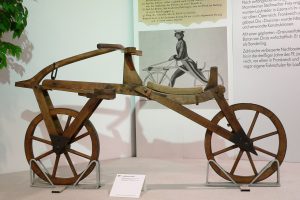
Figure 1. Draisine by Karl Drais
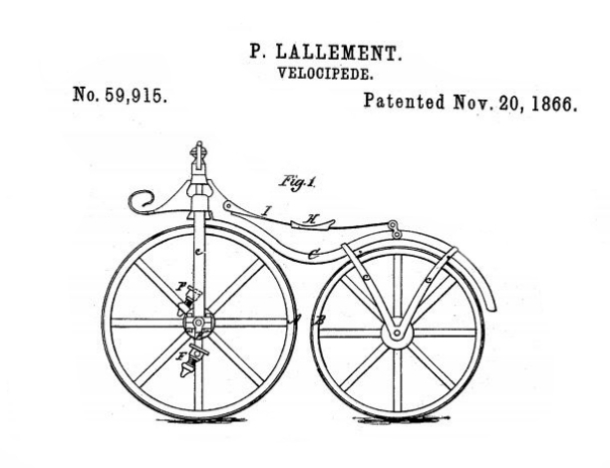
It wasn’t until November of 1866 that the pedals first appeared on rudimentary bikes, but they were attached to the front wheel as per the patented design of French US immigrant Pierre Lallement (Hadland and Lessing, 2014). Even though those early designs incorporated some metal parts, the frames were made of wood. These became known as “Velocipedes” (see Figure 2).
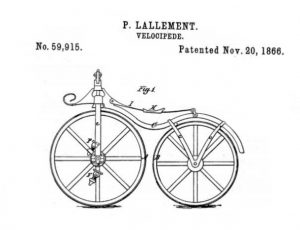
Figure 2. Velocipede by Pierre Lallement
WOODEN BIKES:
There is plenty of information online about bikes and their history, design, and manufacturing. There is also an interesting trend, or counter trend depending on how you think about it, of wood bicycle frame and even wheel manufacturing. Since the first bikes, or precursors of bikes, rolled out of craftsman inventors shops in North America and Europe, there has been a steady progression in design and manufacturing that make use of every more exotic materials and manufacturing processes often with the goal of cost reduction, uniformity of product, and mass sales. However the return to wood being used for frame construction, we find bikes, at least some of them, have come full circle.
On YouTube there are quite a lot of videos available documenting the recent rise in wooden bicycles, though I could not find any that were purely instructional in nature. I did however find interviews with the creators of these modern marvels of old tech. If one watches closely, many hints as to how modern wooden bicycles are made can be gleaned from the interviews and tours of shops. What I learned in particular is that in order to manufacture frames using wood, you can’t simply cut designed from solid pieces of wood, the frames have to be built using laminates of various grains and types of wood. The reason for this is because wood is highly variable in its qualities even within the same species. In order to build a well functioning wooden bike frame, the various grains of wood and properties of strength must be considered in order to create a bike frame that is laterally strong and able to bear the load of the rider efficiently.
In the videos we see that the manufacturing of modern wooden bicycles requires both the tools of old and new manufacturing techniques and products. In order to design and build a wooden frame, craftsman must devote considerable time and effort to the laminating and shaping of their frame designs. This process can be greatly sped up using CNC technology and power tools, but the final finishing touches, the work that makes frames beautiful, must be done by hand using tools we’ve developed for woodworking over the centuries. The one invention of just the past decade or so has been the improvements in glue technology, a key ingredient when laminating wood. Without this improvement perhaps wooden bikes would still be a relic of the past.
In order to build a wooden framed bike, one must have lots of knowledge of bike frame design. The internet does provide some handy info on bike frame designs, chiefly from high end bike bike companies that share plans and schematics of the frames they produce. Such things as tube lengths, head angles, stand over height, wheelbase, etc., is readily available on their websites. However, one could simply copy the geometry of any standard steel, aluminum, or carbon framed bike they currently own.
When it comes to working with wood however, the abundant information related to bikes online is insufficient. In order to work with wood, to choose the right types, to select the right grains, and ultimately produce a thing of beauty, anyone wishing to build their own wooden bike must have hands-on experience with and an artist’s understanding of wood and its properties. In one video, Ken Wheeler (2012), the owner of Renovo tells the story of failed hires saying that first he hired cabinet makers to work for him, but they could not produce the frames and in the end he had to hire artists to do the frame finishing procedures. One step in frame design that I found interesting and potentially the most difficult to achieve was that frames are hollowed out. This in itself may not seem like a daunting task, but given the effect thickness has on tube strength, lots of trial and error would likely have to go into getting this step right.
I have been involved in the biking industry for years, from building bikes from parts at a pro shop in Germany, redesigning a component on Rockshox forks, to designing mountain bike parks in China. When it comes to bikes, I practically live through them. I have also tried my hand at frame design and am an avid enthusiast of frame design evolution over the years. Still, this background is not enough for me to make use of the information available online. The construction of wooden bikes is simply too much of an art, years of learning, and craftsmanship. However, I grew up around wooden boat builders and come from 4 generations of wooden fishing and sail boat manufacture. Though I am no boat builder, I do have quite a bit of knowledge taught to me by my father and grandfather in regards to manufacturing with wood, and I am familiar with many wood working tools. My brother builds model airplanes and has an engineering business and has in his possession a CNC machine. Were I to embark upon building my own wooden bike, I am sure I could make use of my prior knowledge of bicycles and wood, skills working with wood, and my brother’s high tech equipment.
In regards to teaching other how to design a frame, I believe the internet offers plenty of useful information. As far as constructing wooden bike frames, I believe the internet wouldn’t be so useful. There are just too many steps in the process and too many considerations involved to adequately teach anyone using online resources. In addition, in order to build a wooden bike, prospective builders must understand wood. I think anyone who currently builds musical instruments from wood, builds airplanes from wood, or builds boats from wood and can ride a bike could set out to make their own bike if they used the information available online… and had a 1000 hours to spend on their first one (Thompson, 2015).
BAMBOO BIKES:
The information on bamboo bicycles in the Internet is also plentiful, and although the work to build a bamboo bicycle might require some tools the degree of sophistication does not compare to what we see in the case of the wooden bicycle frame. To begin with, bamboo has some natural advantages over wood from the raw materials standpoint. Since wood comes in logs or sheets the parts to build the frame need to be laminated, composed, and hollowed, while bamboo already comes in tubular hollow canes from the bamboo trees requiring only to be selected by dimensions and appearance.
The video tutorials available range from home-made do-it-yourself versions to tutorials filmed during workshops that guide the learner through the process. Provided that you have a garage or similar space at hand that can be used as a workshop, there still might be some set-up required in order to start working. Some usual tools of the sort anyone has would be handy but there are a few tools and materials that would have to come from the hardware store because improvisation is not recommended; for instance, the joints of the bamboo canes with the other parts like the headset tube, seat-post tube, the bottom bracket sleeve, and the dropouts need to be cut and filed at an angle to meet properly with the rest of the frame thus not just any saw or drill bit will do… and then there is the epoxy resin that is required to mix with carbon fibre, hemp, fiberglass, or a similar material that will provide extra strength needed to hold the joints of the frame (Nyampong, 2013).
If available, Kevin Braddock (2011) suggests the reutilisation of the parts of the frame mentioned above from another bicycle. In such a case, and assuming the geometry of the previous frame is adequate, it shall be traced on a wood board to use as template. Each piece that will be reused shall be secured in place to the board with a jig. Then cut the tubes apart, and clean the paintwork with a wire brush.
Nonetheless in contrast with wood, bamboo canes (or tubes) do not require to be laminated nor hollowed since its natural shape already serves the needs of the bicycle frame. Instead they require a preservation treatment on the inner side of the bamboo which is much simpler than hollowing the laminated pieces that would form the wood frame. That said, in addition to being a ubiquitous material, bamboo makes this option a feasible solution for any community, particularly in underdeveloped countries that lack transport infrastructure. Such has been the case in Ghana and Congo, besides other countries (Calfee, 2016).
We believe that the information available from the Internet can help a person with some basic familiarity working with tools and intermediate knowledge on bicycles to build their own bamboo frame. It might be necessary to go over the videos more than once in order to make sure the key points are clear, and that is one of the great advantages of having the tutorials online 24/7.
Facilitating the learning to others can be done with the information we found online. Some videos are more detailed than others, so pre-selecting the support material would be a must. Craig Calfee (2016), who also offers do-it-yourself kits, and Container Collective Yoga and Bikes (2017) are just two examples of the courses offering available in the web.
References
Calfee, C., 2016. Bamboo bikes a boost for Ghana. Posted by: AP Archive on November 16, 2016. Retrieved from: https://www.youtube.com/watch?v=Lbl3JDA0AOU
Container Collective Yoga and Bikes, 2017. Building a bamboo bike. Posted by: Container Collective Yoga and Bikes. Retrieved from: https://www.youtube.com/watch?v=uuNpt57kCI8
Drais, K., picture of Draisine by Karl Drais. https://upload.wikimedia.org/wikipedia/commons/c/ca/ZweiRad
MuseumNSU_Draisine1.JPG
Lallement, P., picture of Velocipede by Pierre Lallement. https://connecticuthistory.org/wp-content/uploads/2014/11/
LallementVelocipede-610×468.jpg
Nyampong, I.D., 2013. Africa Items (Ghana Bamboo bike Video). Posted by: Ibrahim Djan Nyampong on May 28, 2013. Retrieved from: https://www.youtube.com/watch?v=MaWj93f4mxU
Thompson, M., 2015. Building a Wooden Bike from Scratch – Fettlers – Chapter 1. Posted by: Red Bull on February 5, 2015. Retrieved from: https://www.youtube.com/watch?v=xhP12IOeMGQ&t=18s
Wheeler, K., 2012. Why hand-crafted, high-tech wooden bikes give a better ride. Posted by: Karen Dirksen on June 11, 2012. Retrieved from: https://www.youtube.com/watch?v=TBC7NEJwZ5U
The concept of building a bike out of wood as opposed to chromyl or other light metal materials is interesting. Would wood be performance based or esthetic and artistically based?
Hi Laura, thank you for visiting my blog and commenting on the bikes article. Your question should be answered from both perspectives since the wooden bike fulfills them both as well. Going over several of the many videos you can find in the Internet, there is one that addresses the aspects you point out: Performance based and artistically based. You can check the video on the last entry of the references list, and also you can check the Renovo Bikes web site too:
https://renovobikes.com/ [Let me state that I am not getting any commission on sales, ok?]
Cheers!
Alfonso