
In my experience leading a team, I have found that there is a huge benefit in allowing team members to work towards their own strengths. When looking at my plans for the future, I was never one to seek power and that might be a good thing. When looking at the rankings we created based on the work by James M. Kouzes and Barry Z. Posner (2012) the most important leadership qualities to our group were were honest, forward looking, competent and supportive.
An honest leader is more likely to work with team members and allow them to use their abilities to succeed. This works along with the “Enable others to act” practice of leadership from Kouzes and Posner (2008). By allowing the decisions to be made and work to be done by the expert followers, the leader gives them power to make things more successful. This leads to the leadership qualities of being forward thinking and supportive which shares the “Inspire a shared vision” and “encourage the heart” practices which means looking at how a team can use all members to reach a shared vision, and then as a team they’re able to celebrate their successes. Finally, competency is another important element of leadership which shares the last two practices of leadership. A competent leader will “model the way” and use their own skills to “challenge the process” to make it better. In my experience challenging the process often means trying something new and learning quickly on how to make it better.
For me, the introduction of digital technologies hasn’t really made a difference in my leadership and really, it shouldn’t. If anything, I would say that it has likely helped to facilitate many of the previously mentioned practices through newer communications means. In my leadership, I’ve always been working on digital tools so new technology or looking at ways to look at facilitation has always been important. That said, I think the leadership challenges have been with getting everyone on the same page and the same technology. With the proliferation of technology, everyone has had the chance to find their preference and it’s getting everyone on the same platform that is most difficult. For my leadership style I find that moving towards what James O’Toole (2008) refers to as shared leadership allows the team to work together on looking for a win for all rather than working towards individual goals.
One element of leadership discussed by Eric Sheninger (2014) was the concept of leadership and its relation to social influence. In his work he describes to connection of leadership to social media which is something I had never thought of when thinking of leadership. With recent promotion and controversy around events like Fyre Festival (https://www.forbes.com/sites/sap/2019/02/09/fyre-festival-fiasco-a-truly-unforgettable-customer-experience/#18e01e1c5546) and the effects that social influencers had on selling the dream of this festival, it really shows how easy these new digital tools are at leading and creating strong followers. That kind of transactional leadership is something that I typically try to avoid but looking at what happened here and the strength of influencer culture, it is hard to deny its effectiveness. As someone who has previously worked in social media marketing and worked with influencers, I have personal experience in this more transactional field and very much understand how well it can work.
So I think looking at these different elements there is a divide in thinking. There is the ideal that we want to support like Simon Sinek’s “Leaders Eat Last” (2014) where leaders are focused on being empathetic, respectful and create loyalty. This is what we built when ranking what we wanted in the leader. There is then the other side of what Sinek discusses in that the leader is creating a safe environment and giving the followers that sense of safety that they need. This is where we get the contrast between the want of an ideal Servant-Leadership or Shared leadership style but instead end up with a much more of the Transactional leadership where in the end the followers are looking out for their self interest. So it leads to the question of “are we actually getting what we want” and “do we actually know what it is we want”?
In a group of four we put together our rankings for our most important elements of leadership. Then we discussed these rankings to come to a consensus on the rankings. When we finished working through our rankings after a discussion I took our initial rankings to see if our discussion made a difference. You can see the results below:
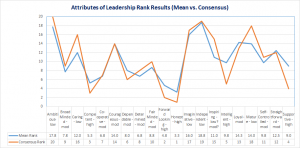
Figure: 1.1 Attributes of leadership Rank Results
In the end we all chose similar results despite having different rankings to start. Our discussion may have slightly changed the rankings but the overall mean showed that even with a small sample size our ideal leader fit some specific traits and even after talking, those wants changed very little.
Howells, R. (2019, February 09). FYRE Festival Fiasco: A Truly Unforgettable Customer Experience. Retrieved from https://www.forbes.com/sites/sap/2019/02/09/fyre-festival-fiasco-a-truly-unforgettable-customer-experience/#18e01e1c5546
Kouzes, J. M., & Posner, B. Z. (2007). “Leadership challenge, fourth edition”.
O’Toole, James (2008). Notes Toward a Definition of Values-Based Leadership. The Journal of Values-Based Leadership, 1(1).
Sheninger, E. (2014). Pillars of digital leadership. International Centre for Leadership in Education.
Sinek, S. (2014). Leaders eat last: Why some teams pull together and others don’t (1st ed.). New York, NY: Penguin Random House.

Leave a Reply