
Diverse contexts find common ground in the Design Thinking Process as our team used Empathy to define the problem. Drawing by Amanda Dunn and Lorne Strachan. CC-BY 
For our current course, LRNT 524, our team was tasked with completing Stanford’s d.school design thinking challenge (Stanford University Institute of Design, 2016). The d.school’s stages of Empathy, Define, Ideate, Prototype, and Test were all used in our process. Our team triad (Amanda, Christy, and Lorne) all work in very diverse contexts, yet the design process exposed a common need for our learners to build relationships and find safe common ground in order to engage in intellectual risk-taking (IRT) in an inclusive environment.
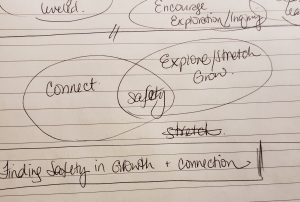
Design Thinking Step 3 & 4: Framing the Problem. Picture by Christy Boyce CC-BY
IRT is defined as “engaging in adaptive learning behaviors . . . that place the learner at risk of making mistakes or appearing less competent than others” (Beghetto, 2009, p. 218). Throughout the empathizing stage of the design process, it was clear that all of our learners were experiencing significant transitions in their lives. Changing careers, retirement, learning how to live with oxygen, and going back to school are often accompanied by anxiety, apprehension, fear, and loneliness. For all three team members, themes of connectedness, knowledge exploration, and psychologically safe learning environments emerged in our design thinking process. Malcolm Knowles supported that both physical and psychological safety are necessary for adult learning (as cited in Gravani, 2005). Gravani (2005) describes the necessary climates for promoting psychological safety in adult learning, including those of mutual respect, collaboration, mutual trust, supportiveness, openness, authenticity, and pleasure. To successfully promote IRT and have active engagement within our online classrooms, our team knew we needed to support learner confidence and work around feelings of hesitancy that may be limiting learner self-efficacy.
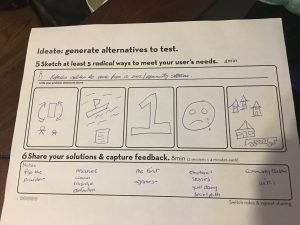
Design Thinking Prototyping, Step 5, Sketching and Mapping. Picture by Lorne Strachan. CC-BY
Our prototype component of an online integrated program is a scaffolded activity broken up into three sections to be completed at the beginning of our programs. First, our learners will write a reflective paragraph about their perceived ability to be successful in the program. Upon uploading their response, our learners would unlock the next step, which instructs them to strike a power pose and hold it for three minutes (see images below for power pose examples). They are then asked to reflect on their thoughts and emotions while holding their power pose. After submitting their reflection, they would unlock Amy Cuddy’s Ted Talk video on the power that body language has on confidence and perceived success. Lastly, they would introduce themselves on a community board and have the option of sharing a picture of themselves in their favorite power pose.

Photo by Lorne Strachan CC-BY

Photo by Christy Boyce. CC-BY
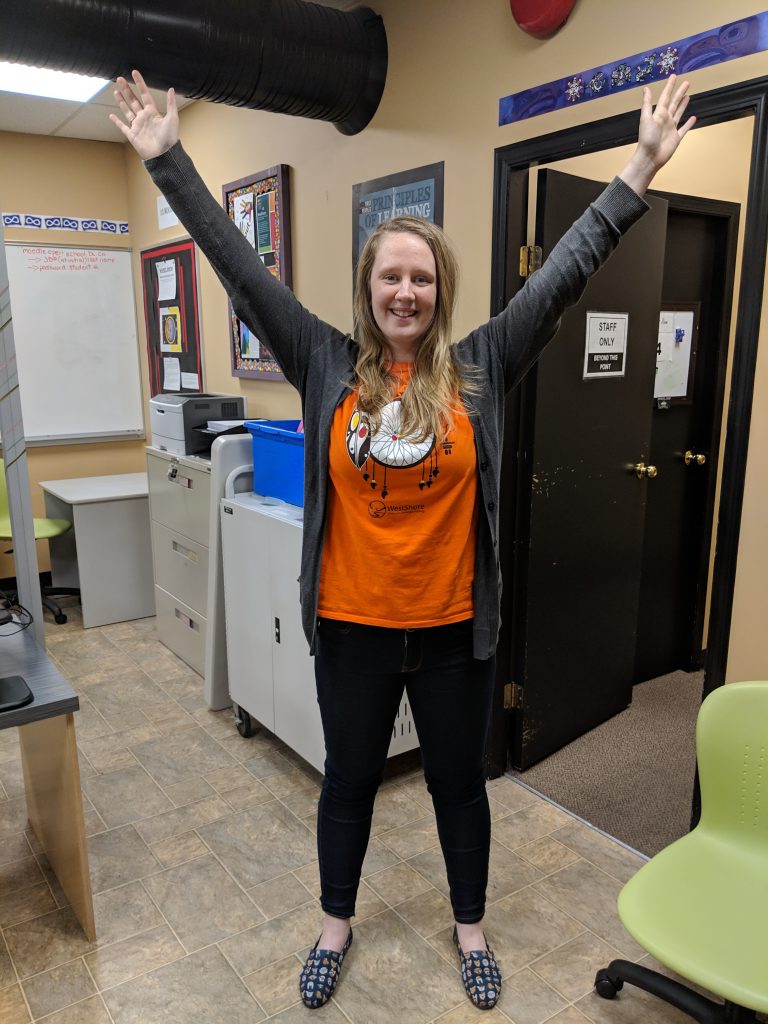
Photo by Amanda Dunn CC-BY
Vann (2017) reminds us that by using empathy in our learning design, we can “anticipate some of the frustration, confusion, and fear that adult learners may face as they engage in online higher education” (p. 242). By scaffolding our learning activities, we utilize Merrill’s First Principles of Instruction to engage learners in real-world problems, activate prior knowledge, demonstrate examples, and apply/integrate the new skills (Thomas, 2010). We hope our learners will see the benefits of power posing and its potential to reduce fear and encourage IRT. Using a light-hearted introductory activity may help start build learner relationships and increase learner engagement. We believe this activity will help learners experience greater self-efficacy and self-confidence.
We welcome your feedback and will be replying to all responses we receive before 8 am on Thursday Dec. 06, 2018 (PST) to incorporate them into the Critique of our solution for Part B of this assignment.
References:
Beghetto, R. A. (2009). Correlates of Intellectual Risk Taking in Elementary School Science. Journal Of Research in Science Teaching, 46(2), 210–223
Cuddy, A. (2012) Your body language may shape who you are. [Web log post] Retrieved from https://www.ted.com/talks/amy_cuddy_your_body_language_shapes_who_you_are?language=en
Gravani, M., (2005). Adult learning in a distance education context: theoretical and methodological challenges. International Journal of Lifelong Education, 34(2), 172-193.
Stanford University Institute of Design. (2016). A virtual crash course in design thinking.
Thomas, P. Y. (2010). Learning and instructional systems design. In Towards developing a web-based blended learning environment at the University of Botswana. (Doctoral dissertation).
Vann, L. S. (2017). Demonstrating empathy: A phenomenological study of instructional designers making instructional strategy decisions for adult learners. International Journal Of Teaching & Learning In Higher Education, 29(2), 233-244.
November 30, 2018
Thanks for sharing this excellent prototype Amanda, Christy, and Lorne, and for giving us some thoughts and ideas for the formal critique. It seems that your triage worked so well together (love the power pose pictures!). I truly appreciate how you described each step and their activities. I can imagine myself adapting (reusing and potentially revising if you make it available) a module like this into my program, as it is fun, and can engage learners with different technical backgrounds.
I wonder if adding a more active component what would offer the learners more chance to get to know one another and feel more confident engaging within the learning environment later on, would further the intellectual risk-taking? I would imagine this optional learning activity/component to engage with classmates at the end of the prototype after the learners introduce themselves on the community board step.
Jessica asked us a similar question relating our prototype, and her question and the provided supporting literature pushed Theresa and me to ideate and to introduce a few activities. Do you see an opportunity to add an optional component to the last step to potentially assist in community building?
December 2, 2018
Thanks Beata for the positive feedback and constructive ideas!
We think that your suggestion for an interactive activity after our learners post onto the community board is one that has great potential. Further discussion on the community board would fit well with Garrison and Vaughan’s Community of Inquiry (CoI) learning design principles (as cited in Thomas, 2010). Principle #3 involves sustaining a learning community “by shifting to purposeful and collaborative conversations” (Thomas, 2010, p. 227). Having our learners continue their engagement in this introductory section of the course will likely lead to stronger relationships and enhanced collaboration as we progress through the course. CoI learning design principle #4 tells us that, as instructional designers, we should “encourage and support the progression of enquiry” (Thomas, 2010, p. 227). Our team believes that by connecting our learners in conversation on the community board, that we may motivate their future conversations in a ‘safe’ environment.
Thinking ahead to next steps in our course, this additional activity that you propose may set the stage for collaborative learner relationships in line with the goals of CoI learning design principles #5 and #6 as listed in Thomas’ work (2010): to support increasing learner assumption of responsibility for their own learning and give them methods of resolving inquiry and developing skills of metacognition.
Thank you for the feedback and helping us utilize your ideas as feedforward for future iterations of this online learning component.
Christy, Amanda, and Lorne
References
Thomas, P. Y. (2010). Learning and instructional systems design. In Towards developing a web-based blended learning environment at the University of Botswana. (Doctoral dissertation).
December 3, 2018
Your prototype brings a fresh approach to IRT and active engagement as learners enter online learning environments.
Recently, Amy Cuddy described her current research as “building ladders up and taking walls down” (Biello, 2017, para. 31). Your blogpost and your reply to Beata’s question provide examples of building ladders up to community building.
How might your proposed activities serve to take the walls down for learners when introduced to activities that do not match their learning preferences or, alternatively, choose not to “engage in adaptive learning behaviours” (Beghetto, 2009, p. 218)?
Biello, D. (2017, 22 February). Inside the debate about power posing: A Q & A with Amy Cuddy [Blog Post]. Retrieved from https://ideas.ted.com/inside-the-debate-about-power-posing-a-q-a-with-amy-cuddy/
December 4, 2018
Hi Deb, and thank you for the comments and question. Biello’s (2017) blog post itself holds concepts from Amy Cuddy about postural feedback effects that may answer your question. Cuddy states that “adopting expansive postures seems to activate the behavioral approach system” and that “When our approach system is activated, we are happier, more optimistic, more confident, more creative, more likely to take action, more likely to seek rewards and opportunities, more physically energetic and less inhibited” (Biello, 2017, para 6). These behaviors are all supportive of the potential for intellectual risk-taking (IRT) in our learners. Having them participate in their own homes (safe spaces) by holding these power postures, there is potential for affecting their willingness to participate further in each scaffolded activity to follow as we engage their behavioral approach system. (Biello, 2017)
If your thoughts are that some learners may not feel comfortable engaging in power posing even in the privacy of their own homes, our team could consider an iteration of the online learning component that included other optional activities. Having some choices to make may allow our learners to feel more empowered in the process. In the article you link to above, Amy Cuddy speaks to the young age at which children begin to associate expansive postures with gender (Biello, 2017). Perhaps alternative tasks could be to allow learners to review several pre-chosen photos that demonstrate children using expansive and contractive postures and our learners could consider this phenomenon and reflect on it. Another alternative would be to have our learners observe individuals in their community for potential power posturing and related behaviours. These iterations of our activity would allow learners to still participate at their comfort level yet still engage in great discourse to examine aspects of power poses.
Christy, Lorne, and Amanda
References:
Biello, D. (2017, 22 February). Inside the debate about power posing: A Q & A with Amy Cuddy [Blog Post]. Retrieved from https://ideas.ted.com/inside-the-debate-about-power-posing-a-q-a-with-amy-cuddy/
December 5, 2018
Hi Christy, Lorne, and Amanda,
I very much enjoyed the essence of your prototype. The aspect of building confidence to promote community engagement through power poses is both playful and psychologically empowering. Your activity not only facilitates learning about the value of self-expressiveness, but it is also priceless in the worth as a life skill that translates into a quick reflexive ability the person can summon in any environment where the person requires that extra boost in self-esteem.
I have three reflections after reading your blog and ruminating on the factors. I hope that they are not too divergent.
1) I wonder if the picture is taken by someone else or as a timed camera (selfie) plays a role in how they would be reflective of their power pose. What are your thoughts on this? Would you want to clarify that to your participants?
2) In each of your photos, there is not only three different poses, but there are also three different expressions in fashion. It reminded me that there are filters in life when one expresses. This leads me to the role of Snapchat filters. As this activity has a playful core to its design, do you think that filters that promote confidence in a person could be useful or non-beneficial to the participants? For example, bunny ears and nose, or a cowboy hat.
3) Following the thought of associations inside the picture, Yang (2018) posits that associating with a brand in a filter elicits a greater self-worth if the person considers that brand to have high value, and therefore is a powerful symbol. What are your thoughts on how the reflections could change if a person applied a brand filter or some other associated image of power? For example, Red Bull, NASA, or Oprah. Would you want or allow filters such as these in your participation?
Thank you for your thoughts. Once again, I really enjoyed the concept, and I look forward to your reply.
Reference
Yang, R. (2018). Self-endorsing effect of brand filters: how the self, self-congruity, and perceived self-expressiveness lead to persuasion (Doctoral dissertation).
December 7, 2018
Hi Michael, and thank you for your questions. They are fantastic and very thought-provoking.
Your first question asks us to consider who is taking the photo and how this would play a role in our learners’ reflections of the power posing task. We would leave it to the learners to choose how they take their photo, but then create engagement by asking them to discuss their choices on the community board forum. This model of facilitation in learner conversations is supported by Garrison and Vaughn’s Community of Inquiry model whereby we would “monitor and manage discourse to ensure that it is productive and learners stay engaged” (Garrison, 2009, p.354).
Your second question inquires about our thoughts on filter use (ex. Snapchat filters) by our learners. We believe that if using a filter supports a learner’s ability to engage in the online community conversation, this would demonstrate the use of social constructivist pedagogical theory as learners reflect and create their own meaning in the filter use and learn via their personal interpretation of the actions of classmates (Thomas, 2010). If using a filter facilitates a ‘levelling of the playing field’ so to speak, thereby empowering our learners to post a photo of themselves in an expansive posture, then it may increase engagement. In all likelihood, our adult learners may find the use of filters confusing (Christy’s patients are often over age 60), which could potentially detract from the original purpose of the power pose task.
Your final question asks how learner reflections may change if a brand filter was applied to the photos by the learners. Using the lens of social constructivism again, power and knowledge would be considered subjective. Thomas offers that social constructivists “deny the existence of an objective knowledge” (2010, p. 130). Duffy & Jonassen offer that “Meaning is imposed on the world by us, rather than existing in the world independently of us“ (as cited in Thomas, 2010, p. 130). We would welcome all representations of our learners that they were willing to submit and offer guided consideration of those contexts and themes.
Our final thoughts are a quote by Thomas: “The single most important factor in online learning is motivation to get online participants through the early stages…” (2010, p. 164) and our team would utilize any interaction that our learners were willing to submit online to engage them in conversations with their learning community. We will accept and welcome all of these additions to their photos but not make them part of the assignment.
Christy, Amanda, and Lorne
Garrison, D. R. (2009). Communities of inquiry in online learning. In Encyclopedia of Distance Learning, Second Edition (pp. 352-355). IGI Global.
Thomas, P. Y. (2010). Learning and instructional systems design. In Towards developing a web-based blended learning environment at the University of Botswana. (Doctoral dissertation)
December 9, 2018
Thank you Christy, Amanda, and Lorne, for your thoughtful reply.
I understand that my response is outside your guidelines of when you will be responding for Part B of the assignment, but nonetheless your reply got my brain going and I thought I would further this engagement. Therefore, you do not have to respond nor add to your second part of this assignment. Your response elicited an active engagement on my side, and I appreciate that in of itself.
Your response to my first question makes absolute sense and reinforces a level of active engagement regardless of their selection on who is to take the power pose photograph.
Your second response was quite interesting to me. I can absolutely understand and appreciate the continuity of active engagement in this response as well. It made me wonder about different aged populations and how that could be a variable to be analyzed. Out of the three power poses, I wonder if there is a pattern in pose selection by age groups. Also, it made me wonder about new technology with older patients in this situation. I could not find anything academic about that, but I did find something that seemed interesting in regards to power pose, eye position, and risk taking activities. Garrison, Tang, and Schmeichel (2016) investigated power poses (expansive [high power] vs contractive [low power]) with gambling while varying their eye position (forward or down). They hypothesized that there would be a higher rate of confidence while gambling after an expansive power pose with a straight eye gaze. Their results were not as expected. I wonder if their results are an anomaly or does a risk taking activity impact the merit of the power pose. What are your thoughts based upon your reading, can eye direction and choice of activity play a significant role in the user’s response to the power pose, and furthermore, would this impact the following engagement in your perspective?
Thanks again for the fun conversation,
Michael
Reference
Garrison, K. E., Tang, D., & Schmeichel, B. J. (2016). Embodying power: A preregistered replication and extension of the power pose effect. Social Psychological and Personality Science, 7(7), 623-630.