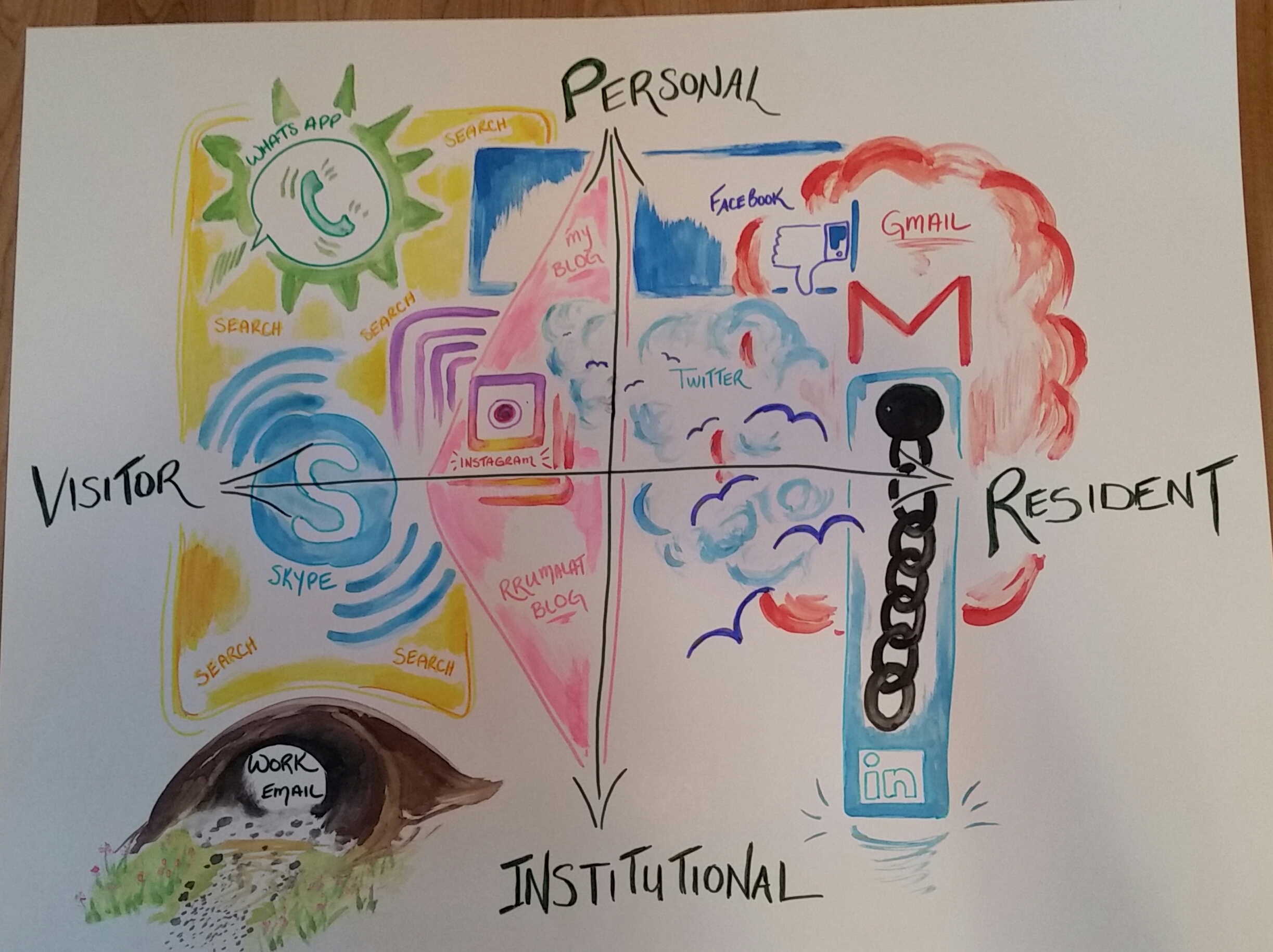
My Digital Visitor-Resident Mapping for MALAT LRNT521 – Digital Learning Environments, Networks and Communities course – Photo by author
As an assignment for the MALAT course Digital Learning Environments, Networks and Communities, our cohort was tasked with examining White and LaCornu’s concept of digital visitor vs. digital resident typology (2011). The concept proposes that digital visitors use platforms and applications as tools, choosing “…an appropriate tool which they use to attain their goal” (White and LaCornu, 2011 n.p.) then disengaging with it one the task is complete. In comparison, a resident would view the Web as more of a community place where they live out a part of their lives and seek support. (White and LaCornu, 2011) We were asked to reflect on our engagement with technology looks like and then map it out accordingly using a tension pairing of personal use vs. institutional. My map is presented in the image above. There is a wonderful explanation of how to do your own map in David White’s video: Just the Mapping.
It was a revealing experience that felt like holding a mirror up and judging myself on my digital engagement. I chose to use paint, as I am most comfortable using traditional instead of online artistic tools to create. Warschauer (2007) may say this is reflective of my multimedia literacy. In his work on paradoxical futures of digital learning, he posed the idea that:
In the 21st century, multimedia literacy is viewed as important for occupational purposes (with an increasing amount of jobs requiring production of multimodal content), civic purposes (with full participation in society enhanced by the ability to interpret and produce multimedia through blogging, podcasting, Website creation, etc.), and artistic purposes (with digital photography, digital video, and other forms of new media emerging as important forms of art and self-expression). (Warschauer, 2007. p. 43)
His concept supports the widespread acceptance and dissemination of online engagement throughout our cultures.
What I also was not expecting was a feeling of guilt or shock in the realization of how heavy my use of my time sits in one space of the map. The heft of my use of Linkedin is represented by a ball and chain keeping me tied to the presentation of professional self. I was shocked to have the evolution of using work email feel like crawling into a dark cave with no engaging objects inside it. My use of some of these applications and platforms is shifting and so I felt compelled to use paint as a medium in order to achieve movement in the map.
This was a revealing exercise and I encourage others to try their own version of a map to explore their digital use and involvement in various online communities.
References:
Warschauer, M. (2007). The paradoxical future of digital learning. Learning Inquiry, 1, 41–49. https://doi.org/10.1007/s11519-007-0001-5
White, D. S., & LeCornu, A. (2011). Visitors and residents: A new typology for online engagement. First Monday, 16(9).
July 28, 2018
Christy, this is a wonderful reflection and you have created great artwork to visualize the applications you use in each setting. I noticed that the personal sides of your map are quite full. Boyd (2010) stated that truly public profiles are accessible to everyone, where semi-public profiles are limited to specific individuals. Do you tend to keep your social networks truly public, or semi-public?
References
Boyd, D. (2011). Social network sites as networked publics: Affordances, dynamics, and implications. In Z. Papacharissi (Ed.), A Networked Self (pp. 39–58). New York, NY: Rutledge.
July 28, 2018
Thanks, Brandon.
That is actually a great question. Both my Facebook account and Instagram account are both limited to allow only those individuals I approve of having access to my profile and posts. Given that, I have felt comfortable engaging and being very open with personal experiences online and I see the potential for great creativity in online spaces.
As per Jenkins, Clinton, Purushotma, Robison, and Weigel (2006), “The community itself [] provides strong incentives for creative expression and active participation” (p. 7). I speculate that online writing and artistic expression feels comfortable for some individuals as they are not being ‘judged’ in person but able to keep a distance. I share some opinions with Hargittai and Walejko (2008), in terms of believing that the “…participation gap may be overcome by a ‘new media literacy’ highlighting the importance of focusing on enhancing people’s creative pursuits and abilities beyond providing technological access” (p. 241). I find blogging really connects me creatively, despite our posts being academic in writing style and content.
References:
Hargittai, E. and Walejko, G. (2008) The Participation Divide: Content creation and sharing in the digital age, Information, Community and Society, 11:2, 239-256, DOI: 10.1080/13691180801946150
Jenkins, H., Clinton, K., Puroshotma, A., Robison, M., and Weigel, M.(2006) Confronting the Challenges of Participatory Culture: Media Education for the 21st Century (An Occaisional paper on digital media and learning) Retrieved from Massachusetts Institute of Technology, The John D and Catherine T MacArthur Foundation, Chicago, IL.