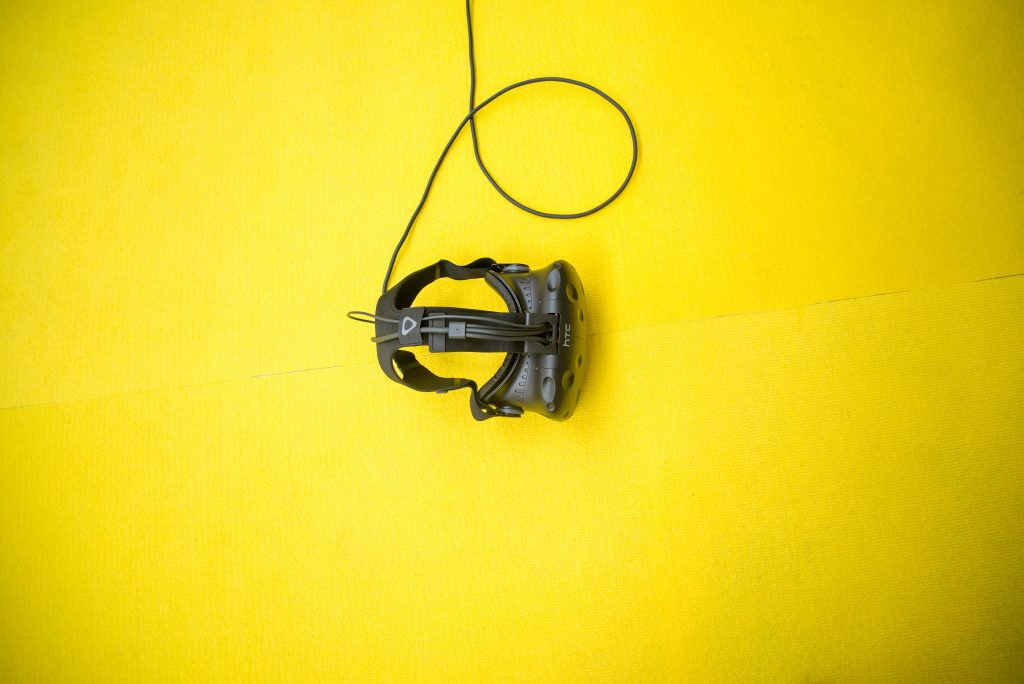
Immersive VR exists and is being used in healthcare. How can we leverage VR capabilities to maximize learning and education in healthcare?
Virtual Reality technology use in the context of healthcare is new, exciting, and, as is often the case with hyped-up tech, being used without a complete understanding of the benefits and risks. The use of immersive virtual reality (IVR) has shown great promise in distraction from pain, training for cognitive and hands-on surgical work, as well as anxiety reduction and improving provider empathy skills. It may be relatively easy to identify the key affordances of IVR that help make it successful in each of these contexts; however, we have a responsibility to consider the technology through a critical lens, examining our strategic priorities in healthcare before using public resources to design the future use of this technology in the complex healthcare system.
In terms of affordances, IVR leverages intense immersion in its effect. With a full headset, you are submerged into the simulated environment, able to get a 360-degree view around yourself. IVR simulations are filmed from the perspective of whoever is wearing the helmet, and the learner is able to be placed in the shoes of anyone with this design. This intense experience may result in increased emotional reactions and increased presence while using IVR; however, Shin informed that this uptake is dependant upon the user (2018). An immersive design function allows us to place ourselves in the perspective of our patients, walking through their experience of our care. Embodied Labs’ Carrie Shaw (2019) built a scenario around this concept to increase the understanding and empathy for the experience of a patient with macular degeneration and hearing loss after her own experiences caring for her mother. Relias (2017) has built a simulation that allows you to see through the eyes of a patient with dementia. These simulations can increase learner focus as they elicit an emotional response, and attempt to provide an understanding of the effects of these impairments. Buchman and Henderson (2019) argued that the IVR used in this manner allowed learners to feel deeply involved in the experience and more able to understand the patient perspective.
Our critical inquiry into the use of IVR in this type of training should include the following questions;
- When we elicit an intense and emotional reaction in our learners, do we follow this up by supporting a comprehensive debrief and reflection on practice as informed by evidence?
- Are we causing an increase in emotional load on our learners that may impact their professional and personal lives?
- How do we adapt the learning design to benefit learners individually if their personalities may limit their engagement with, and experience in, IVR? (Shin, 2018)
- What are the physical side effects of using IVR, and how are these mitigated in the training plan if learners are unable to use the technology as a result of health impact?
- How does access to IVR technology play a role in which healthcare professions are able to benefit from this technology in their training?
- Are interdisciplinary teams using the IVR together in their training or in isolation?
The design functions of IVR allow the building of avatars to represent humans that we would regularly interact with through our care practice. Let’s consider patients. In the diverse province of B.C., our healthcare providers may well benefit from the ability of IVR design to allow multiple avatar presentations of age, gender, and ethnicity. Fertleman, Aubugeau-Williams, Sher, Lim, Lumley, Delacroix and Pan (2018) argued that these avatars could be leveraged to reveal a healthcare provider’s own values and prejudices, demonstrating how these biases may affect clinical practice. This feature may be able to provide a better understanding of marginalized groups to providers in order to foster connection and empathy.
Further questions evolve:
- How are patient populations represented in IVR simulations?
- Do patients themselves have the opportunity to inform the development and design of the simulations and avatars?
- What curricular support is made available to facilitate diversity education and training via IVR in healthcare?
- How can pre-determined and programmed responses accurately reflect diverse healthcare interactions?
The creative, adaptive, immersive, and emotive characteristics of IVR training will lend useful in future iterations of healthcare training programs. At this time, we have considerably more questions than answers regarding the optimal design, use, and support for IVR learning programs in healthcare. As we strive to improve the patient experience, reduce costs of training, improve population health and increase the quality and efficiency of healthcare, a focused and informed approach should drive our future use of IVR technology.
CB
References:
Buchman, S. & Henderson, D. (2019) Interprofessional empathy and communication competency development in healthcare professions’ curriculum through immersive virtual reality experiences. Journal of Interprofessional Education and Practice. 15. 127-130
Embodied Labs, (2019) [website] Retrieved from https://embodiedlabs.com/
Fertleman, C., Aubugeau-Williams, P., Sher, C., , Lim. A., Lumley, S., Delacroix, S., & Pan, X., (2018). A Discussion of Virtual Reality As a New Tool for Training Healthcare Professionals. Frontiers in Public Health, 6, 44. Retrieved from https://www.frontiersin.org/article/10.3389/fpubh.2018.00044
Relias Learning (2017). A Day in the Life of Henry: A dementia experience. [website] Retrieved fromhttps://preview.relias.com/Library/Demo/2017/VR/story_html5.html?lms=1&_ga=2.42031651.765090657.1555168715-694509919.1555168715
Shin, D. (2018). Empathy and embodied experience in virtual environment: To what extent can virtual reality stimulate empathy and embodied experience? School of Media and Communication, 78, 64–73. https://doi.org/10.1016/j.chb.2017.09.012
May 16, 2019
You raise important questions about the ethics and implementation of IVR simulations, all of which need to be considered. Just one example, as you note, representation of populations including portrayal of diverse populations: it’s only recently that we’ve started to see something as simple as a variety of skin tones in emojis, let alone humans in IVR simulations. The question of patient participation in development and designs of IVRs is key as well…how many of these types of technologies are designed and built in hi-tech shops, away from the locations where they are actually used? So you’re right to ask a lot of questions but also to keep researching and testing the uses of IVR simulations in health care.
May 21, 2019
Thank you Irwin,
Agreed that we need to keep focus and guide the developers toward our focused goal of improved population health, increased care efficiency, increased employee well-being, and increased patient experience. Best not to get swept up in the thrill of it all being so new and exciting. Simulation design will require innovative, user-experience-driven, subject-matter expertise. Employing many of the skills of design-thinking and reflective practice we have explored in the MALAT program will be beneficial to guide future design and iterations of simulations.
CB
May 19, 2019
With new technologies and new methods come new responsibilities don’t they? I too am investigating a field that is relatively new and therefore does not have a lot of research to back it up (yet). It is almost a catch 22, people won’t adopt the new tech or methods until the research backs it up, yet there can’t be data unless people are working with the new tech and methods. For those of us willing, and who see possible value in these; one could say that we have a responsibility to help move this ship forward.
May 21, 2019
Hi Chad,
Thank you so much for your thoughts. IVR is slowly seeping into our practice and being funded by numerous sources – corporate, foundations, engagement groups, etc. Many are interested to see where this goes. I would welcome some more robust designs in the research with control groups, face to face training comparisions, and larger samples of healthcare professionals, taking part in the research. Looking forward to hearing more about your research as well!
CB
May 21, 2019
Hi Christy,
I really enjoyed reading your post. You made some good points as well as posed some very important questions. When it comes to healthcare, we have to consider patient-centred care which is ethical. How do we train students and professionals to critically think through an issue without harming a real patient? Would VR or IVR help? I came across a study by Maicher, Danforth, Price, Zimmerman, Wilcox, Liston, Cronau, Belknap, Ledford, Way, Post, Macerollo and Rizer (2017) who worked with students using virtual standardized patients (VSPs) which are computer generated emotionally responsive three-dimensional characters that have an integrated dialogue management system. VSPs are available in a web-based application by using a web browser which can be accessed anytime or anywhere, or in a stand-alone version. VSPs give students an opportunity to practice their patient interviewing skills in a risk-free environment. They found that the VSP will give the student a realistic encounter since the VSP reacts like a real person by using facial gestures, body language and giving verbal feedback. However, this may cause an issue for students with language barriers and hearing difficulties. Currently, our program is exploring the possible use of VR with student training, but we will have to consider both benefits and challenges before implementing the innovation.
I look forward to your findings!
Cheers!
References:
Maicher, K., Danforth, D., Price, A., Zimmerman, L., Wilcox, B., Liston, B., Cronau, H., Belknap, L., Ledford, C., Way, D., Post, D., Macerollo, A., & Rizer, M. (2017). Developing a conversational virtual standardized patient to enable students to practice history-taking skills. Simulation in Healthcare : Journal of the Society for Simulation in Healthcare,12(2), 124-131.
May 21, 2019
Thank you for your comments Joyce!
The study you mention sounds similar to one I came across.
Virtual patients programmed to react with facial expressions and garner reactions from learners. In another study, learners found the Virtual patients better to practice with as they could take their time in formulating a response and did not feel pressured to create an empathetic response. Increased response time in Kleinsmith, Rivera-Gutierrez, Finney, Cendanc, and Loka’s (2015) study correlated with a response that was more empathetic as determined by an outside observer. Which brings up the question of who is determining the level of empathy and how this is scaled. I have also come across some different definitions of empathy – some more cognitive and other more emotional.
Please keep me in the loop as to how your program proceeds. I would love to hear an update when you have one!
CB
Kleinsmith, A., Rivera-Gutierrez, D., Finney, G., Cendanc, J., Loka, B. (2015) Understanding Empathy Training with Virtual Patients. Comput Human Behavior. 52: 151–158. doi:10.1016/j.chb.2015.05.033