
Carefully design and align learning experiences that consider all contexts of both your learners and their environments. Support creative, meaningful and authentic connections by understanding educational theories and principles of instructional design. (Photo credit to Pixabay user webandi)
I’ll be honest, this assignment felt daunting to me. The readings were intense and our Prof’s request to choose a position aligning with one of the stances of either educational theory or instructional principles had me struggling to determine how I would proceed.
After reading Ertmer and Newby’s (2013) exposition on Behaviorism, Cognitivism, and Constructivism in instructional design and Merrill’s (2002) article on principles of instruction, I connected with a classmate hoping to find clarity as we reviewed the documents verbally together. We expressed our understandings of each article and talked them through. We each confirmed that each other’s understanding was sound. We positively reinforced each other’s knowledge and continued to share our ideas. As per Ertmer and Newby, this reinforcement likely benefitted our conversation, allowing us to share and reflect (2013). We expressed that we felt conflicted on how to choose a position and proceed. We began to use what Snelbecker referred to as “…thinking, problem-solving, language, concept formation and information processing… ” to work out our ideas (as cited in Ertmer & Newby, 2013). We then tried to relate the theories and instructional design principles to our work, creating further meaning. Ertmer and Newby remind us that this is not simple knowledge acquisition but the discovery of relational connections to the knowledge in our own lives (2013). In the process of pulling apart the readings, taking notes and incorporating them into our knowledge in a practical way, we had employed components of all three learning theories (Behaviorism, Cognitivism, and Constructivism) in our knowledge transfer.
Each of the learning theories discussed by Ertmer and Newby holds resonance in the process of learning that I had encountered at various times in my life. This feeling is corroborated by Ertmer and Newby in their statement that “As one moves along the behaviorist—cognitivist—constructivist continuum, the focus of instruction shifts from teaching to learning, from the passive transfer of facts and routines to the active application of ideas to problems” (2013, p. 58). So, I cannot see a way to align myself with a particular learning theory in this assignment as I believe they are all applicable in different contexts and time periods within one’s learning experience. Instructional designers may weave each learning theory into their learning plan to aide in knowledge transmission, choosing wisely based on their foundational understanding of theory.
I attempted to focus back on the learning principles listed in Merrill’s (2002) article. Merrill lists principles of problem-centredness, activation of previous experience, demonstration of skill by the instructor, application of skill by learner and integration of the skill into the learner’s environment as the five core principles of instruction (2002).
I was sidetracked by considering each instructional design principle in the context of teaching infant resuscitation simulation classes to RNs, doctors, midwives, and other Respiratory Therapists. Our health authority’s Neonatal Resuscitation Program (NRP) recertification classes are delivered in a blended model. Learners must pass an online exam after self-study and then attend a hands-on, face to face, multi-disciplinary workshop to integrate the didactic knowledge with the necessary hands-on skills. Learners can be both novices or healthcare practitioners that are extremely experienced in infant resuscitation. Empiricists may find comfort in our scaffolding approach to the hands-on skills as we carefully practice our way through a complicated algorithm step by step (Ertmer & Newby, 2013). Since Empiricists view learner experience as one of the main sources of knowledge (Ertmer & Newby, 2013), it is critical that I carefully place foundational modules in my instruction to solidify associations. Throughout the day of face to face instruction, I gently prompt the learners to share previous experiences and knowledge, helping them to recall information, connect it to didactic teachings and encode it. Schunk (1991) supports that this is a Rationalistic view of learning with knowledge being determined through reason (as cited in Ertmer & Newby, 2013) Even my stance on the origin of thought seems to be rooted in indecision, with threads of both Empiricism and Rationalism finding their way into my classes.
I had originally approached Merrill’s (2002) article on principles of instruction with skepticism. If I had found validity in the theories in Ertmer and Newby’s article, perhaps I would not make connections in our second reading? It did not take long to relate every single activity in my simulation classes to Merrill’s (2002) five core principles. I pulled out some blank paper and began to mind-map out how to relate all these theories and principles to my instructor role. In my mind-mapping exercise, I found multiple connections between our teaching strategies, the learning theories, and Merrill’s prescriptive design principles. I involve my sim learners in the four phases for effective instruction as mentioned by Merrill (2002) and listed as:
- Activation of prior experience as a foundation for new knowledge
- Demonstration of the skills to be taught
- Supporting the application of the new skills
- Integration of the new skills into real-life scenarios
My mind mapping results are below, demonstrating connections to origins of thought, principles of instructional design, and learning theory. How can I choose a position, when I want all the options for my learning design?
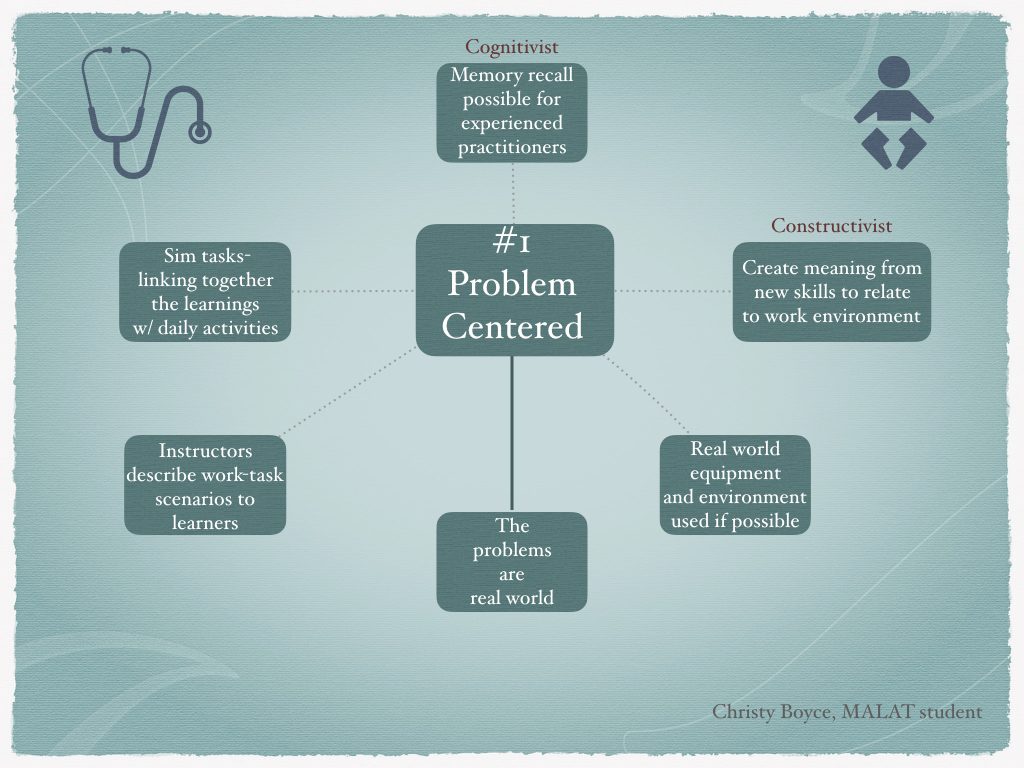
Image by C. Boyce
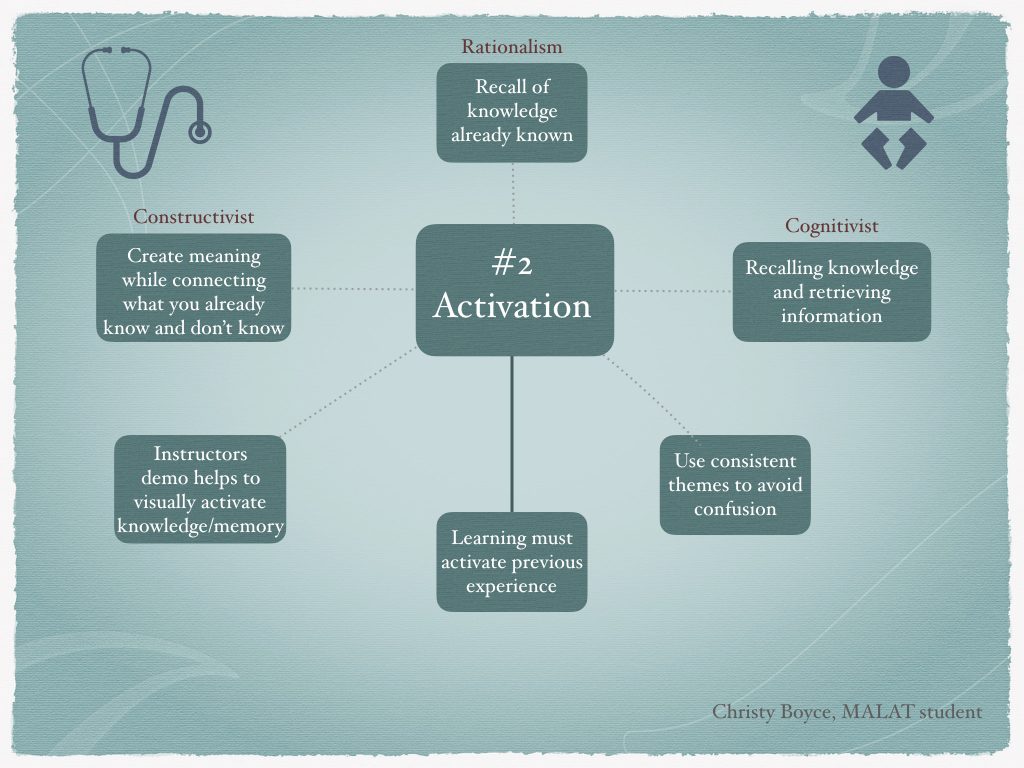
Image by C. Boyce
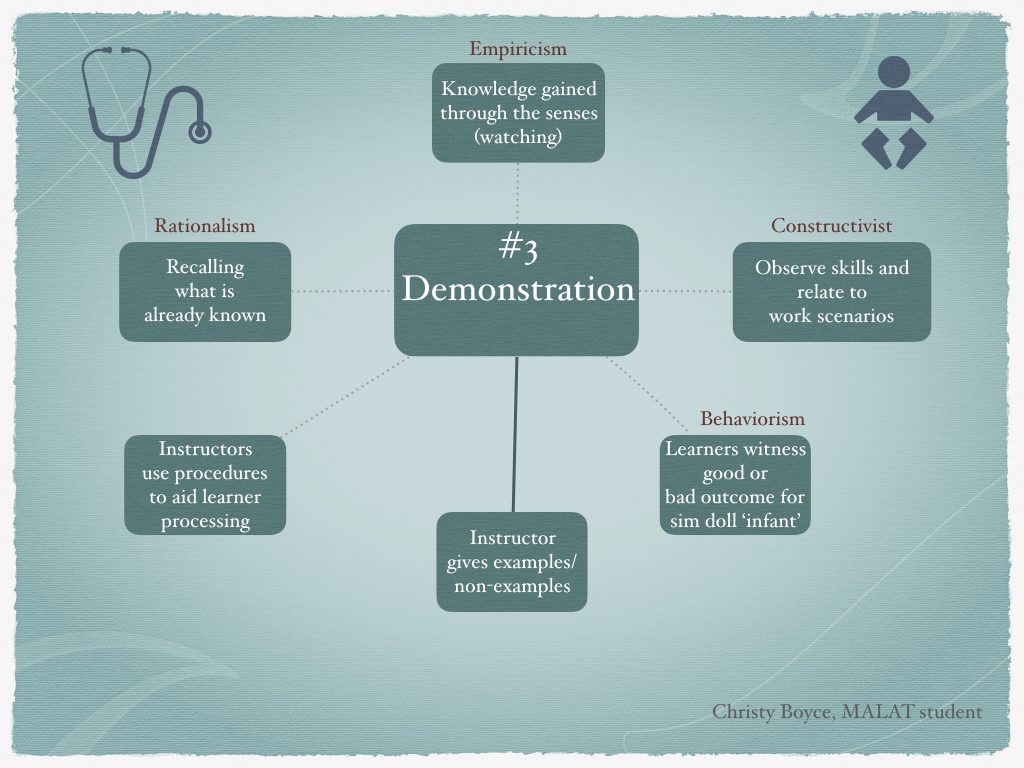
Image by C. Boyce
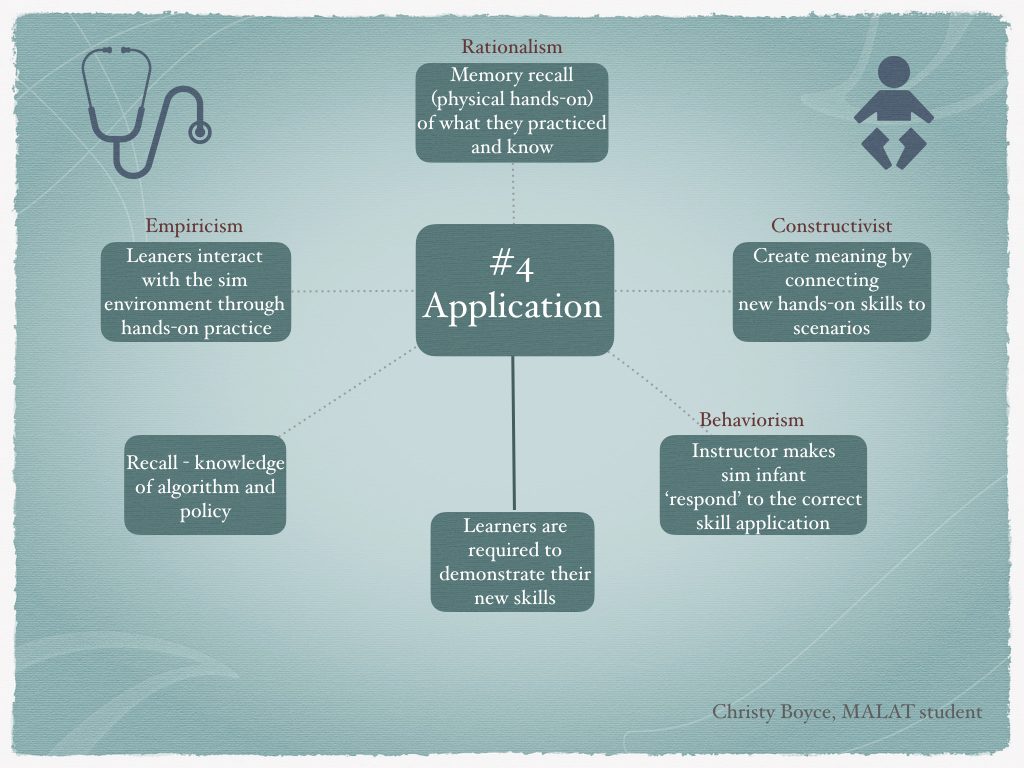
Image by C. Boyce
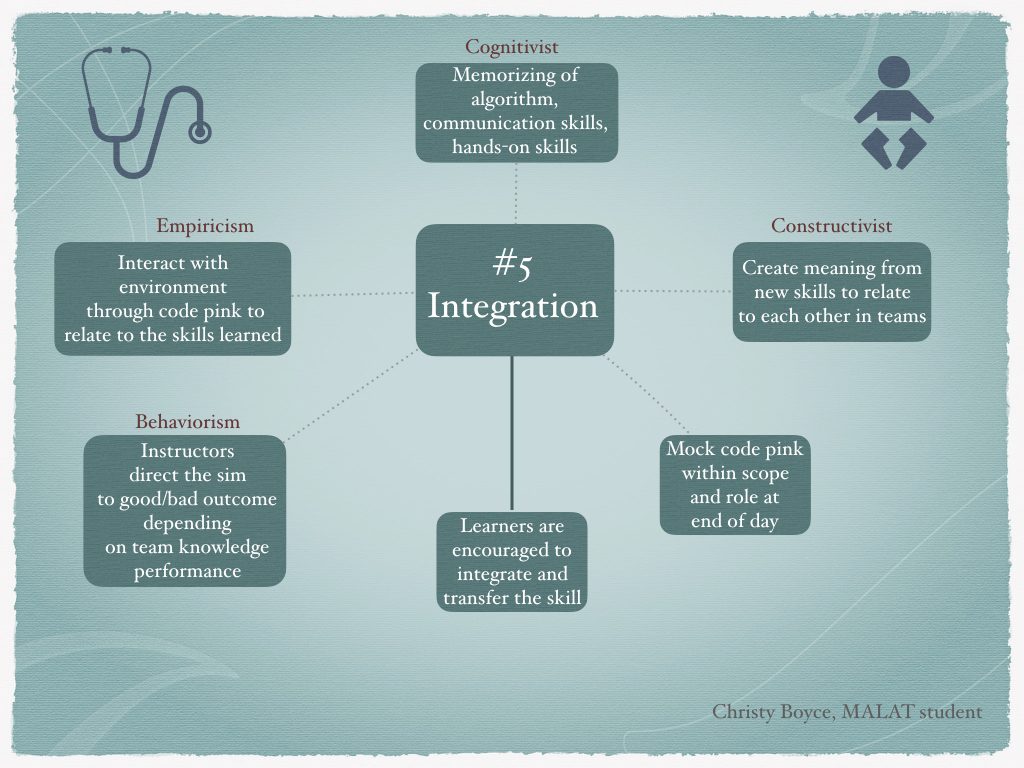
Image by C. Boyce
Kalanithi and Campbell support that great debate exists in the medical training community regarding the necessity for high fidelity training equipment (2015). Despite the debate and unavailable supporting literature, many instructors and practitioners are leaping to embrace high fidelity sim dolls that move, cry, turn blue, and even have heartbeats that you can auscultate. They are following the assumption that more technology equals improved knowledge transfer (Norman, Dore & Grierson, 2012). I would argue that many instructors would rather spend tens of thousands of dollars on fancy equipment without investing the time necessary to truly impact learning outcomes through effective design and knowledge of educational theory.
Understanding learning theories and principles of instruction can enhance your instructional practices, regardless of your field. Instructional designers must consider the context of the learning environment and level of learner knowledge among other things. The threads of design can be woven together to create a beautiful tapestry to support your learners. Consider all the ‘colorful’ options, and build your masterpiece.
C.B.
References
Ertmer, P., & Newby, T. (2013). Behaviorism, Cognitivism, Constructivism: Comparing critical features from an instructional design perspective. Performance Improvement Quarterly, 26(2), 43-71.
Kalanithi, K., & Campbell, D. (2015). Simulation-based medical education: Time for a pedagogical shift. Indian Pediatrics. 52, p. 41-45.
Merrill, M. D. (2002). First principles of instruction. Educational Technology Research and Development, 50(3), 43-59.
Norman, G., Dore, K., Grierson, L. (2012) The minimal relationship between simulation fidelity and transfer of learning. Medical Education. 46(7), 636-647.
September 23, 2018
Hi Christy,
I completely resonated with your words and wrote my blog with a similar perspective. I wonder if global applications of learning theories are more noticeable in healthcare professionals due to the complex nature of human care. What are your thoughts?
September 24, 2018
Hi Michael!
That is a really good question. I have worked within the field of healthcare for most of my instruction (other than some ballroom dance and fitness instruction) so I think I have a poor perspective on how learning theories apply to other fields.
After reading your question last night, I reflected on the nature of one of my specific roles in healthcare – acute care.
I have been responsible for making split-second decisions that carry life or death consequences many times in my career. That kind of reactive thinking doesn’t just result from reflection and making meaning (Constructivism). We require practice, repetition and get very good with our equipment if we handle it dozens of times in a day. Later, either in private or through peer discussions, we process what and how we have done our work. I’m a huge proponent of debriefing as it solidifies what we have learned in a more constructivist way.
In thinking of moments where I did not have a strong grasp on my work, I remembered some long-term leaves. I felt an intense connection to Schunk supporting that Behaviorists feel “Forgetting is attributed to the “nonuse” of a response over time. The use of periodic practice or review serves to maintain a learner’s readiness to respond” (as cited in Ertmer and Newby, 2013). When I returned to work after a year on maternity leave, I would get 4-6 re-orientation shifts until I felt comfortable working in the ICU again. Many of our practices become instinctive, automatic and necessarily so, as some must occur very quickly. These would be lost to me after a year away but only took a week or two to regain. Cognitivists would find resonance in the fact that I also needed to be reminded of certain calculations for a while due to loss of those in my memory while off on leave (Ertmer and Newby, 2013).
Interestingly, both of these scenarios fit with Brown, Collins and Duguid’s description within Constructivist theory that “To be successful, meaningful, and lasting, learning must include all three of these crucial factors: activity (practice), concept (knowledge), and culture (context)” (as cited in Ertmer and Newby, 2013). I had to re-ignite the practice, the knowledge, and the contextual environment to truly be immersed back into the work and re-orientate completely.
So, I suppose the long answer is, yes! Healthcare is very complicated and I feel like our practice benefits from learning in keeping with multiple theories of instruction. I have always felt that I had better know my work inside out, front to back and always be working to improve when the lives of others depend on it!
Christy
References:
Ertmer, P., & Newby, T. (2013). Behaviorism, Cognitivism, Constructivism: Comparing critical features from an instructional design perspective. Performance Improvement Quarterly, 26(2), 43-71.