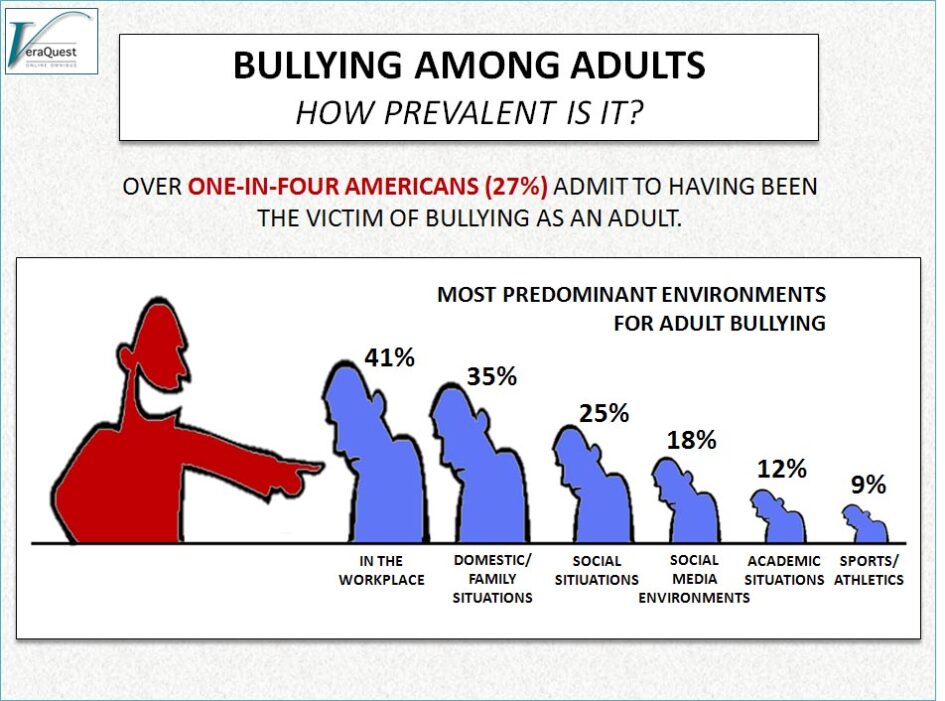
I thought that when I left high school, I also left seeing bullies and what they are capable of. As an adult in a professional environment, I see all kinds of bullying – from students, to faculty, to management; bullying is alive and well. It can be easy to mistake bullying or even ignore it altogether, but for the people effected, ignoring is not an option. There are many factors involved with workplace bullying and apart from the obvious psychological and emotional issues which may arise, productivity and motivation within the workplace can suffer. “Teachers in schools with high rates of bullying reported weaker leadership, teacher affiliation, and collaborative activity than teachers at schools with low rates of bullying” (Ertesvåg & Roland, 2015).
Understanding the design thinking process was quite overwhelming at first, but reviewing the readings helped with direction, purpose and a plan on following through with creating a tool to combat workplace bullying. The first step in designing is understanding the end goal: “designers attempt to get closer to the lives and experiences of users, in order to increase the likelihood that the product or service designed meets the user’s needs” (Kouprie and Visser, 2009). By imploring an empathetic approach and using qualitative data collection, I must keep the user in mind to ensure appropriate, rational support of the learner. Reading Kouprie and Visser helped stress the importance of creating more useful and enjoyable designs, however Kimbell helped me understand what to take away from the design process. Kimbell seems to throw out the traditional rule book regarding design thinking by utilizing other designations and professions to help ensure a well-rounded product that ensures everyone’s interest is met.
Kimbell’s “design-as-practice and designs-in-practice” (2012) made me understand that I was imploring the design-as practice, which is actually quite selfish and strictly viewed from a designer perspective without “reference to the artifacts” (Kimbell’s, 2012). I noticed my design was based on my personal experience and what I personally have observed, not what the user may want or need. I should utilize the designs-in-practice to ensure the process is specific and clearly outlined so I have a strong, well researched product. Kimbell also speaks to the importance of structure: “structure is not located in organizations, or in technology, but is enacted by users in practice” (Kimbell’s, 2012). I was able to begin mapping my design and through the readings, I am confident in the direction I am going. I don’t feel it is possible to eradicate bullies, but I think I can now create a human centered, empathetic tool with the user in mind, which will be effective in reporting workplace bullying.
References
Kimbell, L. (2012). Rethinking design thinking: Part II. Design and Culture, 4(2), 129-148. https://doi.org./10.2752/175470812X13281948975413
Kouprie, M., & Sleeswijk Visser, F. (2009) A framework for empathy in design: stepping into and out of the user’s . Journal of Engineering Design, 20(5), 437-448. DOI: 10.1080/09544820902875033
Sigrun K. Ertesvåg & Erling Roland (2015) Professional cultures and rates of bullying, School Effectiveness and School Improvement, 26:2, 195-214, DOI: 10.1080/09243453.2014.944547
Please click the link to view my Empathy Map: Empathy Map
June 30, 2020 at 10:24 pm
Hi Kerry, very interesting topic! I have definitely come across adult bullies myself (and after further research, discovered that they are usually sociopaths – but that’s an entire different topic!) and I’m excited to see your end design. If you can help even just a few individuals deal with this difficulty, it is well worth the effort!
July 7, 2020 at 3:02 pm
Thank you for your comments. It is both sad and frustrating that we continue to see bullies in the workplace and I agree, if it can help just 1 person, I did my job ☺
– Kerry
July 1, 2020 at 3:44 am
Hello Kerry, I was really excited to find and read Kimbell’s work as well. A great example of critical thinking. I look forward to seeing what you learn from the users’ perspectives about a helpful and effective tool for them in what is likely an emotional and fear immersed time in their lives.
July 7, 2020 at 3:04 pm
Hi Jenni,
Thank you for your comments. It is interesting that you say that as I was left feeling overwhelmed and sad from my interviews. It is an emotional journey being immersed in the world of workplace bullying and I learn more with every article I read. I am curious where this ends up, as the deeper I dig, the more I uncover.
– Kerry
July 1, 2020 at 9:42 am
Wouldn’t it be great if we could eradicate bullies all together! We would have a much better world. Perhaps your design can be the beginning of that eradiation and slowly we can build a world without bullies.
You made a point that, originally, your design came from your experience and not that of the users. I think that is an easy thing to do since we know our own experience best. If I am understanding designs-in-practice correctly, I think it is a great way to create your design since it will allow you to see how users are implementing the plan further allowing you to make adjustments, as required.
Have you considered that an online resource to help victims of bullying may also encourage more people to come forward since it creates a non-public forum (meaning they do not have to vocalize their issues). Knowing about more instances may help eliminate bullying!
July 7, 2020 at 3:07 pm
Hi Kathy,
You are so right, what a lovely world being free of bullying and harrassment. Great comments Kathy, thank you. As I have been researching and carrying on with the interviews, I think the online reporting system will make people more confident to come forward. As we know, the best form of advertising is word of mouth so if someone has a great experience with using the format, they can share with their colleague and hopefully it will get the ball rolling in eradicating work place bullies.
– Kerry