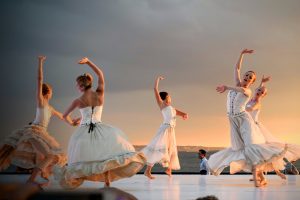
Dance education is one of the fine arts taught at many schools today, and it has a way of creating a great learning environment for students and educators through movement, and the interpretation of movement. Technology has transformed the lighting on any given stage to display depth, life and convey the dance’s message more clearly. Gibbons & Gruno (2013) briefly described the sequential history of technologies in dance [starting in 1960], and showed the interconnection between different technologies and how all together helped understand the history in a logical sequence. According to Gibbons & Gruno (2013), technology has impacted arts, including dance, for centuries in various degrees since both coexisted for centuries. Lee, Lee, & Goo (2013) pointed out that the use of digital technology has expanded and evolved throughout the years where “dance records, movement analysis, computerized moves, and even education have become available to us at all times through technology” (Lee, et al., 2013, p.64). Educational Technology (EdTech) will positively impact the dance education field because it plays a historical role in the development of dance education, it provides an attractive learning environment, and it is an innovative tool for teaching for both students and educators.
Although some may argue that dance is a self-sufficient art, historically, technology has been used in dance education. Of all arts, dance would seem the least likely to incorporate technology with education. Gray (1989) described dance as “the art of human movement, on the surface appears nontechnologically inclined. It is the self-sufficient art” (Gray, 1989, p. 19). Gray (1989) referenced the experience of dance education pioneer Margaret H’Doubler who believed that dancers were independent learners using their textbooks and laboratories to teach themselves. Therefore, dance and dance education evolved without the dependency on technology, but the technology was associated with dance education. Gray’s (1989) paper found that the choreographic process was cautiously codified and manipulated using a computer and a comparatively remarkable memory capacity in the 1960s by the University of Pittsburgh, which was the first attempt to use computers in dance education. There are several examples of using technology in dance education, one example is computerizing labanotation -symbolic “scoring” system for coding and recording dances in the 1970s- where educators “were able to edit, format, analyze, scan, and manipulate dance scores that had been entered into [David Sealy at Iowa University] system by means of a unique IBM Selectric keyboard containing only Laban symbols” (Gray, 1989, p.20). The use of technology in dance education has still been used in the last ten years to present “new methods for creating, instructing, and assessing dance as well as opportunities to expand dance resources and redefine the learning process” (Parrish, 2007, p.1381). Parrish (2007) referenced lifeforms animation, networked performances, and distributed choreography as the current technology innovations used in dance education. Dance on the surface would look like an art that is not associated with technology. However, EdTech applications have been demonstrated in dance education but should be used effectively to serve students and educators in dance education.
Using Technology alone in dance education is not adequate; educators should accompany it by pedagogy and instructional design. Dania et al. (2011) used four examples of schools to judge the effectiveness of technology applications in dance education, although the number of schools is limited. Dania et al. (2011) results showed that valid assessment procedures should take place and not only through the evaluation of students’ attitudes toward the use of EdTech. Both Dania et al. (2011) and Parrish (2007) concurred that there should be designing and constituting principles to govern dance education. (Mayer, & Moreno, 2003 as cited in Dania et al., 2011) Posit that “technologically supported instructional design should work as a tool of knowledge construction in order to be effective in any educational context regardless of the means that are used for the communication of knowledge” (Dania et al., 2011, p.3359). In order for the EdTech to be effective in dance education, Dania et al. (2011) argues that the design of multimedia products should be in conjunction with the principles of a theory of multimedia learning, and the inclusion and application of the technological innovations on the school curricula should be designed to support the dance learning processes. Accordingly, to maximize the benefits of using technology, it should be given its proper place in dance education instructional design addressing the needs of choreographers, critics, analysts, and performers. Parrish (2007) concludes that Technology can enhance dance education and offer a personalized learning experience, not only instructing and transmitting knowledge and skills. Gibbons and Gruno (2013) proves that the pedagogy associated with Technology depends on the instructional design of the educator and provide the students with authentic learning experience, she illustrates that “the dance activities offered in this article focus on effectively using technology to administer student-centered dance assignment” (Gibbons and Gruno, 2013, p.38). Even if EdTech is used effectively and accompanied by pedagogy, their effective use does not justify replacing dance.
If the use of EdTech is effective, it can positively enhance dance education but not replace it. The use of EdTech in dance education has evolved. Lee et al. (2013) described the first use of digital technology as “an effort made to make the stage or the role of the dancer appear more unique” (Lee et al., 2013, p. 64). The use of EdTech in dance education has expanded “dance records, movement analysis, computerized moves, and even education have become available to us at all times through technology” (Lee et al., 2013, p.64). EdTech in dance education has positively affected both students and educators. Lee et al. (2013) argue that the use of stereoscopic video conferencing benefited educators with reducing the online social distance and providing a sense of reality. However, Lee et al. (2013) emphasized that this system may not entirely be able to replace the traditional dance education form, but it could be used as a secondary method of education. The same tool benefited the students as well by motivating them. EdTech can also provide a personalized learning experience for students. Dania et al. (2011) emphasised the role of interactive media in dance education highlighting its importance by stating that “[Interactive media] involves all the aforementioned elements (i.e. text, image, sound, graphics, etc.) all included in a learning environment where creative action and inquiry have the primary role, so that the student can affect his/her own learning stages and determine those that fit to his/her learning style” (Dania et al. 2011, p.3356). The students and educators in dance education should use Technology as tools for improving their work and not as substitutes for their work. Parrish (2007) highlights the risk of using Technology in dance education in delaying dancers from direct and free expression on the dance floor, therefore, emphasized on dance educators’ role to “remember that Technology is merely a tool to improve dance and dance instruction, and that it is meant to be used to enhance real, physical movement, not replace it. (Parrish, 2007, p. 1395). Despite acknowledging the importance of EdTech in dance education, educators and students can not replace their work with Technology, but their work may be enhanced with the use of Technology.
EdTech has many benefits in the world today for both educators and students. The history of EdTech has proven that EdTech positively impacted dance education and was expanded and evolved throughout the years. New EdTech and innovations come up every day, and most are meant to make the world a better place. However, the new EdTech should be accompanied by pedagogical practices and instructional design to be effective and should not replace the word of dancers and educators but enhance it. All in all, EdTech has a positive impact on dance educations; hence, its use should be carefully embedded in dance education and not replace dance in dance education.
References
Dania, A., Hatziharistos, D., Koutsouba, M., & Tyrovola, V. (2011). The use of technology in movement and dance education: Recent practices and future perspectives. Procedia Social and Behavioral Sciences, 15(0),3355-3361. https://doi.org/10.1016/j.sbspro.2011.04.299
Gibbons, S., & Gruno, J. (2013). Using technology to teach high school dance: Two student-centred Activities. Physical & Health Education Journal, 79(1), 34–38.
Gray, J. (1989). The evolution of dance technology. In. J. Gray. (Ed.), Dance technology: current applications and future trends (p. 19-23). Reston, Virginia: American Alliance for Health, Physical Education, Recreation, and Dance
Lee, J., Lee, J., & Goo, B. (2013). Experiment on the e-learning of traditional dances through the utilization of stereoscopic. Proceedings of the Asia-Pacific Advanced Network, 34(0), 63-70. https://doi.org/10.7125/apan.34.8
Parrish, M. (2007). Technology in dance education. International Handbook of Research in Arts Education, 1381–1397. Springer Netherlands. https://doi.org/10.1007/978-1-4020-3052-9_94
October 14, 2019 at 2:34 pm
Hi Tala – I was drawn to your post as I work with students in the arts, including in a dance program. It is interesting to read about the intersections between educational technology and dance education. For example, as you mentioned, the distribution of choreography or analyzing dance movements – truly, edtech can play a role in such a wide variety of educational contexts and content. I also appreciated how you highlighted the role of edtech, to be one of enhancement of the learning experience, rather than a replacement. This is something I have been thinking of as conversations of developing online or hybrid programs is increasing. How can we do this in a meaningful way for programs such as dance, where instructor/student interaction is so interconnected (modelling a pose, physically correcting a position etc.)?