As part of our LRNT 524 course, Christopher Rowe and I created the Guichon Rowe Instructional Model as a re-imagining of our instructional techniques.
Here is a manifesto of the design principles included as part of this model.
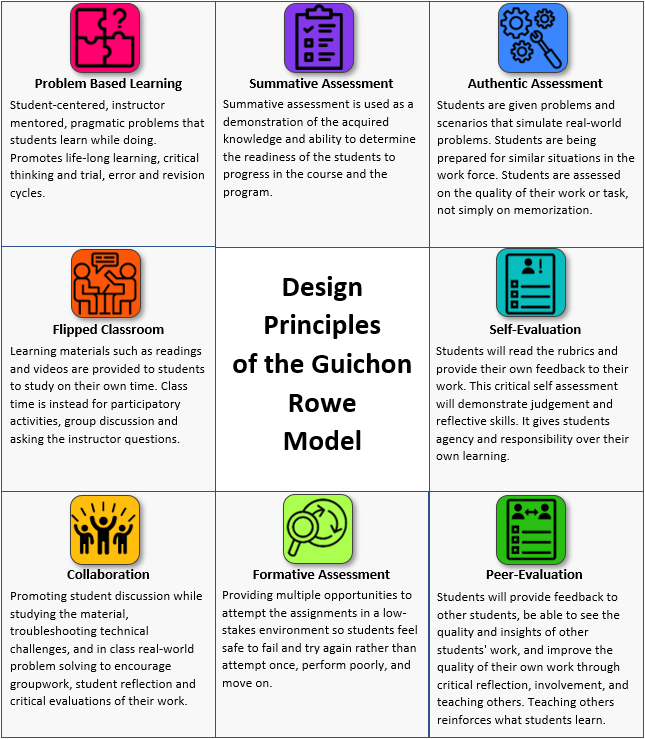
The Guichon Rowe Model includes 8 instructional design principles:
- Problem Based Learning
- Summative Assessment
- Authentic Assessment
- Self-Evaluation
- Peer-Evaluation
- Formative Assessment
- Collaboration
- Flipped Classroom
In order to incorporate these design principles – here are some of the practices that would employ these design principles:
- Exam – Problem Based Learning, Summative Assessment, and Authentic Assessment:
For the exam, which is part of the summative assessment, students would be given an authentic, problem based tasks to complete.
- Study Materials – Flipped Classroom and Collaboration:
Study materials such as textbook readings, pre-recorded lessons, walkthroughs, demonstrations, and external videos would be delivered using a platform such as Perusal which integrates collaborative discussions. Students would be able to ask questions, make comments, learn from each other. This builds teamwork and trust within the students, while reducing the workload for the instructor responding to repeated questions.
- Classes – Problem Based Learning, Flipped Classroom, and Collaboration:
With the study materials being provided in a flipped classroom (i.e. in a self study environment prior to coming to class), more class time would be available for participatory activities, group discussion, problem solving scenarios, and question and answer periods with the instructor.
- Assignments – Collaboration, Formative Assessment, Peer-Evaluation, Self-Evaluation, and Authentic Assessment:
Using a platform similar to Peerceptiv, students would collaborate and provide each other peer feedback as a form of formative assessment. Students would be graded on the quality of their feedback to other students and would in turn become better evaluators. This in turn should improve the quality of their own work as they would be better at recognizing good quality work and the teaching process of the critical evaluation of others would reinforce their own learning.
Image Attributions:
“Problem” by IconPai from the Noun Project 
“Peer Evaluation” by Duke Innovation Co-Lab from the Noun Project (original)  (with edits)
“Formative Evaluation” by Yu luck from the Noun Project 
“Checklist” by Blair Adams from the Noun Project 
“Meeting” by Becris from the Noun Project 
“Collaborative” by popcornarts from the Noun Project 
“Manage” by DailyPM from the Noun Project 
Recent Comments