3 Thoughts
Nine weeks ago we started this course on facilitation in digital learning environments, and it is interesting to look back on my initial thoughts. In my August 3-2-1 blog post, I argued that “facilitation is both an art and science in that the facilitator must have a grasp on the theoretical underpinnings of learning, instruction, and design as well as the ability to act on that knowledge to effectively facilitate learning experiences” (Donahue, 2022, para. 1). This is indeed the case and my experiences in this course have firmly cemented this belief in my mind.
I suspect I am somewhat naive and I have to confess that I thought it would be possible to meet the needs and wants of all learners. I learned that in reality, this is but a dream. However, a strong theoretical basis provides facilitators with the means and methods to meet the needs and wants of many, if not all, learners.
Finally, the range of participant engagement and participation is sometimes surprising and is likely based on a complex variety of factors such as interest in the topic or content, life outside of the learning event, and willingness to take risks.
2 Questions
How can facilitators ensure that all learners are provided with enough rigor to make the learning event meaningful but manageable?
What incentives exist other than grades and participation marks to encourage full participant engagement?
1 Metaphor
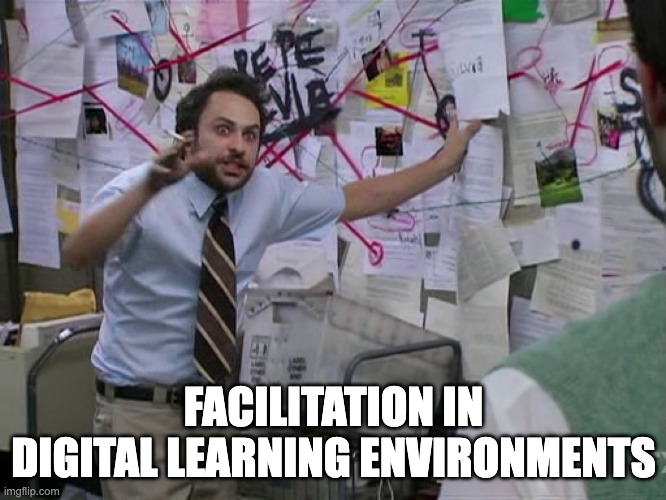
My tired brain struggled to come up with a new metaphor for facilitating learning in digital environments, so I made a meme instead. I would argue that this is a perfect representation of digital facilitation!
Figure 1
Facilitation in Digital Learning Environments
References
Donahue, A. (2022, August 26). 3-2-1 on Digital Facilitation. Amber’s MALAT Blog. https://malat-webspace.royalroads.ca/rru0202/3-2-1-on-digital-facilitation/