What I Want to Do Next…

This question feels like, “what do you want to be when you grow up?” I really love the thought of opportunities, but it is a question that feels overwhelming as well. There are a lot of possibilities for future dissemination and continuing research, and I would really like to explore two of them.

I have applied to participate in an International Atomic Energy (IAEA) group on the newly developed International Nuclear Management Academy (INMA) Master’s Programme in Nuclear Technology Management technical report. The INMA is a part of the IAEA that is supporting universities in developing their own master’s programmes in nuclear technology management. Here in Canada, there are very few nuclear engineering programmes and currently no nuclear technology management programmes. The IAEA community identified a gap in graduate-level nuclear management programmes. Traditional Master of Business Administration (MBA) programmes were not found to be specific enough and pure nuclear engineering programmes were seen as being too technical. I have contacts at both the Nuclear Engineering program and the Educational Informatics Lab (EILab) at the University of Ontario Institute of Technology (UOIT) and have set up meetings to discuss working with them to do research on the career development of nuclear professionals using advanced technologies and hopefully be involved somehow in the development of a nuclear technology master’s programme in Canada. This ties in my research idea about transfer of tacit knowledge from imminently retiring nuclear specialists

The second target for dissemination of my research are the global Radiation Protection (RP), Disruptive, Innovative, and Emerging Technologies (DIET) and Human Factors (HF) communities various conferences. The nuclear industry generates a vast amount of data from everything from the various aspects of the nuclear fuel cycle, management systems, nuclear power plant operation, and incidents. The RP community is often interested in using this data to improve radiation safety communication and RP methods. The HF community is often interested in using this data to reduce incidents and to enhance training programs. The DIET community is often interested in using this data to develop training using technology like Artificial Intelligence (AI) and Extended Reality (XR) technologies such as Virtual Reality (VR) and Augmented Reality (AR). My research could be disseminated as a presentation or paper at next year’s DigiDecom conference or CNS’ DIET conference. For this year’s CNS DIET conference, the requirement to present was to develop a presentation and did not require the publication of a paper. Next year’s Canadian Radiation Protection Association’s (CRPA) conference is in Halifax, Nova Scotia. I could also present a paper and/or a presentation at that conference. A short paper would be required, along with the development of a presentation. Participation in a panel discussion is another option that sometimes happens at CRPA conferences.

Both education research and conference participation are very interesting to me and would provide years’ worth of research and teaching opportunities.
Fab 4: Revolution

Now that I’ve seen all of the presentations (including my own team), I have a lot of thoughts that I am sure will just make my own paper more difficult! I have also gotten away from my early efforts to search for a way to link my love of pop music with blog posts, so I will go back to that in an effort to ameliorate my current mood!

Team 4 was the first team to present. They chose an e-learning course with a very clever name, ‘Hoarding Frogs in a Wheelbarrow’ (which does not sound easy!). It sounds like an interesting premise for a learning event and I think the observation that it is curated by only one person, thereby leaving it open to bias, is a valid one.

The team’s individual projects are as follows (Chaddock, 2022, para. 8):

  • “Alisha: How does engagement through social presence affect cognition?
  • Ben: How does the resource utilize constructivist and behaviourist learning methods?
  • Melissa: How do misinformation and bias affect resource quality (credibility & accuracy), especially when community members are encouraged to contribute?
  • Sharmila: How do we define quality? Who gets to define quality?”

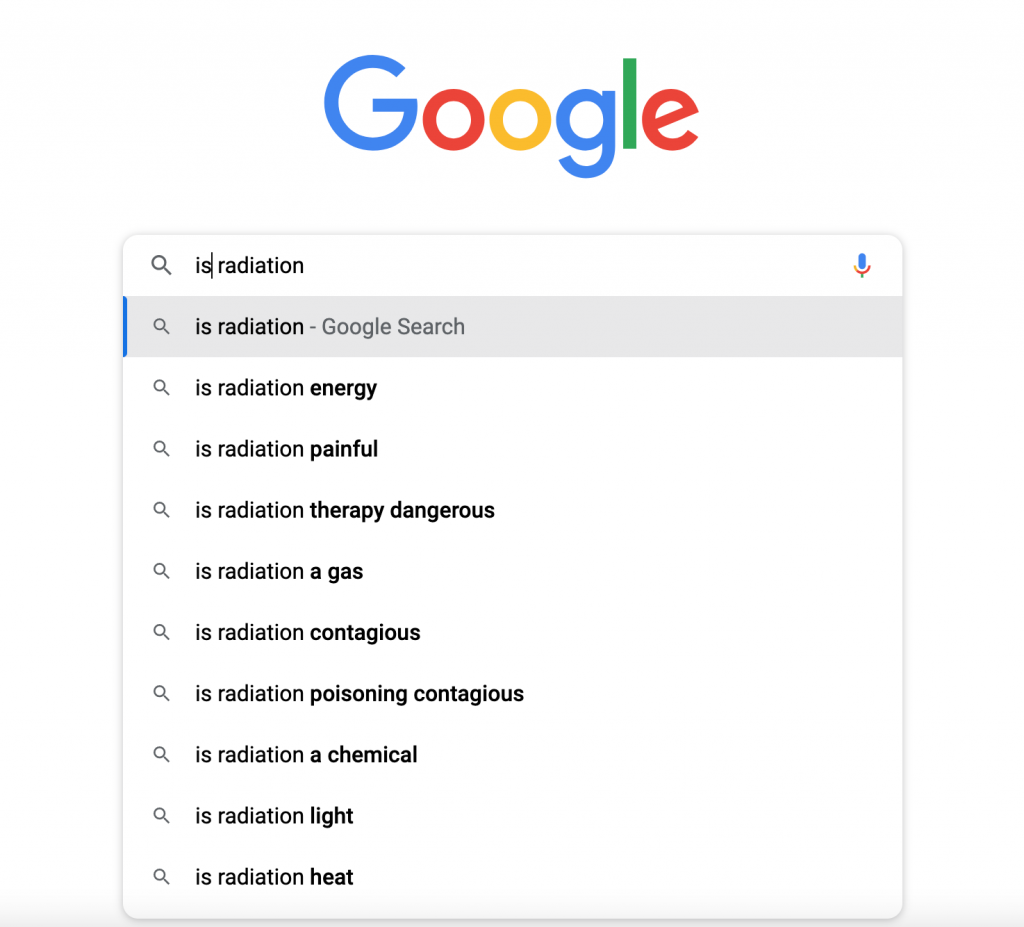
I really resonate with Melissa’s question about bias. Misinformation and bias relate quite closely to regulatory capture that I am investigating in my own research. I work in the nuclear industry and if I do the same search that Caulfield (2017) mentioned, but starting with ‘is radiation’, I get Figure 1:

Figure 1. Google search for ‘is radiation’. Houldsworth, 2022.

His solution to combat misinformation with info-environmentalism is a good one, I think. As experts in our fields, we can combat online misinformation with the concrete examples he gave; updating Wikipedia, posting factual information, and answering questions on fora (Caulfield, 2017).

I want to take this to my own project and consciously work to spread factual information in an effort to combat the misinformation that is so prevalent.

References:

526.1.3 – Team Blog – Ben’s Blog. (18 April, 2022 From https://malat-webspace.royalroads.ca/rru0206/2022-04-18/

Caulfield. (23 October, 2017) Info-Environmentalism: An Introduction. From https://er.educause.edu/articles/2017/10/info-environmentalism-an-introduction

It’s The End Of The World As We Know It (and I don’t feel so good)

Conway et al.’s 2017 paper entitled “From Design Thinking to Systems Change” (Conway, Masters, & Thorold, 2017, p.1) spoke most directly to me out of all the readings for this unit. In 2019, the organization for which I work started to undertake a “comprehensive review” of its work (CNSC, 2020), called Project Athena. It is expected to be complete in fiscal year 2021-2022, according to Departmental Reports, which are filed in the Parliament of Canada through the Minister of Natural Resources (CNSC, February 2021). The goals of the project align with the organization’s four strategic priorities, specifically the “agile” pillar (CNSC, n.d.). As one of the early activities in the review, all staff were invited to design thinking sessions where they were canvassed to see what they thought needed to be changed. As a staff member, having my input requested was novel and refreshing.

The design thinking sessions were open exercises where nothing was off limits. They were “substantial and varied” as Conway et al. discussed (Conway, Masters, & Thorold, 2017, p. 7). Hundreds of ideas were generated and many of these were actioned quickly, especially in situations where there was little to no cost involved and the changes were expected to negatively affect other areas. The rest have been categorized and folded into a project plan that will be actioned by senior management, in coordination with a management consultant (Government of Canada, n.d.).

From my point of view, the “think like a system, act like an entrepreneur” approach (Conway, Masters, & Thorold, 2017, p. 9) seems to have been followed. My hope is that the barriers identified by Conway et al. do not cause the project to fail or slow down. The way that these types of complex systems “mired in complexity” (Conway, Masters, & Thorold, 2017, p. 10) can hit barriers to change, such as regulatory frameworks, media backlash, and cultural norms and send “the innovation back to square one” (Conway, Masters, & Thorold, 2017, p. 13). Specifically, the media backlash and cultural norms noted by Conway et al. in 2017 could not have seen 2020-2022 coming.

This year has shown unbelievable challenges to the project that make Conway et al.’s statement describing the reality of the “route from innovation to scaling” being “fraught with obstacles” (Conway, Masters, & Thorold, 2017, p. 12) as the understatement of the epoch. As I write this, the neighborhood in which the organization’s headquarters in Ottawa, Canada sits has just been cleaned up from a month’s long occupation ostensibly related to the COVID-19 pandemic (Paperny, A. M, 3 March 2022). The Doomsday Clock sits at 100 seconds to midnight (Bulletin of Atomic Scientists, 20 January 2022), although this is likely closer to zero, given the war in Ukraine and recent shelling of the Zaporizhzhia nuclear power plant (AP News, 4 March 2022). Given that my organization stands ready “to offer coordinated support” (CNSC, 4 March 2022, para. 3) to the international nuclear regulatory community in these tense times, all these external barriers to change could certainly derail such an ambitious project as Project Athena. I hope that since Canada already “a mature, well-established nuclear regulatory framework” (CNSC, 2020, para. 2) and Project Athena is a further push for regulatory excellence, rather than a shoring-up of foundations, we may experience a slowing of the project rather than a “system immune response” (Conway, Masters, & Thorold, 2017, p. 13). I know that my own practice will be informed by international and domestic events, and they have taught me how fast things can change.

In summary, we are experiencing incredible barriers to change and the future will show how much impact these will have my organization’s change project.


References:

AP News. Russia attacks Ukraine nuclear plant as invasion advances. (2022, March 3). https://apnews.com/article/russia-ukraine-war-a3092d8e476949ed7c55607a645a9154

Bulletin of the Atomic Scientists. (n.d.). Current Time—2022. Retrieved March 5, 2022, from https://thebulletin.org/doomsday-clock/current-time/

Canadian Nuclear Safety Commission (CNSC). (2021, August 16). Canadian Nuclear Safety Commission (CNSC) Annual Report 2020–21. http://nuclearsafety.gc.ca/eng/resources/publications/reports/annual-reports/ar2020-2021/index.cfm?pedisable=true

Canadian Nuclear Safety Commission (CNSC). (2021, January 27). 2021–22 Departmental Plan. https://www.nuclearsafety.gc.ca/eng/resources/publications/reports/rpp/dp-2021-2022/index.cfm

Canadian Nuclear Safety Commission (CNSC). (2022, March 4). CNSC Statement on the ongoing situation in Ukraine[Statements]. https://www.canada.ca/en/nuclear-safety-commission/news/2022/03/cnsc-statement-on-the-ongoing-situation-in-ukraine.html

Conway, R., Masters, J., & Thorold, J. (2017). From design thinking to systems change. How to invest in innovation for social impact. RSA Action and Research Centre.

Government of Canada. (2020, September 24). Management Consulting Support for Project Athena: CNSC Strategic Review (5000049497/C). https://buyandsell.gc.ca/procurement-data/tender-notice/PW-20-00927612

Paperny, A. M. (2022, March 3). Ottawa police misjudged protesters who besieged Canada’s capital—Testimony. Reuters. https://www.reuters.com/world/americas/ottawa-police-misjudged-protesters-who-besieged-canadas-capital-testimony-2022-03-03/