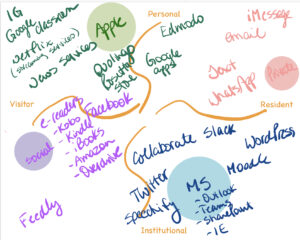
As a member of Generation X, I’ve grown up with computers as part of my life and, like most of my cohort who are “comfortable on the Internet and are making extensive use of it” (Miller, 2017, p. 32), I’ve already got an online presence that goes back at least a decade and a half in my adult life. Further to White and LeCornu’s comments on internet visitors and residents, as well as their follow up article in 2017 that the Visitors and Residents, “metaphors … have proved their worth and we have become aware not only of their conceptual appeal but also of their practical value as individuals and teams from a wide variety of employment contexts and professional roles have spontaneously used them as a simple structure on which to base reflection and exploration” (White, 2017), I would tend to agree that Visitors and Residents are less about the generation of the user and more about “ways of engaging with and via the digital” (White, 2017). I’ve been pretty happy with my online presence so far, because I spent the better part of a decade working as a consultant and using the internet to get work. From 2006-2014, I actively used developing platforms such as LinkedIn, Facebook, Twitter, and my own website to promote my business and believed that “taking control of the situation is always a better strategy than sitting back and seeing what they find” (Korkki, 2010). I set up Google Alerts for my name to stay abreast of how I was showing up online. I made sure that my personal race results and volunteering work showed up in Google searches of my name. Starting in 2014, I slid into a space where I stopped doing a lot of that. By 2018, my life had changed substantially, and I started to re-examine my online life. Given that it had only been four years since I last actively curated myself online, I was surprised at how much had changed. Fast forward to 2021 where the MALAT program is challenging me to rethink what I’ve been doing online in the past and what I want to do in the future. My goals are no longer to promote myself as a consultant, but to rebuild my sense of self, to retake control over my creations, then to create something new. I want to make my online presence like a grand building, full of “extensions of our minds that both reflect thinking and engender it” (Dron, 2014, p. 49). Ideally, it will be a place where I can simultaneously teach and be taught by my community. Ultimately, I want to positively increase information access to my community, disseminate knowledge, and help create a community of practice where we treat “learning as dynamic and situated” (Dron, 2014, p. 56).
To achieve these goals, I need to re-examine the place I currently inhabit in my communities, determine where I want to be, then identify the steps I’ll need to take to get there. I will examine the platforms and online places I inhabit, and critically assess my image. Something I haven’t examined recently is how my various online personas relate to one another. Since, as danah boyd argues, “privacy is simply in a state of transition as people try to make sense of how to negotiate the structural transformations resulting from networked media” (boyd, 2011), I need to examine what my privacy looks like in my current networks and whether I’m comfortable with that. Since I want to explore building a healthy Community of Practice, I’d also like to examine online communities like r/science, frontporchforum, MeWe, and CloudHub where community is built differently than in the big social media companies. As Ethan Zuckerman said, “being global and powerful is incompatible with wanting to build a really healthy and resilient community” (Venkatesh, 2021, 27:00-27:08). Further to this, I will also critically examine the six elements of digital capability described by Beetham and identify any areas of weakness there (Beetham, 2015), as well as my level of social media literacy as described by Rheingold (Rheingold, 2010, p. 16) in the following areas:
- Attention
- Participation
- Collaboration
- Network awareness
- Critical consumption
I have already mapped where I am as part of a previous blog post. I want to redo that visitor resident typology to imagine what I want it to look like, then overlay the two to make a plan forward. I expect that I’ll make blog posts about it, for accountability as I learn new information and skills.
Measures of success are moving targets. With all the new platforms that are being developed as a result of social change and scientific (e.g. pandemic) change, there will be new platforms to examine in the future. This isn’t a matter of “success” or “failure”, but rather a continuum of continually re-analyzing and readjusting. I see this as an annual (at most) activity, or sooner if something major changes, like a job change or some other life event. I fully expect to continue to use my MALAT blog to track this evolution.
Beetham, Helen. (2015, November 10). Framing digital capabilities for staff – deliverables. https://digitalcapability.jiscinvolve.org/wp/2015/11/10/framing-digital-capabilities-for-staff-deliverables/
boyd, danah. (2010). Social Network Sites as Networked Publics:Affordances, Dynamics, and Implications. Networked Self: Identity, Community, and Culture on Social Network Sites, 39–58.
Dron, J., & Anderson, T. (2014). Teaching Crowds Learning and Social Media. https://www.aupress.ca/books/120235-teaching-crowds/
Korkki, P. (2010, October 9). Is Your Online Identity Spoiling Your Chances? The New York Times. https://www.nytimes.com/2010/10/10/jobs/10search.html
Miller, Jon D., and Laspra, Belén. “Generation X in Mid Life: A Summary from the Longitudinal Study of American Life.” Generations – Journal of the American Society on Aging 41, no. 3 (Fall 2017): 32.
Rheingold, H. (2010). Attention, and Other 21st-Century Social Media Literacies. EDUCAUSE, 45(5), 14–24.
Venkatesh, Sudhir. (n.d.). “Someone Needs to Save the World from Silicon Valley” (SBTI Ep. 3) (No. 3). https://freakonomics.com/podcast/sbti-social-media-solutions/
White, David S., Le Cornu, Alison. (2011). Visitors and Residents: A new typology for online engagement. 16(9). https://doi.org/10.5210/fm.v16i9.3171
White, David S., Le Cornu, Alison. (n.d.). Using “Visitors and Residents” to visualize digital practices. https://doi.org/10.5210/fm.v22i18.7802