Team 5 aka Jazzy Awesome Legendary Genius Minds – Podcasts

As promised in my blog post on Fab 4’s e-learning selection, and tying in Team 3’s presentation about TikTok and sampling, I want to discuss podcasts both through Team 5’s lens, as well as my own experience. Team 5’s blog post title was, “Podcasts. Everyone has a story”, which I thought was beautiful. They brought up some very good points about time-shifting, where listeners can take in a podcast at their leisure, as well as how access can be an issue in a vast country like Canada. The team presented their thoughts in the form of a mock podcast, which was clever, especially given that we could go back and watch the recording later!

The team created a wordy, if well laid out infographic to reinforce what each member is working on (Rodriguez, 2022). I liked their choice of a Canadian podcast produced by the Canadian Broadcasting Corporation (CBC) called, “The Secret Life of Canada”. One of the more engaging ideas that Myrna brought up was the concept of podcasts for storytelling from an indigenous lens for use in teaching. I was struck by the juxtaposition of her point of view with the one that I heard that same week from an elder with the Passamaquoddy Recognition Group Inc. about how he was hesitant to share his knowledge for fear of it being misused (Passamaquoddy Recognition Group Inc., 2022). The thought that indigenous knowledge can survive from generation to generation, but possibly be misinterpreted if presented without context, is fascinating to me. The team wrapped that thought nicely by advising readers, “to be mindful that podcasts, like any widely accessible technology, bring questions around credible and accurate information to the fore”.

Podcasts have become very widespread, likely due to people having time on their hands during the pandemic. I know that my favorite podcasts have good production value that includes sound effects and quality narration, but that takes resources. The evolution of podcasts as a sort of ‘new radio’ will be interesting to follow.

References:

Rodriguez, L. (11 May, 2022). Podcasts. Everyone has a story – Luis Rodriguez. (n.d.). From https://malat-webspace.royalroads.ca/rru0216/podcasts-everyone-has-a-story/

Passamaquoddy Recognition Group Inc. (27 April, 2022). CMD 22-H2.244A: Written submission from the Passamaquoddy Recognition Group Inc. https://www.nuclearsafety.gc.ca/eng/the-commission/hearings/cmd/pdf/CMD22/CMD22-H2-244A.pdf

For my music choice, I’ve included one of my favorite nerdy podcasts about music history. This episode specifically talks about the impact that sampling has on future music. Team 3’s presentation about TikTok reminded me of this episode. Hit Parade has good production value that includes music examples that bring back memories, a good narrator, and interesting facts that I learn a lot from. As a podcast production company, Slate tends to create entertaining and informative podcasts in my experience.
https://open.spotify.com/episode/3qnQ85QKXpvloG1KvCBCkp?si=rhAnO4XvTa6mflqgUrNc1Q
https://open.spotify.com/episode/72fzXLgUSsUwgwjV51ZJba?si=jVOs6dg4Sj-4iBjS1XmB4w

Team Brilliant (Team 2) – MOOCs

I really looked forward to this presentation and this team did not disappoint. They included lots of relevant information on the pluses and minuses of Massive Open Online Courses (MOOCs). I completed this MOOC at the beginning of the pandemic and, as I described during the live presentation, it became part of the impetus for me to apply to the MALAT program. I am also one of the minority of students who have completed the course, which was a nice feeling of accomplishment at a time when I did not feel like I was accomplishing much at all. Another thing that I appreciated was feeling the same way as the team about the odd sort of artificial connection that the MOOC tried to convey (Breton et al., 2022).

I loved the infographic that this team posted on Ashley’s blog (Breton et al., 2022). I agree with what they say about MOOCs being shiny and optimistic on the surface, where you can easily see what the developers want us to see, but there being a deeper, perhaps darker, underside that is more difficult to see. During the presentation that the group made, I especially found the discussion about low completion rates (Murphy et al, 2014) that was part of Emma’s critical issue most fascinating.

Overall, this team has raised some very interesting thoughts on MOOCs that I had not thought of before reading their thoughts. I look forward to seeing where their research goes.

References:

Murphy, J., Williams, A., & Lennox, A. (2014). MOOCs in VET and higher education. 22nd National Vocational Education and Training Research Conference ‘No Frills’: refereed papers. Australian College of Applied Education. 76-82.

Breton, A. (9 May, 2022). Making Sense of MOOCs: A Critical Look at the Impact of MOOCs in Teaching and Learning | Ash’s Blog. From https://malat-webspace.royalroads.ca/rru0205/making-sense-of-moocs-a-critical-look-at-the-impact-of-moocs-in-teaching-and-learning/

Now for my music choice. Shinedown is an interesting band that used to occupy some space on my running playlist with “Second Chance”. As a nod to this team, I chose “Brilliant” for this entry. It has a good message about not giving up, which speaks to me right now.

Golddiggers: Well, that’s too easy

Team 3: Golddiggers

Well, my pop music choice for this is too easy, especially given that this group presented on TikTok! Discussions on music sampling and using that to teach music history are also a good link between TikTok and podcasts, which was the topic of Team 5’s presentation. I have thoughts on the use of podcasts for education, but that will have to wait for a later blog post.

I loved this group’s chosen topic, TikTok in education. The comment that I posted on Stephanie’s blog about TikTok being largely unverifiable, based on their presentation, and Stephanie’s reply about there being a new application around the corner for our kids (we have kids about the same age) rings very true (Messier, 2022). The concept of nano-learning was really interesting to me as well. I wonder how much smaller learning credentialling will get, but that is a question for another time.

For now, I want to focus on learner motivation in organizational learning that Stephanie discussed (Messier, 2022). Adnan et al. (2021) discussed listening comprehension. As a language learner myself, I. know how important comprehension is to be able to communicate to others, especially in another language than one’s mother tongue. A TikTok example of this is Dave Poirier, a Canadian teacher that I follow on TikTok. He quite cleverly uses student engagement with pop music in listening comprehension, as the following clip shows (Poirier, 2022):

You can see in the background that he positions his camera so that viewers can see his social media coordinates, as well as how long it has been since he forgot to take attendance. I know from watching my own son in Grade 8 admire his cool Social Studies teacher who played Toto’s ‘Africa’ in class how much impact these kinds of teachers have. I agree with Stephanie’s assessment that workplaces owe it to their future generations to at least explore TikTok seriously.

References:

Adnan, N. I., Ramli, S., & Ismail, I. N. (2021). Investigating the usefulness of TikTok as an educational tool. International Journal of Practices in Teaching and Learning (IJPTL)1(2), 1-5. https://ir.uitm.edu.my/id/eprint/52140/

Messier, S. (9 May, 2022). Reflection on TikTok in education – Stephanie’s Blog. From https://malat-webspace.royalroads.ca/rru0225/reflection-on-tiktok-in-education/

Poirier, D. (27 Februarym 2022). Dave Poirier on TikTok. TikTok. From https://www.tiktok.com/@teachpoirier/video/7069394139367984389?_t=8SGFvo5EYTN&_r=1

Fab 4: Revolution

Now that I’ve seen all of the presentations (including my own team), I have a lot of thoughts that I am sure will just make my own paper more difficult! I have also gotten away from my early efforts to search for a way to link my love of pop music with blog posts, so I will go back to that in an effort to ameliorate my current mood!

Team 4 was the first team to present. They chose an e-learning course with a very clever name, ‘Hoarding Frogs in a Wheelbarrow’ (which does not sound easy!). It sounds like an interesting premise for a learning event and I think the observation that it is curated by only one person, thereby leaving it open to bias, is a valid one.

The team’s individual projects are as follows (Chaddock, 2022, para. 8):

  • “Alisha: How does engagement through social presence affect cognition?
  • Ben: How does the resource utilize constructivist and behaviourist learning methods?
  • Melissa: How do misinformation and bias affect resource quality (credibility & accuracy), especially when community members are encouraged to contribute?
  • Sharmila: How do we define quality? Who gets to define quality?”

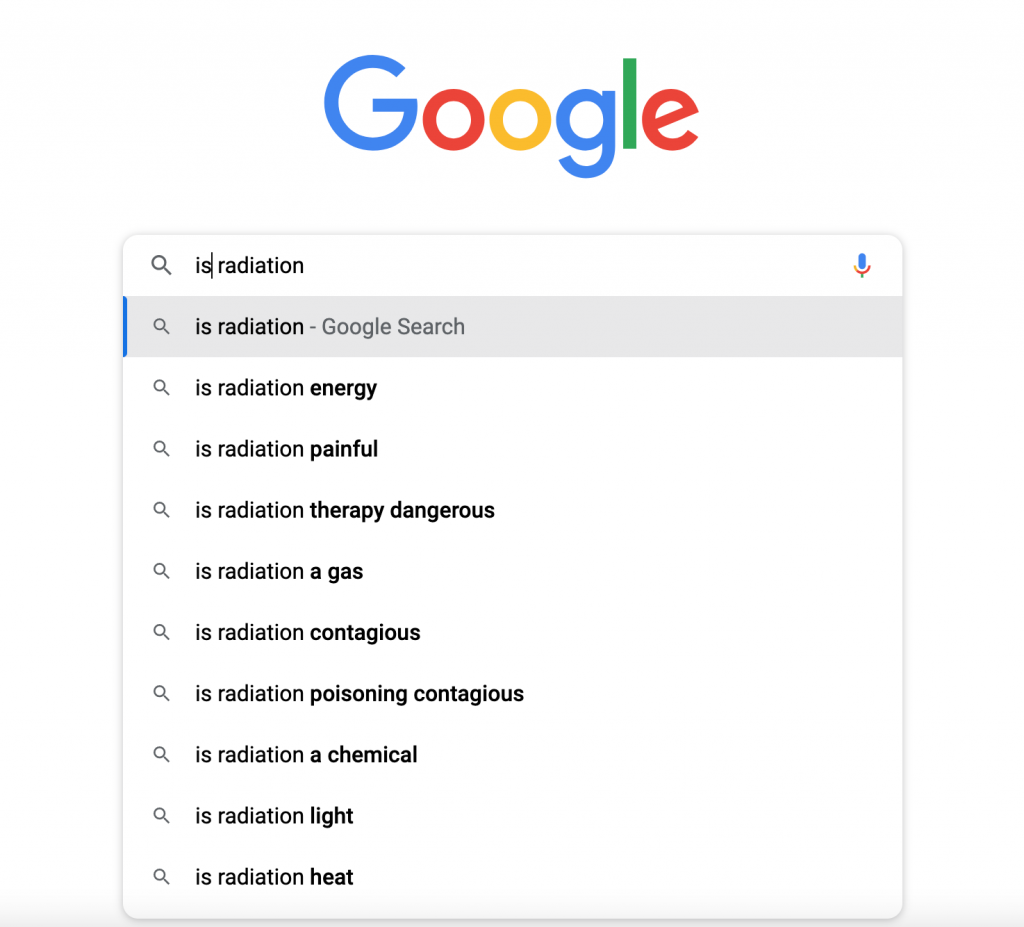
I really resonate with Melissa’s question about bias. Misinformation and bias relate quite closely to regulatory capture that I am investigating in my own research. I work in the nuclear industry and if I do the same search that Caulfield (2017) mentioned, but starting with ‘is radiation’, I get Figure 1:

Figure 1. Google search for ‘is radiation’. Houldsworth, 2022.

His solution to combat misinformation with info-environmentalism is a good one, I think. As experts in our fields, we can combat online misinformation with the concrete examples he gave; updating Wikipedia, posting factual information, and answering questions on fora (Caulfield, 2017).

I want to take this to my own project and consciously work to spread factual information in an effort to combat the misinformation that is so prevalent.

References:

526.1.3 – Team Blog – Ben’s Blog. (18 April, 2022 From https://malat-webspace.royalroads.ca/rru0206/2022-04-18/

Caulfield. (23 October, 2017) Info-Environmentalism: An Introduction. From https://er.educause.edu/articles/2017/10/info-environmentalism-an-introduction