

What I Want to Do Next…

This question feels like, “what do you want to be when you grow up?” I really love the thought of opportunities, but it is a question that feels overwhelming as well. There are a lot of possibilities for future dissemination and continuing research, and I would really like to explore two of them.

I have applied to participate in an International Atomic Energy (IAEA) group on the newly developed International Nuclear Management Academy (INMA) Master’s Programme in Nuclear Technology Management technical report. The INMA is a part of the IAEA that is supporting universities in developing their own master’s programmes in nuclear technology management. Here in Canada, there are very few nuclear engineering programmes and currently no nuclear technology management programmes. The IAEA community identified a gap in graduate-level nuclear management programmes. Traditional Master of Business Administration (MBA) programmes were not found to be specific enough and pure nuclear engineering programmes were seen as being too technical. I have contacts at both the Nuclear Engineering program and the Educational Informatics Lab (EILab) at the University of Ontario Institute of Technology (UOIT) and have set up meetings to discuss working with them to do research on the career development of nuclear professionals using advanced technologies and hopefully be involved somehow in the development of a nuclear technology master’s programme in Canada. This ties in my research idea about transfer of tacit knowledge from imminently retiring nuclear specialists

The second target for dissemination of my research are the global Radiation Protection (RP), Disruptive, Innovative, and Emerging Technologies (DIET) and Human Factors (HF) communities various conferences. The nuclear industry generates a vast amount of data from everything from the various aspects of the nuclear fuel cycle, management systems, nuclear power plant operation, and incidents. The RP community is often interested in using this data to improve radiation safety communication and RP methods. The HF community is often interested in using this data to reduce incidents and to enhance training programs. The DIET community is often interested in using this data to develop training using technology like Artificial Intelligence (AI) and Extended Reality (XR) technologies such as Virtual Reality (VR) and Augmented Reality (AR). My research could be disseminated as a presentation or paper at next year’s DigiDecom conference or CNS’ DIET conference. For this year’s CNS DIET conference, the requirement to present was to develop a presentation and did not require the publication of a paper. Next year’s Canadian Radiation Protection Association’s (CRPA) conference is in Halifax, Nova Scotia. I could also present a paper and/or a presentation at that conference. A short paper would be required, along with the development of a presentation. Participation in a panel discussion is another option that sometimes happens at CRPA conferences.

Both education research and conference participation are very interesting to me and would provide years’ worth of research and teaching opportunities.

Extended Reality Introduction

On this Easter weekend, with family visiting from France and my mother in isolation due to rising COVID cases in her community, I’ve struggled to meet these deadlines. I’m here now though and have just realized as I write this that I have been using our chosen technology for a while.

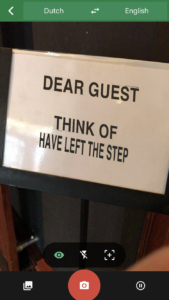
The issue that we are interested in exploring is Augmented Reality (AR) in education. The technology sounds amazing and has a lot of promise, but like a lot of technology, there are downsides, or rather risks that need to be managed. My experience with AR so far is limited to work travel. I traveled to The Netherlands in 2019 for work. I speak absolutely no Dutch, so I downloaded the Dutch language package for Google Translate on my cell phone. Some of the translations were a little off, as this warning about a step down in a hotel restaurant shows (Figure 1).

Figure 1. Warning in hotel restaurant. Houldsworth, 2019.

What I learned from other translations was deeper, as shown by this poster in the Resistance Museum. I invite readers to use their own application, whether Google Translate or a different one, to translate this happy family image and let me know your thoughts on its intent.

Figure 2. World War 2 German propaganda poster. Verzetsmuseum Amsterdam, taken 2019.

The ability of a machine to communicate powerful ideas in live time intrigued me. At the same time, the strange translations showed me that the technology is only as good as its inputs. When I helped my in-laws download the same application this weekend so that they can be more independent as they travel around our very anglophone town, the looks on their faces as they realized the power of the application was tempered by the privacy warnings that Google includes when the user gives permission to save conversations and photo translations.

Ostensibly, Google wants to improve its translations and algorithms, but with that comes the need to allow Google access to users’ searches to provide training for the algorithm. Depending on what the user inputs, Google potentially has access to some very private information. Hotly debated in whether a massive company like Google, with such huge market share, is fairly using users’ data and providing equitable results (Cossiavelou, 2018). Also risky is the quality of translation when the application is used for critical instructions. According to one paper, “Google Translate has only 57.7% accuracy when used for medical phrase translations” (Patil & Davies, 2014), which leads us to conclude that machine translations are not yet as good as or better than human translators.

Our team, the Extendables, have decided to choose Augmented Reality (AR), or rather Extended Reality (ER) (hence the team name!), for our learning event and delivery technology. Our group chose a relatively new application called Jigspace that was created by an Australian duo in 2014. Since then, Jigspace has developed quite a few impressive networks using their technology, most recently with Alfa Romeo. Jigspace wants users to be able to create a team with which creators can share 3D information. The paid version of the software uses uploaded Computer Aided Design (CAD) files, common in design and manufacturing, to render 3D images that the application can project onto a camera’s viewer. The images projected wind up looking very much like Pokémon GO images,but instead of cartoon monsters, users can explore how a toaster works, or how an Alfa Romeo Formula 1 (F1) racecar works. A recent software update has also added sound files so that users can hear how the Jig, as the output is called, sounds. I look forward to exploring more about Jigspace’s evolution, its current uses, and its future plans, as well as trying to exploit its weaknesses.

References:

Cossiavelou, V. (2018). Global Regulations in Content Industries: The Google Privacy Policy as a News Gatekeeping Factor. International Journal of Interdisciplinary Telecommunications and Networking, 10(3), 9–20. https://doi.org/10.4018/IJITN.2018070102

Patil, S., & Davies, P. (2014). Use of Google Translate in medical communication: Evaluation of accuracy. BMJ, 349(dec15 2), g7392–g7392. https://doi.org/10.1136/bmj.g7392

Team posts:

Paula: https://malat-webspace.royalroads.ca/rru0221/investigating-the-reality-of-virtual-reality/

Zac: https://malat-webspace.royalroads.ca/rru0226/lrnt-526-%e2%94%82extendable-team1-activity-3-on-jigspace/

Katia: https://malat-webspace.royalroads.ca/rru0213/activity-3-individual-blog-post-specific-issue-exploration/