On this Easter weekend, with family visiting from France and my mother in isolation due to rising COVID cases in her community, I’ve struggled to meet these deadlines. I’m here now though and have just realized as I write this that I have been using our chosen technology for a while.
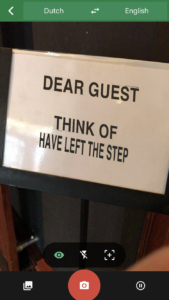
The issue that we are interested in exploring is Augmented Reality (AR) in education. The technology sounds amazing and has a lot of promise, but like a lot of technology, there are downsides, or rather risks that need to be managed. My experience with AR so far is limited to work travel. I traveled to The Netherlands in 2019 for work. I speak absolutely no Dutch, so I downloaded the Dutch language package for Google Translate on my cell phone. Some of the translations were a little off, as this warning about a step down in a hotel restaurant shows (Figure 1).

Figure 1. Warning in hotel restaurant. Houldsworth, 2019.
What I learned from other translations was deeper, as shown by this poster in the Resistance Museum. I invite readers to use their own application, whether Google Translate or a different one, to translate this happy family image and let me know your thoughts on its intent.
Figure 2. World War 2 German propaganda poster. Verzetsmuseum Amsterdam, taken 2019.
The ability of a machine to communicate powerful ideas in live time intrigued me. At the same time, the strange translations showed me that the technology is only as good as its inputs. When I helped my in-laws download the same application this weekend so that they can be more independent as they travel around our very anglophone town, the looks on their faces as they realized the power of the application was tempered by the privacy warnings that Google includes when the user gives permission to save conversations and photo translations.
Ostensibly, Google wants to improve its translations and algorithms, but with that comes the need to allow Google access to users’ searches to provide training for the algorithm. Depending on what the user inputs, Google potentially has access to some very private information. Hotly debated in whether a massive company like Google, with such huge market share, is fairly using users’ data and providing equitable results (Cossiavelou, 2018). Also risky is the quality of translation when the application is used for critical instructions. According to one paper, “Google Translate has only 57.7% accuracy when used for medical phrase translations” (Patil & Davies, 2014), which leads us to conclude that machine translations are not yet as good as or better than human translators.
Our team, the Extendables, have decided to choose Augmented Reality (AR), or rather Extended Reality (ER) (hence the team name!), for our learning event and delivery technology. Our group chose a relatively new application called Jigspace that was created by an Australian duo in 2014. Since then, Jigspace has developed quite a few impressive networks using their technology, most recently with Alfa Romeo. Jigspace wants users to be able to create a team with which creators can share 3D information. The paid version of the software uses uploaded Computer Aided Design (CAD) files, common in design and manufacturing, to render 3D images that the application can project onto a camera’s viewer. The images projected wind up looking very much like Pokémon GO images,but instead of cartoon monsters, users can explore how a toaster works, or how an Alfa Romeo Formula 1 (F1) racecar works. A recent software update has also added sound files so that users can hear how the Jig, as the output is called, sounds. I look forward to exploring more about Jigspace’s evolution, its current uses, and its future plans, as well as trying to exploit its weaknesses.
References:
Cossiavelou, V. (2018). Global Regulations in Content Industries: The Google Privacy Policy as a News Gatekeeping Factor. International Journal of Interdisciplinary Telecommunications and Networking, 10(3), 9–20. https://doi.org/10.4018/IJITN.2018070102
Patil, S., & Davies, P. (2014). Use of Google Translate in medical communication: Evaluation of accuracy. BMJ, 349(dec15 2), g7392–g7392. https://doi.org/10.1136/bmj.g7392
Team posts:
Paula: https://malat-webspace.royalroads.ca/rru0221/investigating-the-reality-of-virtual-reality/
Zac: https://malat-webspace.royalroads.ca/rru0226/lrnt-526-%e2%94%82extendable-team1-activity-3-on-jigspace/
Katia: https://malat-webspace.royalroads.ca/rru0213/activity-3-individual-blog-post-specific-issue-exploration/