
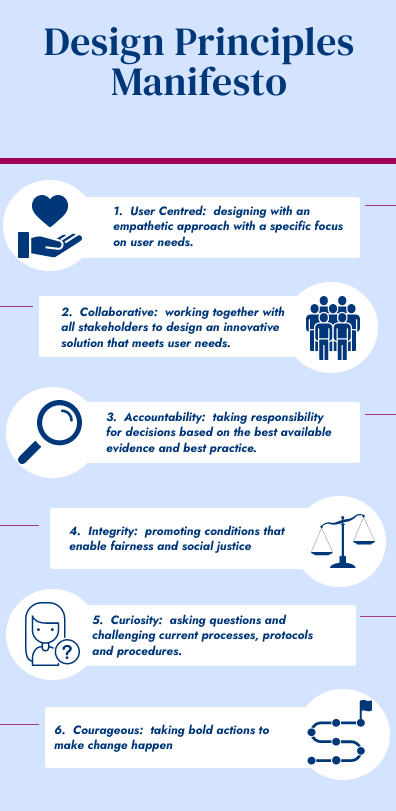
Design Principles Manifesto

As I was preparing to create my design principles, I made the conscious decision to ensure they closely aligned with my dental hygiene practice philosophy. My dental hygiene practice philosophy consists of core personal values and a code of ethics which has only been strengthened over time and practice. After taking some time to reflect over the past nine weeks, I created six design principles to guide my design and innovation process which not only intertwines with my practice philosophy but also has broadened the scope of my practice philosophy.

References

Brown, A. H., & Green, T. D. (2018). Beyond teaching instructional design models: exploring the  design process to advance professional development and expertise. Journal of Computing in Higher Education, 30(1), 176-186.

Canadian Dental Hygienists Association. (2012). Dental hygienists’ code of ethics. https://www.cdha.ca/pdfs/Profession/Resources/Code_of_Ethics_EN_web.pdf

Morris, S. M. (2018). Critical Instructional Design. In An Urgency of Teachers. Pressbooks. https://criticaldigitalpedagogy.pressbooks.com/chapter/critical-pedagogy-and-learning-online/

Stefaniak, J. E. (2021). Documenting Instructional Design Decisions. Design for Learning.

Proposed Design Solution / by Cook and Yee

As part of our design thinking process, we defined our problem statement as:  Gail needs a way to support Indigenous families in learning about good oral health because of the health risks to children and to help build capacity in communities.

We selected the idea of an oral health story contest as our solution to build, as for us, this solution holds the most potential to align with a critical instructional approach whereby users (children) are encouraged to co-create instructional content by partnering with other students, and by using various modes of representation, understandings, and languages as aligned with Universal Design for Learning (UDL) principles (CAST, 2021; Rogers-Shaw et al., 2018). As Morris (2018) argued, critical instruction design “aims for the fullest inclusion possible” (para. 24).

As parents, we have experienced how our own children love to have agency over their own learning and often enjoy instructing others. We imagined a multidisciplinary approach, whereby the stories shared, and lessons learned might be a collaborative arts-based process, for example, by partnering dental hygiene students with students and schoolteachers in science, music, or language classes.

Partnering with schools also hopefully addresses possible barriers to connectivity, with reliable Wi-Fi and computers on site. We also envisioned gathering oral health stories in an open platform (with consultation), to be shared with other health care professionals, parents, caregivers, and children, and other community stakeholders can help to increase capacity, and with an upstream wellness approach.  

We created the following infographic using Piktochart to illustrate our prototype and look forward to questions and feedback for further iterations.

References

CAST (2021). Universal Design for Learning Guidelines version 2.2. http://udlguidelines.cast.org 

Morris, S. M. (2018). Critical Instructional Design. In An Urgency of Teachers. Pressbooks. https://criticaldigitalpedagogy.pressbooks.com/chapter/critical-pedagogy-and-learning-online/ 

Rogers-Shaw, C., Carr-Chellman, D. J., & Choi, J. (2018). Universal design for learning: Guidelines for accessible online instruction. Adult learning, 29(1), 20-31. https://doi.org/10.1177%2F1045159517735530