Photo by Vie Studio: https://www.pexels.com/photo/crumpled-brown-paper-on-pink-surface-7006366/
It has been almost two months since I posted some thoughts, questions and a metaphor about facilitation in digital environments. With regards to my initial thoughts, I would say that my views have remained the same and in some cases have only been reinforced due to my recent experiences in facilitation in a digital learning environment.
In the case of never making assumptions about things being clear, I would wholeheartedly agree with this point based on a recent experience and that has led me to gain a better understanding of the importance of check-ins with learners for feedback and to see where they are at. Are they having challenges? Do they need support? As mentioned, there are no gestures, no body language or non-verbals in a digital learning environment so regular check-ins can help offer insight into learners.
Unplanned issues arise in a digital learning environment and so it is critical to ensure that you have a back up plan on hand or be prepared to pivot as needed. I have learned that sometimes when things go sideways, there is always a simple solution; you just need to be creative.
I mentioned in my post the importance of balance of synchronous and asynchronous but establishing a community to support learners is key. When learners feel connected and supported, they are more likely to take risks. Sometimes those risks may be unexpected but they can be rewarding for all involved.
With regards to my questions about digital facilitation, I recognise the value of establishing social presence and teaching presence to build community in a digital environment. When learners feel connected, this increases the likelihood of openness which leads to collaboration. Teaching presence specifically the design and organisation will help learners understand what is expected and minimise confusion thereby keeping learners engaged.
Photo by Pixabay: https://www.pexels.com/photo/black-tree-near-body-of-water-35796/
This week I got the opportunity to annotate an article using Hypothes.is and attempted to lean into the experience of openness while gaining a better understanding of the challenges facing educators who are looking to embrace openness. There was a learning curve to using Hypothes.is as it was not as straightforward as I would have liked it to be and may have tainted my openness experience.
The article left me with questions about how openness could be integrated into my field where there are longstanding existing hierarchies which are resistant to change. I believe there may be opportunities where openness could be integrated but there needs to be a team of change agents who embrace openness to begin the change.
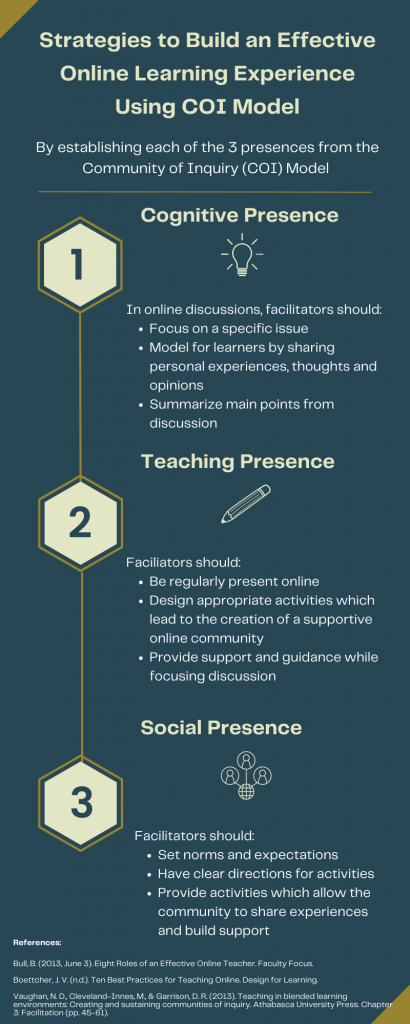
This infographic was created based on my reflection of a previous online training session for oral health professionals I facilitated last year. Although the calibration and information training session went well based on feedback from the team; there are always areas for improvement moving forward. Using Garrison & Anderson’s Community of Inquiry (COI) Model and this lens, I have listed some strategies facilitators can utilize when leading this type of session with this group of learners.
Working with a diverse group of learners from various training backgrounds and experiences, it is important to identify a specific issue for the team to focus on while providing some context as some team members may not have any prior experience, knowledge or training. In addition, the facilitator needs to model for the team by sharing personal experiences as the facilitator may have a different perspective from the team based on their role and responsibilities. It is for this reason that the facilitator must indicate to the team that they are a co-learner in the discussion and actively listen to the various perspectives within the team. To close the discussion, I believe that it benefits the team when the main points from the discussion are summarized and disseminated to the team. I have selected these strategies based on the Tour Guide role from Bull’s (2013) article where the tour guide “directs and redirects the attention of learners toward key concepts and ideas” (para 2).
To establish a teaching presence, the team needs to know that the facilitator is regularly present online and available to provide support as needed. The facilitator needs to design appropriate activities which engage the team yet allow them to feel supported. For example, an activity to calibrate the team involves ensuring that the dental images used clearly indicate a specific dental condition and allow individual team members to provide their answer anonymously, such as a poll. When a discrepancy occurs, the facilitator needs to provide guidance and lead the team to an agreed upon final conclusion. Boettcher’s (n.d.) article on 10 best practices for teaching online influenced my strategies for teaching presence especially best practice 2: create a supportive online course community.
Lastly is social presence, a facilitator needs to communicate set norms and expectations to the team; ensure the team knows the schedule, directions for the activities and have activities which help build the community. Building the community is essential for getting the group to feel safe and supported in order to engage in discussion. This aligns with Vaughan et al. (2013) principle of establishing community and cohesion for social presence. For example, I scheduled time for an elder to open with a prayer and to set our intentions. As well, I had an icebreaker to allow those new to the team to meet and introduce themselves and finally there was an activity to close the session in a good way. The elder returned to close with a prayer and led us in a song which helped to strengthen the bonds of the learning community. These activities instilled a sense of community which was conveyed by the team. They were surprised at how connected they felt even though they were not physically together.
References
Boettcher, J. V. (n.d.). Ten Best Practices for Teaching Online. Design for Learning. http://designingforlearning.info/writing/ten-best-practices-for-teaching-online/
Bull, B. (2013, June 3). Eight roles of an effective online teacher. Faculty Focus. https://www.facultyfocus.com/articles/online-education/online-course-delivery-and-instruction/eight-roles-of-an-effective-online-teacher/
Vaughan, N. D., Cleveland-Innes, M., & Garrison, D. R. (2013). Teaching in blended learning environments: Creating and sustaining communities of inquiry. Athabasca University Press. Chapter 3: Facilitation (pp. 45-61).
3 Initial thoughts about facilitation in digital environments:
One can never make assumptions that everything is clear to the user/learner. Unlike face-to-face environments, there are no gestures, no body language or nonverbal signals to give the facilitator insight into their users in a digital environment. For this reason, regular check-ins may assist the facilitator with gaining insight into their learners.
Digital environments come with their own unique challenges and facilitators need to be able to adjust, adapt and pivot as needed when unplanned issues arise.
There should be a balance of synchronous and asynchronous in order to create a community where learners feel connected and supported. Without this some learners may feel they are alone and flying blind.
2 Questions about digital facilitation:
What are some proven strategies that help to build community and strengthen connections in a digital environment? And strategies to ensure that the connections do not start to waver midway through a course or program?
What are some strategies to help support and motivate learners in a digital environment that are different from face-to-face?
1 Metaphor about Digital Facilitation
Photo by Jean-Christophe André: https://www.pexels.com/photo/iceberg-2574997/
In the dental world, we often use the metaphor of the iceberg to describe dental issues to clients. Common dental issues may present with little to no symptoms which may give them a false sense of security that everything is great but underneath there may be something more serious happening. When the dental issue becomes serious, it can no longer be ignored.
I believe this metaphor can be applied to how I perceive digital facilitation at this time; all may look smooth above water but a digital facilitator needs to be aware and checking for potential issues under the water.