Assignment 1 | Infographic

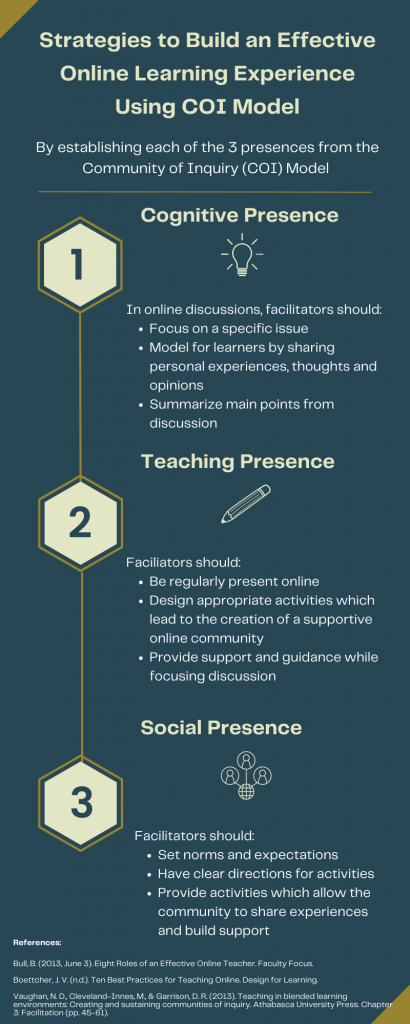
This infographic was created based on my reflection of a previous online training session for oral health professionals I facilitated last year. Although the calibration and information training session went well based on feedback from the team; there are always areas for improvement moving forward. Using Garrison & Anderson’s Community of Inquiry (COI) Model and this lens, I have listed some strategies facilitators can utilize when leading this type of session with this group of learners.

Working with a diverse group of learners from various training backgrounds and experiences, it is important to identify a specific issue for the team to focus on while providing some context as some team members may not have any prior experience, knowledge or training. In addition, the facilitator needs to model for the team by sharing personal experiences as the facilitator may have a different perspective from the team based on their role and responsibilities. It is for this reason that the facilitator must indicate to the team that they are a co-learner in the discussion and actively listen to the various perspectives within the team. To close the discussion, I believe that it benefits the team when the main points from the discussion are summarized and disseminated to the team. I have selected these strategies based on the Tour Guide role from Bull’s (2013) article where the tour guide “directs and redirects the attention of learners toward key concepts and ideas” (para 2).

To establish a teaching presence, the team needs to know that the facilitator is regularly present online and available to provide support as needed. The facilitator needs to design appropriate activities which engage the team yet allow them to feel supported. For example, an activity to calibrate the team involves ensuring that the dental images used clearly indicate a specific dental condition and allow individual team members to provide their answer anonymously, such as a poll. When a discrepancy occurs, the facilitator needs to provide guidance and lead the team to an agreed upon final conclusion. Boettcher’s (n.d.) article on 10 best practices for teaching online influenced my strategies for teaching presence especially best practice 2: create a supportive online course community.

Lastly is social presence, a facilitator needs to communicate set norms and expectations to the team; ensure the team knows the schedule, directions for the activities and have activities which help build the community. Building the community is essential for getting the group to feel safe and supported in order to engage in discussion. This aligns with Vaughan et al. (2013) principle of establishing community and cohesion for social presence. For example, I scheduled time for an elder to open with a prayer and to set our intentions. As well, I had an icebreaker to allow those new to the team to meet and introduce themselves and finally there was an activity to close the session in a good way. The elder returned to close with a prayer and led us in a song which helped to strengthen the bonds of the learning community. These activities instilled a sense of community which was conveyed by the team. They were surprised at how connected they felt even though they were not physically together.

References

Boettcher, J. V. (n.d.). Ten Best Practices for Teaching Online. Design for Learning. http://designingforlearning.info/writing/ten-best-practices-for-teaching-online/

Bull, B. (2013, June 3). Eight roles of an effective online teacher. Faculty Focus. https://www.facultyfocus.com/articles/online-education/online-course-delivery-and-instruction/eight-roles-of-an-effective-online-teacher/

Vaughan, N. D., Cleveland-Innes, M., & Garrison, D. R. (2013). Teaching in blended learning environments: Creating and sustaining communities of inquiry. Athabasca University Press. Chapter 3: Facilitation (pp. 45-61).

Activity 1-4 | 3-2-1

3 Initial thoughts about facilitation in digital environments:

  1. One can never make assumptions that everything is clear to the user/learner.  Unlike face-to-face environments, there are no gestures, no body language or nonverbal signals to give the facilitator insight into their users in a digital environment.  For this reason, regular check-ins may assist the facilitator with gaining insight into their learners.  
  2. Digital environments come with their own unique challenges and facilitators need to be able to adjust, adapt and pivot as needed when unplanned issues arise.
  3. There should be a balance of synchronous and asynchronous in order to create a community where learners feel connected and supported.  Without this some learners may feel they are alone and flying blind. 

2 Questions about digital facilitation:

  1. What are some proven strategies that help to build community and strengthen connections in a digital environment?  And strategies to ensure that the connections do not start to waver midway through a course or program?
  2. What are some strategies to help support and motivate learners in a digital environment that are different from face-to-face? 

1 Metaphor about Digital Facilitation

Photo by Jean-Christophe André: https://www.pexels.com/photo/iceberg-2574997/

In the dental world, we often use the metaphor of the iceberg to describe dental issues to clients. Common dental issues may present with little to no symptoms which may give them a false sense of security that everything is great but underneath there may be something more serious happening. When the dental issue becomes serious, it can no longer be ignored.

I believe this metaphor can be applied to how I perceive digital facilitation at this time; all may look smooth above water but a digital facilitator needs to be aware and checking for potential issues under the water.

Unit 2 Activity 1: Reflection

Photo by Lum3n: https://www.pexels.com/photo/close-up-of-photo-of-books-327882/

It has now been a little over one month since Team 5 began exploring and researching podcasts.  During which, I have been looking at the research, exchanging and discussing findings with fellow team members and listening to our chosen podcast. I recognise the value which podcasts bring to mobile learning and storytelling. In addition, there are little to no barriers to starting up a podcast therefore giving anyone a platform to share their opinions and thoughts.  As well, I have discovered that podcasts have the ability to form communities of people with shared interests or views and podcasters have the ability to connect with their listeners and vice versa through social media.

Through my research, I have been exploring the spread of misinformation over podcasts with a focus on public health (PH) issues such as vaccines and the coronavirus.  My topic was triggered by events from earlier this year.  With the formation of these tight podcast communities, research shows that listeners will continue to have their opinions and views reinforced while avoiding information or messaging that counter their views (Del Vicario et al., 2016; Collier, 2018).  I was curious to learn how PH can combat misinformation and what strategies could they apply to share their stories via podcasts?  

In a podcast interview with Dr. Bauchner (2021), Dr. Merchant declared that misinformation is a public health crisis (20:32). Merchant et al. (2021) went on to express that PH needs to meet people where they are at by connecting with them through the information networks and devices they use on a daily basis.  Research has suggested leveraging digital tools such as podcasts and other social media platforms to engage with the public by communicating key PH messages and interventions (Kass-Hout & Alhinnawi, 2013; Merchant et al., 2021. These new digital tools such as podcasts have been shown to disseminate information faster to communities vs. the traditional methods of television, newspaper or billboards.   

From my research, I have discovered some mitigation strategies which PH can implement to combat misinformation.  I particularly like the suggestion of partnering with trusted community influencers (podcasters) who can help with communicating key messages and correct misinformation among their listeners (Merchant, 2021). With these partnerships, PH can learn to construct messages more personalised to the unique needs of the community ensuring they will reach more people and be better received.  I believe that leveraging podcasts’ ability to learn anytime, anywhere with public health’s desire to meet people where they are at has the potential to be another successful way to communicate key messaging to the public along with other social media platforms. I would like to continue researching for further examples of PH using this partnership to disseminate information to the public via social media/podcasts.

References

Bauchner, H. (Host). (2021, January 4). Public health messaging in an era of social media [Audio podcast episode]. In Conversations with Dr Bauchner. AMA Ed Hub. https://edhub.ama-assn.org/jn-learning/audio-player/18577488

Collier, R. (2018). Containing health myths in the age of viral misinformation. Cmaj, 190(19), E578-E578.

Del Vicario, M., Bessi, A., Zollo, F., Petroni, F., Scala, A., Caldarelli, G., Stanley, H.E., & Quattrociocchi, W. (2016). The spreading of misinformation online. Proceedings of the National Academy of Sciences, 113(3), 554-559.

Kass-Hout, T. A., & Alhinnawi, H. (2013). Social media in public health. British medical bulletin, 108(1).

Merchant, R. M., South, E. C., & Lurie, N. (2021). Public health messaging in an era of social media. Jama, 325(3), 223-224.

Rodriguez, L., Chan, J., Donahue, A., Pokiak, M., & Yee, G. (2022, April 15). Team 5’s venture into the World of Podcasts. Luis Rodriguez: A Student Blog | MALAT 2021-2023. https://malat-webspace.royalroads.ca/rru0216/team-5s-venture-into-the-world-of-podcasts/

Activity 3: Leadership Reflections

Photo by Anna Tarazevich from Pexels

In an ever changing world, leaders have to be quick to adapt to changing landscapes especially in digital learning environments (DLEs) which are dynamic and often involve multiple stakeholders at various levels.  For this reason, I believe in order for a leader to be successful working in a DLE, they require these three attributes:  inspiring, strategic or forward-looking and possess effective communication skills.  Intertwining these three skills will allow the leader to mobilize their stakeholders and/or followers, plan and make decisions accordingly and build capacity.

Inspiring has always been at the top of my list of attributes of leadership which is consistent with the findings from Kouzes & Posner’s (2011) research; inspiring consistently ranked among the top 4 attributes over the years and globally (p. 5).  Reflecting on my experience of working for an organization where transformational change was the driving force in achieving the organization’s vision gave me insight into how valuable this leadership attribute is at motivating workers and ensuring that everyone’s work aligns with the organization’s values.  Leaders were passionate when presenting the Gantt charts and action plans to staff and stakeholders while providing regular updates on our progress and timelines in achieving the goal. Their optimistic, positive energy made it easy to aspire to the work.  I believe that working in a DLE, a leader would need to be able to convey their passion and commitment to the work and vision.  

The LEADS framework is a leadership capabilities framework which guides much of my work and under the Systems Transformation heading of this framework, it states “leaders demonstrate systems/critical thinking and orient themselves strategically to the future” (Canadian College of Health Leaders, 2021).  For this reason, I believe leaders working in a DLE need to be strategic planners or forward-looking with the ability to see the “big picture”.  They need to be prepared for anything and everything that comes their way while providing the necessary support, resources and tools their followers may require to continue to align their work with the vision.  Effective leaders require the ability to predict potential conflicts or challenges which may affect the vision.  It is this ability to look ahead which allows them to be prepared to address challenges or conflicts by formulating possible solutions to address them.  In addition, because they are able to see the whole picture and communicate effectively with the various stakeholders, they can make a well-informed decision in which all the stakeholders’ cases have been taken into consideration; no crucial information is missing.  This attribute is essential for a leader working in a dynamic environment in order to be able to deliver results.

Lastly, Sheninger (2019), lists communication as one of the seven pillars of digital leaders in education and states, “digital leadership is about engaging all stakeholders in two-way communication” (p. 2).  A leader needs to be an effective communicator to engage stakeholders so that there will be “buy in” with the vision by gaining a better understanding of how it benefits them. This attribute is also highlighted by the LEADS framework (2021) and includes the leader’s ability to listen well while creating an environment where there is an open exchange of information and ideas. This in turn leads to team building where there is collaboration and cooperation towards achieving the desired results.  As stated above, good effective communication ensures that all factors are considered before a leader makes a decision.  For these reasons, I believe that communication is a necessary attribute for a leader working in a DLE to build the necessary relationships.

In closing, the following three attributes: inspiring, forward-thinking and an effective communicator are necessary for a leader working in a DLE to possess in order to achieve success in a dynamic environment with multiple stakeholders at various levels.  

References

Canadian College of Health Leaders. (n.d.). LEADS Framework. https://www.leadscanada.net/site/about/about-us/framework?nav=sidebar

Kouzes, J. M., & Posner, B. Z. (2011). Credibility: How leaders gain and lose it, why people demand it (Vol. 203). John Wiley & Sons.

Sheninger, E. (2014). Pillars of digital leadership. International Center for Leadership in Education, 1(4).

Activity 1: Tools, Roles and Superpowers

As a Dental Hygiene Practitioner, I wear multiple hats and continue to undertake things which my dental hygiene education program never prepared me for. I have created this infographic to illustrate a couple of my superpowers.

At the top is an ear to illustrate that any point of contact with any client or program stakeholder is entered with cultural safety and humility meaning that I listen respectfully without judgement. My role in public health is not only about addressing issues in the mouth but also addressing other issues clients may face which impacts their oral health; money and access being the biggest barriers. From there, I take all the information gathered to create a plan which addresses the client’s or stakeholders’ concerns which encompasses critical thinking and decision making as I do not believe in a one size fits all approach. Lastly, I ensure discussion and agreement with clients and stakeholders.

In addition to creating a safe space, three of my superpowers are problem-solver, collaborator and health promoter. The pandemic has forced public health dental programs to harness technology in creative and innovative ways in order to pivot face-to-face points of contact for oral health conversations. Using technology for Zoom video calls for 1:1s or group oral health sessions, webinars for potential stakeholders to better understand the importance of oral health for overall health and proposing collaboration opportunities for stakeholders. Using social media to connect with FaceBook storytime video sessions, posting videos from dental professionals about the importance of tooth brushing, and posting photos of children brushing their teeth to participate in a tooth brushing contest.

Recently, I have been able to utilize the in house mobile video interpreter to communicate with clients in their native language while educating them about the importance of oral health. In other cases, when technology is not available or accessible, I have added printed oral health resources into oral health care packages which are distributed within communities. In my day-to-day work, I am often problem solving by asking questions, leveraging my relationships and raising the oral health profile in search for possible solutions.

Morgan (2019) describes the role of instructional designers as complex with some seeing the role of Instructional Designers as change agents (Campbell et al., 2009 as cited in Morgan 2019). This point resonated with me as dental hygienists are change agents who advocate for marginalized groups while challenging and pushing boundaries; they are not solely “gum gardeners” or “teeth cleaners”. My work allows me to harness these superpowers with the reward of seeing a child’s happy, healthy smile.

References

First Nations Health Authority. (n.d.) Cultural safety and humility.
https://www.fnha.ca/wellness/wellness-and-the-first-nations-health-authority/cultural-safety-and-humility

Morgan, T. (2019). Instructional Designers and Open Education Practices: Negotiating the Gap between Intentional and Operational Agency. Open Praxis, 11(4), 369-380.


Selecting Design Models

There are many factors to take into consideration when selecting a design model.  I have chosen to highlight the following 3 factors:

      1. Instructional Designers personal opinions
      2. Learning Objectives and outcomes
      3. Learners’ needs 

“Technology is created with the developers’ world views, values, beliefs, and assumptions embedded into its design.  These worldviews are revealed through the activities supported and encouraged by the technology” (Veletsianos, 2016, p. 253).  Past experiences of learning designers has the potential to form biases and preferential tendencies of certain design models.  Some instructional designers may continue to utilise a particular design model because of comfort level or avoid others because of negative past experiences.  By doing so, they may not be selecting the most suitable design model to address the needs of the instructional design project. According to Dousay (2018), “…popularity serves as a form of validation for these design models, but a wise instructional designer knows when to use, adapt, or create a new model of instructional design to fit their purposes” (para. 10).  

Learning objectives, goals and outcomes should be taken into consideration when selecting a design model.  One of the most recognised and utilised design models is ADDIE.  Bates (2015), attributes the success of ADDIE to “…good quality design, with clear learning objectives, carefully structured content,…and assessment strongly tied to desired learning outcomes” (para. 11).  Within the Analyse and Design phases of the ADDIE model, the learning objectives, goals and outcomes are identified and addressed, then incorporated into the Develop phase.  For anyone entering the field of instructional design, ADDIE’s linear and step by step method will ensure the desired end outcomes or the results and feedback from the Evaluation phase will feed into the next iteration of the project.

Learners’ needs and preferences will influence which design model to use.  In a quickly changing world, learners’ need to quickly adapt and learn the necessary skills or information for school or for work.  Bates (2015) points out that the agile design model has the capability to help students develop the necessary specific skills needed in the digital age while maintaining a focus on preparing students for the rapidly changing world.  Whereas the ADDIE model known for working best with large and complex projects may not be able to adapt as quickly to learners’ needs.  Therefore some design models may be better able to accommodate learners’ needs.  

At this time, I have not had experience with making these design model decisions.  However, upon learning more design models and the variety that exists, I may want to gravitate towards the industry standard and use the ADDIE model while keeping in mind its limitations. 

References:

Bates, T. (2015). Chapter 4.3 The ADDIE Model and Chapter 4.7 ‘Agile’ Design: flexible designs for learning. In Teaching in the digital age. BCcampus. 

Dousay. T. A. (2017). Chapter 22. Instructional Design Models. In R. West (Ed.), Foundations of Learning and Instructional Design Technology (1st ed.).

Veletsianos, G. (2016). Digital learning environments. In N. Rushby & D. Surry (Eds), Handbook of Learning Technologies (pp. 242-260). UK: John Wiley & Sons.

Assignment 3: Learning Analytics and Dental Education in 2030

The COVID-19 pandemic forced dental education programs which had traditionally only ever been taught via face-to-face to pivot quickly to online instruction in order to complete the 20/21 school year.  With this sudden shift to online learning, institutions re-evaluated the previously held notion that dental programs could never be taught online because students needed face-to-face instruction to develop the necessary competent clinical skills and communication skills to have close personal interactions with their patients.  

In 2030, blended or hybrid dental programs have become the norm allowing dental students increased flexibility to do a portion of their studies online.  However, moving to this model required learning institutions to rely on the steady, reliable nature of the Learning Management System (LMS) as described by Weller (2020) which led to the increased usage of learning analytics to inform decision making.  With learning analytics, Pelletier et al., (2021) explain that institutions were able to harness the data to respond to student needs early by identifying those who exhibited low engagement or did not perform well on early assessments.  By doing so, institutions were able to ensure that there was little to no attrition within cohorts. With the gathering of all this student data, issues arose of whether it was legal, ethical or both.  Zijlstra-Shaw & Stokes (2018) state, “the issue of what is essential data for tracking learner performance and what is data captured because it is available and might be useful in the future presents an issue for the ethical and informed use of student data” (p. 659).  By 2030, institutions had worked through some of the challenges faced early on with the push to blended or hybrid dental programs.

Although learning analytics has proven to be advantageous for the various stakeholders; ethical issues around transparency, data ownership and data interpretation had to be addressed when dental programs switched to a hybrid model.  Initially, there was little transparency and lack of understanding regarding data collection from stakeholders.  Pardo & Siemens (2014) argued that stakeholders should understand how the analytics process is carried out and stakeholders, specifically students should be informed of the type of information that is being collected; including how it is collected, stored, and processed.  By 2030, dental institutions had created and implemented the necessary policies, protocols and procedures which raised student awareness about data collection so that students were in a better position to give their informed consent to data collection.  With the increase in transparency along with better understanding, students were able to embrace and justify the use of learning analytics to their advantage by achieving their individual learning goals which in turn led to an increase in student retention in dental programs.  In addition, Prinsloo & Slade found that (as cited in Zijlstra-Shaw & Stokes, 2018, e659) student trust and cooperation could be gained when there was an increase in the transparency of learning analytic activities. 

Another challenge with learning analytics which needed to be addressed was the issue around ownership of the data. Pardo & Siemens (2014) proposed the student open model where transparency was increased because students were able to access and correct the data obtained about them.  Prinsloo & Slade (2013) stressed the importance that institutions should not be the sole player with decision making power when it came to determining the scope, the definition and the use of educational data for learning analytics.  Input from other stakeholders was required to make decisions. At one point early on in the shift to hybrid model, institutions considered that datasets could be collected from different dental schools and then pooled together for a larger dataset which could potentially be used for comparison purposes between provinces or countries.  However, with the new policies in place and input from stakeholders, dental institutions ensured students had control of their data which included the ability to correct their data and institutions in turn would guarantee that students’ data were not going to be given out or shared with other institutions. By 2030, dental institutions needed to ensure that there were no 3rd party collectors of data involved in order to maintain the trust of their students.  

A further challenge of learning analytics which had to be addressed by institutions was the interpretation of the data and the potential for profiling. In their study, Howell et al. (2018) reported concerns from academics regarding the potential to collect data which did not accurately reflect students’ activities.  If that were the case, then how would dental instructors respond to the inaccurate interpretations which could potentially lead to the damage of a student’s self-esteem based on the inaccurate data.  As well, early on many students were under the misapprehension that when their data was collected it was anonymous.  However, as Holloway (2020) highlighted that advanced algorithms were easily able to pull personal and demographic information about individuals whose data had been collected from the vast abundance of data available.  Institutions implemented policies which addressed both of these by taking the approach that more educational data did not always mean better educational data.  In addition, institutions reassured students that these types of algorithms were not in use and that their identities would remain private and secure as part of their consent. 

Learning analytics has proven to be advantageous for students, facilitators and institutions involved in hybrid dental programs in 2030.  For students, they are able to track their own progress through the dental program and make improvements in their performance based on the interpretations and analysis of their data.  Instructors are made aware of those dental students who are having challenges in the program and can review certain dental concepts if the data interpretation shows that students did not understand the concepts.  Finally, institutions are able to ensure that there is little to no student attrition in the cohort and make changes to their programs to maintain student engagement.  In order to gain acceptance from stakeholders, policies and protocols had to be created to address the challenges around transparency, data ownership and false interpretation of the data.

References

Holloway, K. (2020). Big Data and learning analytics in higher education: Legal and ethical considerations. Journal of Electronic Resources Librarianship, 32(4), 276-285.

Howell, J. A., Roberts, L. D., Seaman, K., & Gibson, D. C. (2018). Are we on our way to becoming a “helicopter university”? Academics’ views on learning analytics. Technology, Knowledge and Learning, 23(1), 1-20.

Pardo, A., & Siemens, G. (2014). Ethical and privacy principles for learning analytics. British Journal of Educational Technology, 45(3), 438-450.

Pelletier, K., Brown, M., Brooks, D. C., McCormack, M., Reeves, J., Arbino, N., Bozkurt, A., Crawford, S., Czerniewicz, L., Gibson, R., Linder, K., Mason, J., & Mondelli, V. (2021). 2021 EDUCAUSE Horizon Report Teaching and Learning Edition.

Prinsloo, P., & Slade, S. (2013, April). An evaluation of policy frameworks for addressing ethical considerations in learning analytics. In Proceedings of the third international conference on learning analytics and knowledge (pp. 240-244).

Siemens, G., & Long, P. (2011). Penetrating the fog: Analytics in learning and education. EDUCAUSE review, 46(5), 30.

Weller, M. (2018). Twenty years of EdTech. Educause Review Online, 53(4), 34-48.

Zijlstra-Shaw, S., & Stokes, C. W. (2018). Learning analytics and dental education; choices and challenges. European journal of dental education: official journal of the Association for Dental Education in Europe, 22(3), e658-e660. 

Thoughts about the Future

The COVID-19 pandemic forced dental programs which had only ever been face to face to quickly move to online instruction in order to complete the 20/21 school year.  With this sudden shift to online learning, institutions re-evaluated the previously held notion that dental programs could never be taught online because students needed face to face instruction to develop competent clinical skills and the necessary communication skills to have close personal face to face interactions with their patients. 

In 2030, blended or hybrid dental programs have become the norm allowing dental students increased flexibility to do a portion of their studies from home.  However, moving to this model required learning institutions to rely on the steady, reliable nature of the LMS as described by Weller (2020) which led to an increased use of learning analytics.  With learning analytics, Pelletier et al., (2021) explain that institutions were able to harness the data to respond to student needs early by identifying those who exhibited low engagement or did not perform well on early assessments.  By doing so, institutions were able to ensure that there was little to no attrition within cohorts,  With the gathering of all this student data issues arose issues of whether it was legal, ethical or both.  Zijlstra-Shaw & Stokes (2018) state, “the issue of what is essential data for tracking learner performance and what is data captured because it is available and might be useful in the future presents an issue for the ethical and informed use of student data” (e659).  By 2030, institutions had worked through some of the challenges faced early on with the push to blended or hybrid dental programs.  

References

Pelletier, K., Brown, M., Brooks, D. C., McCormack, M., Reeves, J., Arbino, N., Bozkurt, A., Crawford, S., Czerniewicz, L., Gibson, R., Linder, K., Mason, J., & Mondelli, V. (2021). 2021 EDUCAUSE Horizon Report Teaching and Learning Edition.

Weller, M. (2020). 25 Years of Ed Tech. Athabasca University Press.

Zijlstra-Shaw, S., & Stokes, C. W. (2018). Learning analytics and dental education; choices and challenges. European journal of dental education: official journal of the Association for Dental Education in Europe, 22(3), e658-e660.

The Great Media Debate Continues…

By Gail and Luis

For this activity, we were tasked with investigating the Great Media Debate in the Ed Tech field where Clark and Kozma expressed opposing viewpoints.  Simply stated, Clark (1994) believes that media does not influence learning and compares media to a “vehicle” which delivers instruction whereas Kozma (1994) believes that new technologies offer opportunities to change things and how it has the potential to impact how teaching and learning occur.  We chose these 2 articles to demonstrate the relevance of the media debate by applying Clark & Kozma’s points of view to critique and question the articles’ claims.  

Quizlet teams up with TikTok for interactive learning.

In January 2021, it was announced that educators using TikTok for teaching would be able to reach their students in a new way by integrating Quizlet interactive flashcards directly into their short-form videos.  This integration would shift TikTok’s platform into the education world and support their Creative Learning Fund.  This fund aims to address the COVID-19 pandemic challenges to remote and hybrid learning by bringing educational programs created by educators and other subject matter experts to the platform.  

The director of growth at Quizlet, Phil Carter (2021) states, “this integration between TikTok and Quizlet is a unique opportunity to bring together the fastest-growing mobile entertainment platform, and the largest AI-powered learning platform to reach students where they are” (para. 3).  The presumption is that educators can enhance their TikTok videos with Quizlet’s links thereby allowing students to engage and learn in a more interactive way on the popular platform.  TikTok’s head of product, Sean Kim (2021) states, “the integration with Quizlet is an important step in our commitment to assist creators in the production of learning content, provide resources for learners and introduce emerging teachers to the TikTok platform” (para. 6).

Clark would argue that this new integration of video and flashcards would not influence student learning based on his initial claim that media are “mere vehicles that deliver instruction” and that TikTok combined with Quizlet are just a different delivery “vehicle”.  Sean Kim (2021) states the integration “can help build human connection, promote creating learning content and inspire enriching ideas” and although Clark would agree that there is strong evidence that different media attributes accomplish the same learning goal.  He would maintain that it is not the media that influences the learning and instead it is the method.  

Kozma’s position on this new media partnership would ask the question:  how does this integration affect learning?  He would dispute that technology is a “vehicle” and stress that this media partnership possesses certain characteristics which make it more suitable to achieve particular learning tasks (1994).  Kozma (1994) would argue that learning with media is a complementary process where the learner and the media (TikTok and Quizlet) interact to expand and refine the learner’s mental model of a particular phenomenon.   

Incorporating popular media into social studies learning.

Darcy White has over 20 years of experience teaching secondary social sciences and is currently a Social Studies Curriculum Developer in California. In this article, she describes how students spend a lot of their time in front of their phones and other devices. She also points out how easy it is nowadays for students to create and share content to a large audience. As a teacher, instead of competing with the multiple devices and trending technologies she decided to embrace the popular culture and incorporate it in her lectures. White believes that using a variety of media such as movies, TV sitcoms and TikTok videos among others can be an effective learning tool for students. White (2021) states,  “the trick is to give students the opportunity to relate to the topic” (para. 9).

Clark would be intrigued to learn how White has implemented the new media and technology to her lectures. However, he would still argue that White’s methods “do not influence student achievement” and that her use of media in her classes are simply a different way of delivering instruction and does not influence learning under any circumstances.  

In contrast, Kozma (1994) would argue that the use of various new media with their own distinct capabilities would complement those of the learners producing an improved learning experience. Kozma would concur with White in her use of various media for her lectures since he perceives learning as an “active, constructive, cognitive and social process”. Kozma would align with White’s beliefs arguing that by forging a relationship between media and learning, the process itself can also contribute to the creation of new methods of instruction delivery. 

References:

EdScoop Staff (2021, January 28). Quizlet teams up with TikTok for interactive learning. Higher Education.

Clark, R. E. (1994). Media will never influence learning. Educational Technology Research and Development, 42(2), 21-29.

Kozma, R. B. (1994). Will media influence learning: Reframing the debate. Educational Technology Research and Development, 42(2), 7-19.

White, D. (2021, Sept. 7). Incorporating popular media into social studies learning. SmartBrief. Industry news.


“There is nothing ever static, it is always growing or building or changing” — Amanda Coolidge

I had the pleasure of hearing Amanda Coolidge, Director of Open Education BCCampus, speak at the 2021 MALAT Virtual Symposium on Open Education: what it is; what it does and its amazing impact!  The idea of open education and open textbooks was a foreign concept to me at the time.  I recall thinking about how much I had paid for my university textbooks.  How some were hardly used and how they were now gathering dust on my bookshelf.  While listening to Amanda speak, I also thought about how amazing it would have been to customise some of these textbooks based on personal experiences.  

I have chosen Amanda Coolidge based on her significant contributions and advocacy work in the field of Open education and Open textbooks in British Columbia.  Highlights of her and her team’s work include:

    • 2012: BC Open Textbook Project.  Since its launch the project has
      • Saved students more than $14 million in textbook costs
      • Impacted 130,000+ students
      • Experienced growth of the Open textbook collection.  The collection includes books and guides for post secondary education
    • 2012:  BC Open Education Librarians
      • Creation of the first open education librarians community in BC to learn about open education practices through sharing knowledge and providing support for others
    • 2014: Faculty Fellow Program 
      • Instructors brought together to determine efficacy of open textbook use and to provide mentorship to those new to open textbooks
    • 2016: Start of project to bring OpenStax books into Pressbooks
      • These books which could be edited, adapted and customized to meet students’ needs
      • By the Fall of 2019, there were 33 OpenStax books available in Pressbooks
    • Current:  Indigenization Project
      • Co-create open education resources to support incorporation of Indigenous epistemologies into professional practice

It is clear how passionate Amanda is about creating an equitable environment which embraces inclusion, diversity and accessibility.  She emphasizes the importance of collaboration and stepping out of our silos in order for change to occur.  

“Our greatest resource is the relationships we build in our community through collaboration” –Amanda Coolidge

I have included the following links for more information about Amanda Coolidge and her work:  

Amanda Notes

Between the Chapters 25 Years of Ed Tech:  Open Textbooks

From Lost to Belonging by Amanda Coolidge – OpenEd 2019 Keynote

Open Education BCCampus

Teaching in Higher Ed Podcast Episode 299

References

BCcampus.  (2019, October 28).  From lost to belonging by Amanda Coolidge – OpenEd 2019 keynote.  BCcampus.  https://bccampus.ca/2019/10/28/from-lost-to-belonging-by-amanda-coolidge-opened-2019-keynote/

Pasquini, L. (Host). (2021, March 25). Between the chapters #20 opening up a textbook & more access to learning with @acoolidge. [Audio podcast episode]. 25 Years of Ed Tech: The Serialized Audio Version Bonus. https://25years.opened.ca/2021/03/28/between-the-chapters-open-textbooks/

Stachowiak, B. (Host). (2020, March 5). Growing up open (Episode 299) [Audio podcast episode].  In Teaching in Higher Ed.   https://teachinginhighered.com/podcast/growing-up-open/#transcript