
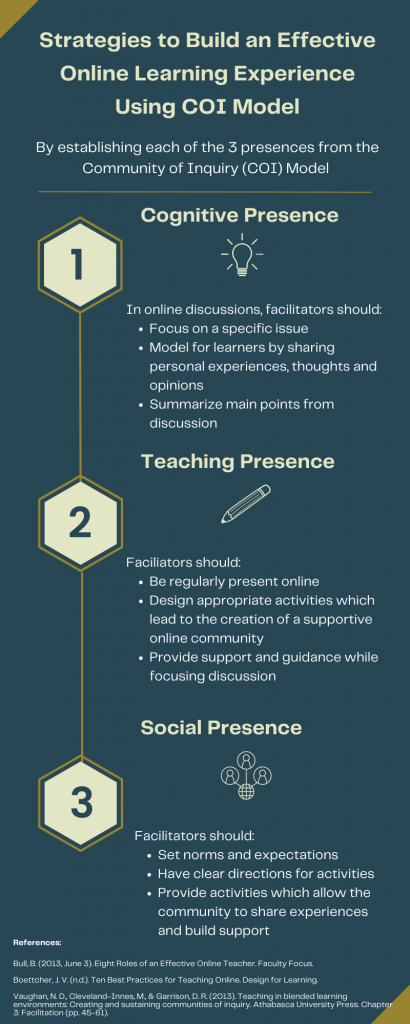
This infographic was created based on my reflection of a previous online training session for oral health professionals I facilitated last year. Although the calibration and information training session went well based on feedback from the team; there are always areas for improvement moving forward. Using Garrison & Anderson’s Community of Inquiry (COI) Model and this lens, I have listed some strategies facilitators can utilize when leading this type of session with this group of learners.
Working with a diverse group of learners from various training backgrounds and experiences, it is important to identify a specific issue for the team to focus on while providing some context as some team members may not have any prior experience, knowledge or training. In addition, the facilitator needs to model for the team by sharing personal experiences as the facilitator may have a different perspective from the team based on their role and responsibilities. It is for this reason that the facilitator must indicate to the team that they are a co-learner in the discussion and actively listen to the various perspectives within the team. To close the discussion, I believe that it benefits the team when the main points from the discussion are summarized and disseminated to the team. I have selected these strategies based on the Tour Guide role from Bull’s (2013) article where the tour guide “directs and redirects the attention of learners toward key concepts and ideas” (para 2).
To establish a teaching presence, the team needs to know that the facilitator is regularly present online and available to provide support as needed. The facilitator needs to design appropriate activities which engage the team yet allow them to feel supported. For example, an activity to calibrate the team involves ensuring that the dental images used clearly indicate a specific dental condition and allow individual team members to provide their answer anonymously, such as a poll. When a discrepancy occurs, the facilitator needs to provide guidance and lead the team to an agreed upon final conclusion. Boettcher’s (n.d.) article on 10 best practices for teaching online influenced my strategies for teaching presence especially best practice 2: create a supportive online course community.
Lastly is social presence, a facilitator needs to communicate set norms and expectations to the team; ensure the team knows the schedule, directions for the activities and have activities which help build the community. Building the community is essential for getting the group to feel safe and supported in order to engage in discussion. This aligns with Vaughan et al. (2013) principle of establishing community and cohesion for social presence. For example, I scheduled time for an elder to open with a prayer and to set our intentions. As well, I had an icebreaker to allow those new to the team to meet and introduce themselves and finally there was an activity to close the session in a good way. The elder returned to close with a prayer and led us in a song which helped to strengthen the bonds of the learning community. These activities instilled a sense of community which was conveyed by the team. They were surprised at how connected they felt even though they were not physically together.
References
Boettcher, J. V. (n.d.). Ten Best Practices for Teaching Online. Design for Learning. http://designingforlearning.info/writing/ten-best-practices-for-teaching-online/
Bull, B. (2013, June 3). Eight roles of an effective online teacher. Faculty Focus. https://www.facultyfocus.com/articles/online-education/online-course-delivery-and-instruction/eight-roles-of-an-effective-online-teacher/
Vaughan, N. D., Cleveland-Innes, M., & Garrison, D. R. (2013). Teaching in blended learning environments: Creating and sustaining communities of inquiry. Athabasca University Press. Chapter 3: Facilitation (pp. 45-61).
I like how clear and easy to follow your infographic is Gail. I find it reassuring that a number of us, including yourself, have included the facilitator setting norms and expectations. This has been an area I struggle with because of the racism I experience in the classroom. I wonder if sometimes, we focus so much on ensuring our students are safe that we forget about ourselves or are ‘ok’ with being ill-treated? At home, I joke with my children saying a happy Katia is a happy house, I think that applies to my classes as well. If I feel safe and supported that allows me to want to do the same for the students. Conversely, if I do not feel safe or supported – it does make entering the classroom drop to the bottom of my favourite things to do list.
Thank you Katia for your comments. I agree that it is a delicate balance of creating safety for students and ourselves. Perhaps, using a strategy where everyone helps to create the norms and expectations where everyone agrees can be beneficial. I believe that we can’t assume that everyone just knows expected norms and expectations due to the diverse backgrounds and experiences learners come from. Like you if I am not feeling safe or supportive, it’s very difficult to engage. I also take this point of view when selecting a dental practice to work for by asking for their philosophy or values. If they don’t align with my philosophy, it’s not going to be a successful working relationship. Thanks.
Thank you for your post. As someone working with diverse learners and backgrounds I can appreciate your post. I appreciate how you create context and use discussion as exploration and not what Bereiter & Scardamalia call “knowledge-telling.” I do have a question for you. Sometimes as a facilitator of DLEs that have diverse ages and backgrounds, there are different norms and expectations. What techniques or activities do you initiate to make expectations or norms clear? I do sometimes use a little “performance” to grab attention and be a little dynamic when materials are dry but I try to refrain from “knowledge-telling.” Do you have any insight for me?
Sam
Hi Sam,
In previous experience, I have found working with learners and/or teams to create an agreed upon set of norms and expectations can be helpful. Once these have been created ensure to circulate so that everyone has a copy to refer to if needed. For some topics, I have found that having an open discussion about the differences as an opportunity to learn can be useful too. Like you I refrain from “knowledge-telling” especially when providing oral health education to parents/caregivers. Instead, I ask for permission to share information and/or ask them what they like to know more about. Hope that helps. Thanks,