
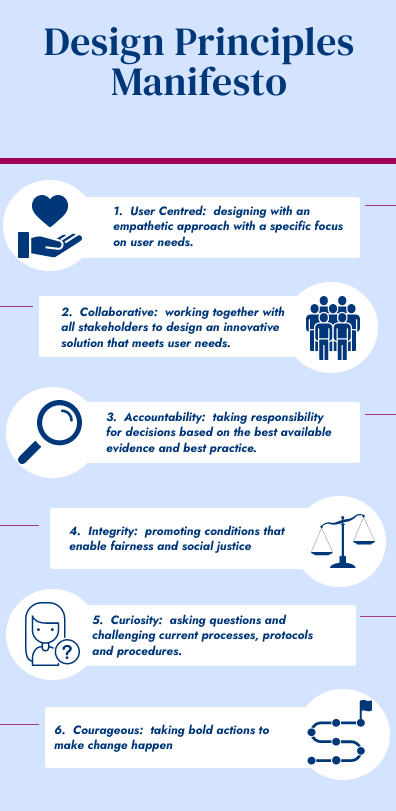
Design Principles Manifesto

As I was preparing to create my design principles, I made the conscious decision to ensure they closely aligned with my dental hygiene practice philosophy. My dental hygiene practice philosophy consists of core personal values and a code of ethics which has only been strengthened over time and practice. After taking some time to reflect over the past nine weeks, I created six design principles to guide my design and innovation process which not only intertwines with my practice philosophy but also has broadened the scope of my practice philosophy.

References

Brown, A. H., & Green, T. D. (2018). Beyond teaching instructional design models: exploring the  design process to advance professional development and expertise. Journal of Computing in Higher Education, 30(1), 176-186.

Canadian Dental Hygienists Association. (2012). Dental hygienists’ code of ethics. https://www.cdha.ca/pdfs/Profession/Resources/Code_of_Ethics_EN_web.pdf

Morris, S. M. (2018). Critical Instructional Design. In An Urgency of Teachers. Pressbooks. https://criticaldigitalpedagogy.pressbooks.com/chapter/critical-pedagogy-and-learning-online/

Stefaniak, J. E. (2021). Documenting Instructional Design Decisions. Design for Learning.

Proposed Design Solution / by Cook and Yee

As part of our design thinking process, we defined our problem statement as:  Gail needs a way to support Indigenous families in learning about good oral health because of the health risks to children and to help build capacity in communities.

We selected the idea of an oral health story contest as our solution to build, as for us, this solution holds the most potential to align with a critical instructional approach whereby users (children) are encouraged to co-create instructional content by partnering with other students, and by using various modes of representation, understandings, and languages as aligned with Universal Design for Learning (UDL) principles (CAST, 2021; Rogers-Shaw et al., 2018). As Morris (2018) argued, critical instruction design “aims for the fullest inclusion possible” (para. 24).

As parents, we have experienced how our own children love to have agency over their own learning and often enjoy instructing others. We imagined a multidisciplinary approach, whereby the stories shared, and lessons learned might be a collaborative arts-based process, for example, by partnering dental hygiene students with students and schoolteachers in science, music, or language classes.

Partnering with schools also hopefully addresses possible barriers to connectivity, with reliable Wi-Fi and computers on site. We also envisioned gathering oral health stories in an open platform (with consultation), to be shared with other health care professionals, parents, caregivers, and children, and other community stakeholders can help to increase capacity, and with an upstream wellness approach.  

We created the following infographic using Piktochart to illustrate our prototype and look forward to questions and feedback for further iterations.

References

CAST (2021). Universal Design for Learning Guidelines version 2.2. http://udlguidelines.cast.org 

Morris, S. M. (2018). Critical Instructional Design. In An Urgency of Teachers. Pressbooks. https://criticaldigitalpedagogy.pressbooks.com/chapter/critical-pedagogy-and-learning-online/ 

Rogers-Shaw, C., Carr-Chellman, D. J., & Choi, J. (2018). Universal design for learning: Guidelines for accessible online instruction. Adult learning, 29(1), 20-31. https://doi.org/10.1177%2F1045159517735530 

Activity 1: Tools, Roles and Superpowers

As a Dental Hygiene Practitioner, I wear multiple hats and continue to undertake things which my dental hygiene education program never prepared me for. I have created this infographic to illustrate a couple of my superpowers.

At the top is an ear to illustrate that any point of contact with any client or program stakeholder is entered with cultural safety and humility meaning that I listen respectfully without judgement. My role in public health is not only about addressing issues in the mouth but also addressing other issues clients may face which impacts their oral health; money and access being the biggest barriers. From there, I take all the information gathered to create a plan which addresses the client’s or stakeholders’ concerns which encompasses critical thinking and decision making as I do not believe in a one size fits all approach. Lastly, I ensure discussion and agreement with clients and stakeholders.

In addition to creating a safe space, three of my superpowers are problem-solver, collaborator and health promoter. The pandemic has forced public health dental programs to harness technology in creative and innovative ways in order to pivot face-to-face points of contact for oral health conversations. Using technology for Zoom video calls for 1:1s or group oral health sessions, webinars for potential stakeholders to better understand the importance of oral health for overall health and proposing collaboration opportunities for stakeholders. Using social media to connect with FaceBook storytime video sessions, posting videos from dental professionals about the importance of tooth brushing, and posting photos of children brushing their teeth to participate in a tooth brushing contest.

Recently, I have been able to utilize the in house mobile video interpreter to communicate with clients in their native language while educating them about the importance of oral health. In other cases, when technology is not available or accessible, I have added printed oral health resources into oral health care packages which are distributed within communities. In my day-to-day work, I am often problem solving by asking questions, leveraging my relationships and raising the oral health profile in search for possible solutions.

Morgan (2019) describes the role of instructional designers as complex with some seeing the role of Instructional Designers as change agents (Campbell et al., 2009 as cited in Morgan 2019). This point resonated with me as dental hygienists are change agents who advocate for marginalized groups while challenging and pushing boundaries; they are not solely “gum gardeners” or “teeth cleaners”. My work allows me to harness these superpowers with the reward of seeing a child’s happy, healthy smile.

References

First Nations Health Authority. (n.d.) Cultural safety and humility.
https://www.fnha.ca/wellness/wellness-and-the-first-nations-health-authority/cultural-safety-and-humility

Morgan, T. (2019). Instructional Designers and Open Education Practices: Negotiating the Gap between Intentional and Operational Agency. Open Praxis, 11(4), 369-380.


Selecting Design Models

There are many factors to take into consideration when selecting a design model.  I have chosen to highlight the following 3 factors:

      1. Instructional Designers personal opinions
      2. Learning Objectives and outcomes
      3. Learners’ needs 

“Technology is created with the developers’ world views, values, beliefs, and assumptions embedded into its design.  These worldviews are revealed through the activities supported and encouraged by the technology” (Veletsianos, 2016, p. 253).  Past experiences of learning designers has the potential to form biases and preferential tendencies of certain design models.  Some instructional designers may continue to utilise a particular design model because of comfort level or avoid others because of negative past experiences.  By doing so, they may not be selecting the most suitable design model to address the needs of the instructional design project. According to Dousay (2018), “…popularity serves as a form of validation for these design models, but a wise instructional designer knows when to use, adapt, or create a new model of instructional design to fit their purposes” (para. 10).  

Learning objectives, goals and outcomes should be taken into consideration when selecting a design model.  One of the most recognised and utilised design models is ADDIE.  Bates (2015), attributes the success of ADDIE to “…good quality design, with clear learning objectives, carefully structured content,…and assessment strongly tied to desired learning outcomes” (para. 11).  Within the Analyse and Design phases of the ADDIE model, the learning objectives, goals and outcomes are identified and addressed, then incorporated into the Develop phase.  For anyone entering the field of instructional design, ADDIE’s linear and step by step method will ensure the desired end outcomes or the results and feedback from the Evaluation phase will feed into the next iteration of the project.

Learners’ needs and preferences will influence which design model to use.  In a quickly changing world, learners’ need to quickly adapt and learn the necessary skills or information for school or for work.  Bates (2015) points out that the agile design model has the capability to help students develop the necessary specific skills needed in the digital age while maintaining a focus on preparing students for the rapidly changing world.  Whereas the ADDIE model known for working best with large and complex projects may not be able to adapt as quickly to learners’ needs.  Therefore some design models may be better able to accommodate learners’ needs.  

At this time, I have not had experience with making these design model decisions.  However, upon learning more design models and the variety that exists, I may want to gravitate towards the industry standard and use the ADDIE model while keeping in mind its limitations. 

References:

Bates, T. (2015). Chapter 4.3 The ADDIE Model and Chapter 4.7 ‘Agile’ Design: flexible designs for learning. In Teaching in the digital age. BCcampus. 

Dousay. T. A. (2017). Chapter 22. Instructional Design Models. In R. West (Ed.), Foundations of Learning and Instructional Design Technology (1st ed.).

Veletsianos, G. (2016). Digital learning environments. In N. Rushby & D. Surry (Eds), Handbook of Learning Technologies (pp. 242-260). UK: John Wiley & Sons.