Photo by Pixabay: https://www.pexels.com/photo/books-in-black-wooden-book-shelf-159711/
For my Applied Research Project, I have decided to explore Kearsley & Shneiderman’s (1998) Engagement Theory as a theoretical framework for my project. As I continue to further explore, I have discovered it is a model for learning in technology-based environments which has the potential to be a stepping point for my research in examining the question of how might an online training module be designed for dental professionals to be better able to provide the specialized care for children with autism spectrum disorder.
“The fundamental idea underlying engagement theory is that students must be meaningfully engaged in learning activities through interaction with others and worthwhile tasks” (Kearsley & Shneiderman, 1998, p. 20). Keeping this point in mind, I wonder if this engagement piece can be explored further to look at not only learners’ engagement but also the engagement of stakeholders when designing an online training module? Should stakeholders be engaged throughout the design process or just at certain points within the design process?
References Kearsley, G., & Shneiderman, B. (1998). Engagement Theory: A Framework for Technology-Based Teaching and Learning. Educational Technology, 38(5), 20–23. http://www.jstor.org/stable/44428478
Photo by EKATERINA BOLOVTSOVA: https://www.pexels.com/photo/arranged-paper-clips-around-an-eraser-6192337/
For my Applied Research Project, I would like to look at how might an online training module be designed for dental professionals to be better prepared for providing specialised care for children with autism spectrum disorder (ASD) and increasing capacity of trained professionals. There is currently no formal training module for the management of children with ASD at my workplace.
My research is relevant to my practice and one in which I believe needs to be further explored in order to address the gaps in knowledge of dental professionals. Firstly, I would like to disseminate my research to my workplace, specifically in the form of a formal Briefing Note proposal to senior management for the creation and implementation of this type of online training for the dental team. My research will be the evidence which will support the briefing note and inform decision making. My workplace will benefit from my research because the creation of the online training module for the dental team would mean that more children with ASD would be seen in house vs. referring out and possibly waiting a long time before being seen for treatment.
With my extensive network in the dental profession, there may be opportunities for me to connect with those working on the Advisory Committees at the Centre for Interdisciplinary Research and Collaboration in Autism. I am aware that development is underway to create an online professional development for autism and Neurodiversity in Dentistry and this may present an opportunity to disseminate my research.
Another option for disseminating my research is to write an article for Oh Canada!; the official oral health magazine of the Canadian Dental Hygienists Association (CDHA). It is a non peer reviewed publication and instead provides a forum for the communication of association news, clinically relevant dental hygiene and oral health information, and product information for its members.
Last option to consider is the Canadian Journal of Dental Hygiene (CJDH) which is a peer reviewed journal and whose mission is “to publish high-quality, credible, and accessible research to inform practice, education, and policy, and promote the oral health and well-being of the public” (p.110). However, my research will have to fall under one of these themes: risk assessment and management, access to care and unmet needs, or capacity building of the profession. As my research progresses, it may morph and change that it may clearly fall under one of these three themes.
Photo by Vie Studio: https://www.pexels.com/photo/crumpled-brown-paper-on-pink-surface-7006366/
It has been almost two months since I posted some thoughts, questions and a metaphor about facilitation in digital environments. With regards to my initial thoughts, I would say that my views have remained the same and in some cases have only been reinforced due to my recent experiences in facilitation in a digital learning environment.
In the case of never making assumptions about things being clear, I would wholeheartedly agree with this point based on a recent experience and that has led me to gain a better understanding of the importance of check-ins with learners for feedback and to see where they are at. Are they having challenges? Do they need support? As mentioned, there are no gestures, no body language or non-verbals in a digital learning environment so regular check-ins can help offer insight into learners.
Unplanned issues arise in a digital learning environment and so it is critical to ensure that you have a back up plan on hand or be prepared to pivot as needed. I have learned that sometimes when things go sideways, there is always a simple solution; you just need to be creative.
I mentioned in my post the importance of balance of synchronous and asynchronous but establishing a community to support learners is key. When learners feel connected and supported, they are more likely to take risks. Sometimes those risks may be unexpected but they can be rewarding for all involved.
With regards to my questions about digital facilitation, I recognise the value of establishing social presence and teaching presence to build community in a digital environment. When learners feel connected, this increases the likelihood of openness which leads to collaboration. Teaching presence specifically the design and organisation will help learners understand what is expected and minimise confusion thereby keeping learners engaged.
Photo by Pixabay: https://www.pexels.com/photo/black-tree-near-body-of-water-35796/
This week I got the opportunity to annotate an article using Hypothes.is and attempted to lean into the experience of openness while gaining a better understanding of the challenges facing educators who are looking to embrace openness. There was a learning curve to using Hypothes.is as it was not as straightforward as I would have liked it to be and may have tainted my openness experience.
The article left me with questions about how openness could be integrated into my field where there are longstanding existing hierarchies which are resistant to change. I believe there may be opportunities where openness could be integrated but there needs to be a team of change agents who embrace openness to begin the change.
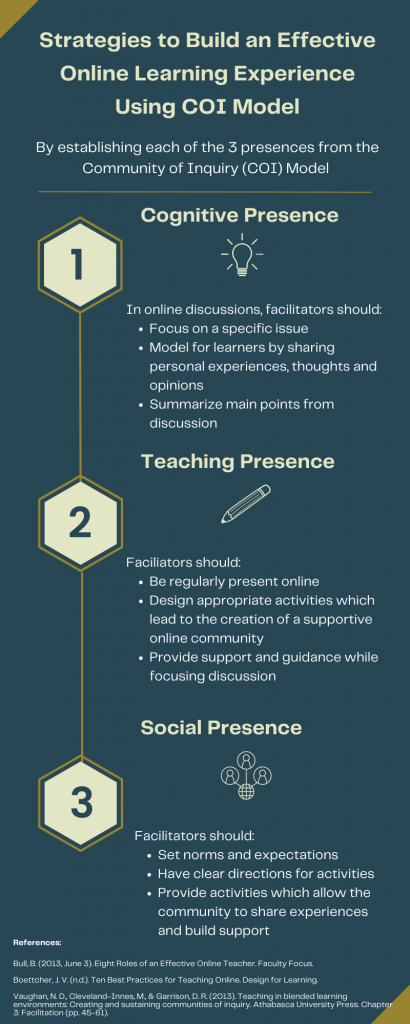
This infographic was created based on my reflection of a previous online training session for oral health professionals I facilitated last year. Although the calibration and information training session went well based on feedback from the team; there are always areas for improvement moving forward. Using Garrison & Anderson’s Community of Inquiry (COI) Model and this lens, I have listed some strategies facilitators can utilize when leading this type of session with this group of learners.
Working with a diverse group of learners from various training backgrounds and experiences, it is important to identify a specific issue for the team to focus on while providing some context as some team members may not have any prior experience, knowledge or training. In addition, the facilitator needs to model for the team by sharing personal experiences as the facilitator may have a different perspective from the team based on their role and responsibilities. It is for this reason that the facilitator must indicate to the team that they are a co-learner in the discussion and actively listen to the various perspectives within the team. To close the discussion, I believe that it benefits the team when the main points from the discussion are summarized and disseminated to the team. I have selected these strategies based on the Tour Guide role from Bull’s (2013) article where the tour guide “directs and redirects the attention of learners toward key concepts and ideas” (para 2).
To establish a teaching presence, the team needs to know that the facilitator is regularly present online and available to provide support as needed. The facilitator needs to design appropriate activities which engage the team yet allow them to feel supported. For example, an activity to calibrate the team involves ensuring that the dental images used clearly indicate a specific dental condition and allow individual team members to provide their answer anonymously, such as a poll. When a discrepancy occurs, the facilitator needs to provide guidance and lead the team to an agreed upon final conclusion. Boettcher’s (n.d.) article on 10 best practices for teaching online influenced my strategies for teaching presence especially best practice 2: create a supportive online course community.
Lastly is social presence, a facilitator needs to communicate set norms and expectations to the team; ensure the team knows the schedule, directions for the activities and have activities which help build the community. Building the community is essential for getting the group to feel safe and supported in order to engage in discussion. This aligns with Vaughan et al. (2013) principle of establishing community and cohesion for social presence. For example, I scheduled time for an elder to open with a prayer and to set our intentions. As well, I had an icebreaker to allow those new to the team to meet and introduce themselves and finally there was an activity to close the session in a good way. The elder returned to close with a prayer and led us in a song which helped to strengthen the bonds of the learning community. These activities instilled a sense of community which was conveyed by the team. They were surprised at how connected they felt even though they were not physically together.
References
Boettcher, J. V. (n.d.). Ten Best Practices for Teaching Online. Design for Learning. http://designingforlearning.info/writing/ten-best-practices-for-teaching-online/
Bull, B. (2013, June 3). Eight roles of an effective online teacher. Faculty Focus. https://www.facultyfocus.com/articles/online-education/online-course-delivery-and-instruction/eight-roles-of-an-effective-online-teacher/
Vaughan, N. D., Cleveland-Innes, M., & Garrison, D. R. (2013). Teaching in blended learning environments: Creating and sustaining communities of inquiry. Athabasca University Press. Chapter 3: Facilitation (pp. 45-61).
3 Initial thoughts about facilitation in digital environments:
One can never make assumptions that everything is clear to the user/learner. Unlike face-to-face environments, there are no gestures, no body language or nonverbal signals to give the facilitator insight into their users in a digital environment. For this reason, regular check-ins may assist the facilitator with gaining insight into their learners.
Digital environments come with their own unique challenges and facilitators need to be able to adjust, adapt and pivot as needed when unplanned issues arise.
There should be a balance of synchronous and asynchronous in order to create a community where learners feel connected and supported. Without this some learners may feel they are alone and flying blind.
2 Questions about digital facilitation:
What are some proven strategies that help to build community and strengthen connections in a digital environment? And strategies to ensure that the connections do not start to waver midway through a course or program?
What are some strategies to help support and motivate learners in a digital environment that are different from face-to-face?
1 Metaphor about Digital Facilitation
Photo by Jean-Christophe André: https://www.pexels.com/photo/iceberg-2574997/
In the dental world, we often use the metaphor of the iceberg to describe dental issues to clients. Common dental issues may present with little to no symptoms which may give them a false sense of security that everything is great but underneath there may be something more serious happening. When the dental issue becomes serious, it can no longer be ignored.
I believe this metaphor can be applied to how I perceive digital facilitation at this time; all may look smooth above water but a digital facilitator needs to be aware and checking for potential issues under the water.
Photo by Jacub Gomez: https://www.pexels.com/photo/ocean-during-sunset-1143006/
This week I took some time to reflect upon my time in this course and my overall MALAT journey up to this point. Addae-Kyeremeh & Rezaie (2022) define reflective thinking as “the ability to demonstrate self direction, reflect on your own progress as a learner, to continue to advance your own knowledge and understanding and develop new skills to a high level” (para. 1). As an oral health professional, I am constantly reflecting on my experiences to determine what went well, what I learned, and what I can do differently especially in new and difficult situations.
Over the last eight weeks, I have committed to fully engage in the design thinking process to solve an identified problem of practice for the dental team. During this process, I was most surprised to learn that design thinking is not linear but is in fact an iterative process which requires taking time to critically reflect. For example, new data/information was brought to my attention as I was starting to brainstorm in the prototype phase. This new information forced me to go back to the initial phases to ensure that I clearly understood what the users needed in the design by putting aside my assumptions, actively listening and asking questions to gather information. I enjoyed the creative process of designing and was forced to learn new skills to create my proposal video which was shared with the team to ensure that I captured the information correctly without making any assumptions. I have enjoyed receiving the invaluable feedback from the team because it has given me more “food for thought”, forced me to question my decisions, reflect and make adjustments to the prototype; things that I had overlooked or not considered such as the type of font.
As I continue to work on the prototype, I recognize that it will undergo an evaluation phase for the team to provide feedback and once again I will have to reflect on the process. Or I may need to consider adding additional modules to the digital learning resource as charting issues arise with the new process. The support from my dental team has been incredible and I look forward to delivering a learning tool to help the team during this period of transition.
I see my journey through the MALAT program as a transformative one and how each course has pushed me to learn new knowledge, gain a deeper understanding, and develop new skills. All of the courses continue to build on my knowledge from the previous one and that is reflective in my blog as I can see examples of my progression and evolution through this program.
Photo by Lum3n: https://www.pexels.com/photo/close-up-of-photo-of-books-327882/
It has now been a little over one month since Team 5 began exploring and researching podcasts. During which, I have been looking at the research, exchanging and discussing findings with fellow team members and listening to our chosen podcast. I recognise the value which podcasts bring to mobile learning and storytelling. In addition, there are little to no barriers to starting up a podcast therefore giving anyone a platform to share their opinions and thoughts. As well, I have discovered that podcasts have the ability to form communities of people with shared interests or views and podcasters have the ability to connect with their listeners and vice versa through social media.
Through my research, I have been exploring the spread of misinformation over podcasts with a focus on public health (PH) issues such as vaccines and the coronavirus. My topic was triggered by events from earlier this year. With the formation of these tight podcast communities, research shows that listeners will continue to have their opinions and views reinforced while avoiding information or messaging that counter their views (Del Vicario et al., 2016; Collier, 2018). I was curious to learn how PH can combat misinformation and what strategies could they apply to share their stories via podcasts?
In a podcast interview with Dr. Bauchner (2021), Dr. Merchant declared that misinformation is a public health crisis (20:32). Merchant et al. (2021) went on to express that PH needs to meet people where they are at by connecting with them through the information networks and devices they use on a daily basis. Research has suggested leveraging digital tools such as podcasts and other social media platforms to engage with the public by communicating key PH messages and interventions (Kass-Hout & Alhinnawi, 2013; Merchant et al., 2021. These new digital tools such as podcasts have been shown to disseminate information faster to communities vs. the traditional methods of television, newspaper or billboards.
From my research, I have discovered some mitigation strategies which PH can implement to combat misinformation. I particularly like the suggestion of partnering with trusted community influencers (podcasters) who can help with communicating key messages and correct misinformation among their listeners (Merchant, 2021). With these partnerships, PH can learn to construct messages more personalised to the unique needs of the community ensuring they will reach more people and be better received. I believe that leveraging podcasts’ ability to learn anytime, anywhere with public health’s desire to meet people where they are at has the potential to be another successful way to communicate key messaging to the public along with other social media platforms. I would like to continue researching for further examples of PH using this partnership to disseminate information to the public via social media/podcasts.
Collier, R. (2018). Containing health myths in the age of viral misinformation. Cmaj, 190(19), E578-E578.
Del Vicario, M., Bessi, A., Zollo, F., Petroni, F., Scala, A., Caldarelli, G., Stanley, H.E., & Quattrociocchi, W. (2016). The spreading of misinformation online. Proceedings of the National Academy of Sciences, 113(3), 554-559.
Kass-Hout, T. A., & Alhinnawi, H. (2013). Social media in public health. British medical bulletin, 108(1).
Merchant, R. M., South, E. C., & Lurie, N. (2021). Public health messaging in an era of social media. Jama, 325(3), 223-224.
Photo by cottonbro: https://www.pexels.com/photo/overhead-shot-of-a-cellphone-between-a-mug-and-headphones-6686442/
As a member of Team 5, we decided to venture into the World of Podcasts as our choice of technology to explore. We selected the CBC’s podcast, The Secret Life of Canada, as it offers a diverse range of subjects and topics to appeal to each of our own individual interests. As of today, I have listened to two podcast episodes; each one varied in length and content and did not experience any challenges. I was able to listen to the podcast on my mobile device as well as my laptop. While listening to the podcasts, I made the conscious decision to sit down and actively listen to the podcast to ensure that I was fully immersed in the experience. I enjoyed listening to the engaging hosts share bite-sized snippets of information about Canada’s history that curiosity got the better of me and I felt the need to search the Internet for more information about the content I had just listened about.
From my experience, I agree with some of the points made by Maiorca (2021) about the popularity of podcasts. I can see how it is convenient to listen to a podcast while driving, taking the bus or doing some other activity and use that time to learn something new. I liked how the episodes varied in length making it easy for someone to justify fitting 10-15 minutes of listening and learning into their busy schedule. As well, the hosts were entertaining and welcoming listeners to engage with them via social media, email or regular mail to offer their comments and suggestions. By doing this, I can see how easy it is for listeners to connect to like-minded communities based on personal interests via podcasts.
However, as I was listening to the podcasts, I was curious to know more about the education and background of the hosts; were they historians, educators? Did they have expertise in this area? Where did they get their information or research from for each episode? After some searching, I found out that the hosts are playwrights and that much of their research came from the CBC Archives. This led me to think about the credibility of content being shared on podcasts, specifically public health issues such as vaccines, COVID-19 and water fluoridation, especially if the hosts are not an authority figure in the field they are speaking about. As well, I had questions about equity and representation in podcasts; does everyone have the same ability and opportunity to be heard? Do podcasts have the capability to reach everyone with public health messaging that is respectful of different cultures and beliefs? Do listeners have the ability to evaluate the “claims” and if not what may be the reasons or barriers? Selwyn (2010) points out the need for a critical approach towards educational technology highlighting equality and social justice concerns. Taking this approach, I would like to further explore this equity piece in relation to podcasts using a public health lens to answer some of my questions.
Selwyn, N. (2010). Looking beyond learning: Notes towards the critical study of educational technology: looking beyond learning. Journal of Computer Assisted Learning, 26(1), 65–73. https://doi.org/10.1111/j.1365-2729.2009.00338.x
In my earlier post on Leadership Reflections, I was asked to identify the attributes which I felt a leader required to be successful working in digital learning environments (DLEs). As I near the end of this course, I still believe that a leader requires the ability to be inspiring, strategic or forward-looking and possess effective communication skills. However, I have gained a better appreciation for change management processes, the complexity of systems and now believe that a successful leader needs to recognize “a change in any part of the system creates change throughout the system” (Biech, 2007, p. 3). I witnessed firsthand how a transformative change had impacted staff and their jobs. Looking back, I believe that more change management mitigation strategies needed to be incorporated into planning as the staff did not receive enough communication, preparation and support for the impending change.
Strong leaders working in complex organizational systems will always encounter stakeholders opposing changes. For this reason, leaders need to have a clear understanding of the organization’s objectives and strategic content from the perspective of each of the stakeholders (Antwi & Kale, 2014). By understanding the different stakeholders’ perspectives, leaders are in a better position to effectively communicate the need for the changes. I think aligning the varying stakeholders’ positions to the organization objectives and strategies is helpful for getting “buy in” from stakeholders.
A wise mentor gave me two pieces of advice which has stuck with me all these years. The first piece of advice was that we are all leaders meaning that we all have the ability to inspire change no matter how small. This is especially true for those working in small teams of 3-5 people where small changes are easier to implement vs. larger teams that require “buy in”. The second piece of advice she gave me was to always ask questions and to challenge the status quo. Just because something has always been done a certain way, ask yourself if there is a better way? Or why is it done this way? I have been in work situations where I have inquired about set processes and often received the response that it has always been done this way. In many cases, staff recognize that their processes should be changed but often there is no one willing to step up to lead and/or become the change agent. I have also been in situations where managers will ask me if I have any suggestions/feedback because I am new and can offer a fresh perspective on their processes.
Moving forward, I recently learned that there are leadership and change management learning opportunities at work. I would like to continue to explore and learn more while building relationships and coalitions at work to see if there are opportunities to challenge the status quo.
References
Antwi, M., & Kale, M. (2014). Change management in healthcare: Literature review. Monieson Centre for Business Research in Healthcare, Queen’s University.
Biech, E. (2007). Thriving through change: A leader’s practical guide to change mastery. American Society for Training and Development.