
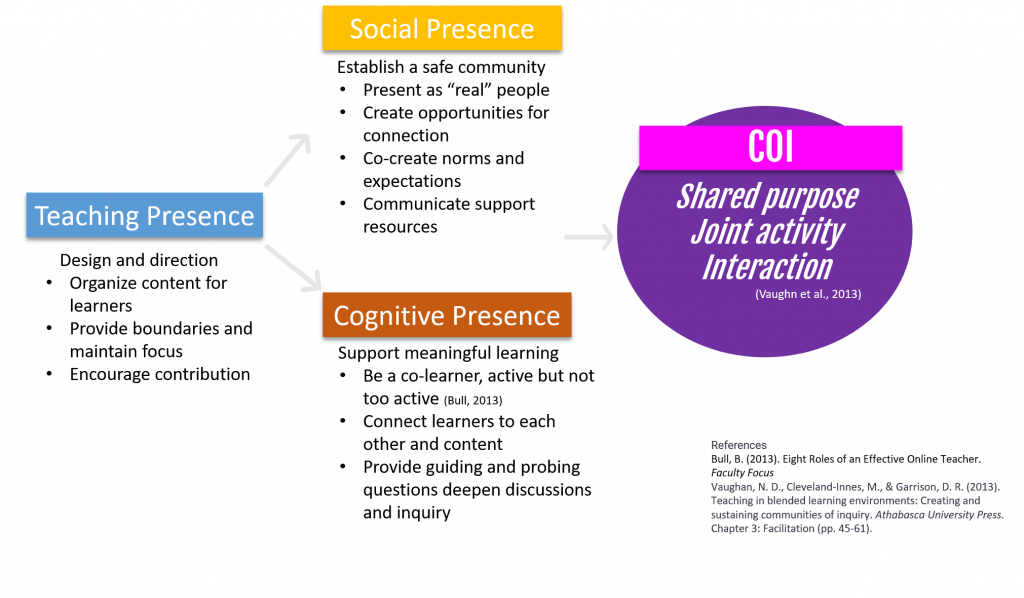
Vaughn et al. state that a Community of Inquiry (CoI) emerges from shared purpose, joint activity, and interaction and that effective teaching presence is required to establish social presence which will in turn support the necessary cognitive presence that leads to meaningful learning (2013).
Informed by Vaughn et al. (2013), this infographic highlights some strategies from each CoI presence that a facilitator can apply to support a healthy CoI.
I selected strategies for each presence that resonate with me and my work in a corporate learning environment. There are challenges and opportunities in corporate learning environments that relate to each of the CoI presences:
Social Presence: In corporate learning environments, often learners will be known to each other professionally however, it is a new type of relationship as co-learners that needs to be cultivated. It is important that a safe community is established where learners see themselves apart from their job titles and roles and feel comfortable interacting in the community as learners, asking questions, contributing, and having open discussions with colleagues. To foster relationships and build community we can include introduction, mixer, collaborative, and low-stake activities. Through these activities, the goal is to reach a point where learners will feel comfortable showing up in the community as their whole, authentic selves. Co-creating a set of norms and expectations will be beneficial in creating a safe learning environment, including respect for the privacy of what is shared in group or class discussions.
Cognitive Presence: In alignment with adult learning principles, we can establish relevance, acknowledge their previous experience, and provide a meaningful experience to keep learners motivated and engaged. To achieve this, a facilitator can model as a learner, engage as a co-learner, connect learners with content or others, and guide and challenge the learners in discussion. In doing so, we can facilitate discourse and reflection leading to deeper learning.
Teaching Presence: An effective facilitator in a corporate learning environment will present content in an organized way that acknowledges and respects the learner’s time and clearly communicates how to navigate the learning. Learners will expect the facilitator to provide leadership and set boundaries to keep focus. A great facilitator will also take on the role, as described by Bull (2013), of cheerleader. As a cheerleader, the facilitator will be supportive and encouraging, keeping things positive and light. This will help sustain motivation and engagement in the community and support the development of the social and cognitive presences needed to establish an effective CoI.
In addition to these strategies, a good facilitator will be attentive to the needs of the group and individuals and be flexible and adapt to those needs. Also, the nature of the content, timeline, and purpose of the learning initiative may require additional considerations and strategies.
References
Bull, B. (2013). Eight Roles of an Effective Online Teacher. Faculty Focus
Vaughan, N. D., Cleveland-Innes, M., & Garrison, D. R. (2013). Teaching in blended learning environments: Creating and sustaining communities of inquiry. Athabasca University Press. Chapter 3: Facilitation (pp. 45-61).
September 14, 2022 at 3:08 pm
I appreciate your your social presence section of your infographic. I deeply believe in providing a safe space for students and strive to do so. I also like that you included the ‘real people’ reference. I find having boundaries around teaching presence and connecting learners to each other and content under cognitive presence helps support that real people piece. In reference to how I wish to be treated by students, and to ensure my safety, I have started to include a ‘netiquette’ presentation. I was encouraged by security to be clear about how I expect to be treated in class, on discussion boards, in emails, and online. I was also encouraged to let students know I will issue verbal warnings or involve security as required. Took a while for me to be comfortable with the latter, however, racism is alive and well and living in my classes, and my safety is just as important as the students’ and treating each other with with respect and as real people, matters.
September 15, 2022 at 9:44 am
Thank you for your comments Katia. I look forward to exploring further how we can create “safe” learning spaces for our learners more in our team assigment. I am wondering where your strategies for creating safe spaces are similar and differ for in-class vs online.
I agree, in this digital world it is important to have a real and relatable presence in an effort to support the relationships needed to interact and collaborate effectively. Are your classes delivered primarily in a blended format? Do you meet students in-person first or?
Melissa
September 20, 2022 at 11:36 am
Hi Melissa,
I like your comment about a facilitator applying each presence for a healthy CoI. I agree with your social presence in a corporate learning environment that peers know each other professionally, and this emphasis on social presence is key in a CoI, especially now with virtual environments. When discussing ‘authentic selves’, do you feel based on your experience that it is a challenge in a corporate environment, especially virtual or hybrid? I recently had a comment from a colleague who said that she doesn’t need to socialize at work because she is too busy. So when introducing the need to be ourselves as part of social presence, it makes it complicated when staff only want to do their job/tasks. What do you think?
– Stephanie
September 21, 2022 at 9:10 am
Hi Stephanie,
You’re right, that can be complicated! My thoughts are that in a learning environment at work it really depends on the content and purpose. Sure, if you are doing a course on something like how to process an expense claim there probably isn’t much need for nurturing social relationships. However, in something like a leadership course, EDI training, or a CoP where more impactful learning can take place through collaboration, shared experience, discussions, etc. then I think that the social aspect needs to be developed if you want people to show up authentically and contribute.
Probably always going to be individuals who are more/less willing to participate fully when it is something they are required to do rather than chose for themselves. Do you agree?