
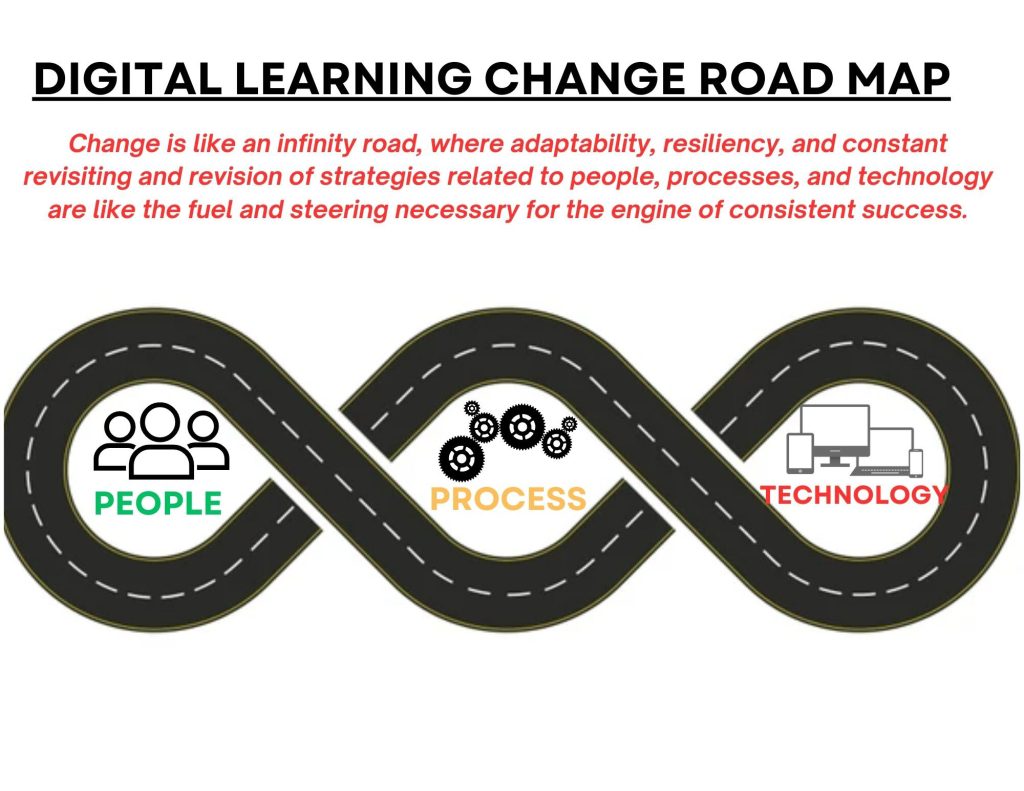
In today’s rapidly evolving world, the significance of change cannot be overstated. Change is like an infinity road that never stops. As technologies and digital learning become essential tools for enhancing workplace organizational effectiveness and skill development, organizations must embrace a mindset that fosters collaboration, productivity, and constant adaptation to new changes. Biech (2007) highlighted that organizations are always moving towards change, propelled by the abundance of information and the rapid pace at which we can access it. As a result, the key to success in creating a digital learning environment is to merge people, processes, and technology, recognizing that this is an ongoing and never-ending process. Consequently, Conner (1998, as cited in Al-Haddad and Kotnour, 2015) noted, “any change action has a chain reaction that impacts the whole organization” (p. 235). Hence, we must consider the change initiatives before implementing them.
After reviewing the literature, conducting peer interviews, reflecting on personal experiences, and listening to the “voices” of past students in the MALAT program, I found that selecting the best change model to address digital learning was challenging. As Al-Haddad and Kotnour (2015) noted, the high failure rate of change initiatives only emphasizes the importance of selecting the right model. I reviewed several models, including Lewin’s Change Management Model, Kotter’s 8-Step Model, and Prosci’s ADKAR Model. Still, combining the best practices from each model was necessary to develop an effective approach. This led me to create the “Digital Learning Change Road Map,” a customized model tailored to the unique context of digital learning. The “Digital Learning Change Road Map” is a continuous process that resembles an infinity road, requiring ongoing involvement of stakeholders to drive the change forward, processes to carry out the change, and technology to implement and utilize the change effectively. The model includes a clear vision, focuses on building momentum, engaging stakeholders, creating a detailed implementation plan, and providing ongoing communication and support to adapt.
People undoubtedly play a crucial role in change, especially in the digital world. In addition, people play a role in change by needing to recognize the organization’s working practices, know how new technologies and changes affect the organization and adapt to the demands of today’s business. Thus, people are an essential and ongoing factor in the infinity road map of change, and comprehending their apprehensions and necessities is critical for accomplishing any change initiative. In addition, the colleagues I interviewed noted that people significantly impact change and ensure you have the right people involved, like, leadership, executives, subject matter experts and professionals who understand the needs for and of digital change. Furthermore, they added that to implement digital change successfully, it is crucial to show executive and leadership support. When leaders support and deliver the change’s value and benefits, individuals are more likely to accept it.
Similarly, it is vital to assemble a team of dedicated individuals with the necessary expertise to implement the change. Jones (2022) stated that listening to the people being led is crucial for effective leadership. Therefore, change leaders must take the time to understand their audience, listen to their voices, and support them in successfully implementing a digital learning environment. Furthermore, Al-Haddad and Katonour (2015) emphasized that change leaders should employ the most suitable change strategies for their people once the nature of the change is known.
As we are now in the second phase of the infinity roadmap, which is the process, having a well-structured and engaging process personalized for employees is crucial to effectively implementing digital learning in the workplace. As my colleague stated, processes should be designed to fit seamlessly into the organization’s workflow and be easily accessible and user-friendly for employees. Moreover, Weiner (2019) claimed that consistent leadership messages and actions that convey the vision are essential throughout the change process to remind stakeholders why change is being pursued. Additionally, it is crucial to provide employees with the necessary tools and training to help them navigate the transition successfully. Furthermore, optimizing business processes is vital in digital change strategies, primarily customer-focused ones. For instance, in our organization, we utilize tools to monitor contingent workers, which assists managers with hiring, managing, and paying contractors, ensuring that these processes are efficient, secure, and cost-effective. Finally, any created process needs to seamlessly integrate with existing systems and technologies to provide employees with a simple, flawless user experience that makes sense to the business and its users.
Technology plays a crucial role in the digital learning change road map of people, processes, and technology in a workplace. Technology is all around us, from when we wake up to when we go to sleep. Still, more importantly, technology is widely used in our organization, providing employees with the tools and resources to work from anywhere and to help facilitate new ways of collaboration, communication, and training. As we progress through the different phases of the infinity road map for digital learning change, it becomes increasingly apparent that technology plays a crucial role in this process. Furthermore, according to Byerl et al. (2013, as cited in Al-Hadded and Kotnour, 2015), “technology is key to drive change and plays a strategic role in facilitating change and making it part of the organizational culture” (p. 244). Therefore, technology must be incorporated into all processes and departments if a company is to undergo a complete transformation. Like the infinity road map, my colleagues spoke about the importance of always ensuring technology is up to date and works for the needs of the end-users.
In conclusion, a continuous, ongoing change management process is needed to create a thriving digital learning environment in the workplace. People, processes, and technology are the three key components of this process, and they all need to operate in unison and coherence. It is essential to involve the right people, offer a user-friendly process that is simple to integrate with current systems and use technology to drive and facilitate change to succeed. This continuous process demands ongoing attention and flexibility in response to emerging changes, much like an infinity road. Understanding the significance of change and implementing an effective change management process will help organizations create a thriving digital learning environment that improves organizational effectiveness and skill development in the workplace.
References
Al-Haddad, S., & Kotnour, T. (2015). Integrating the organizational change literature: a model for successful change. Journal of Organizational Change Management 28(2), 234-262. https://doi.org/10.1108/JOCM-11-2013-0215
Biech, E. (2007). Models for Change. In Thriving Through Change: A Leader’s Practical Guide to Change Mastery. https://ezproxy.royalroads.ca/sso/skillport?context=22651
Jones, C. (2022). Voices of leadership: Interview with Christina Jones. [Audio]. Royal Roads University MALAT Course Site.https://malat-coursesite.royalroads.ca/lrnt525/schedule/voices/
Weiner, B. J. (2019). A theory of organizational readiness for change. Implementation Science, 4(1). https://doi.org/10.1186/1748-5908-4-67