
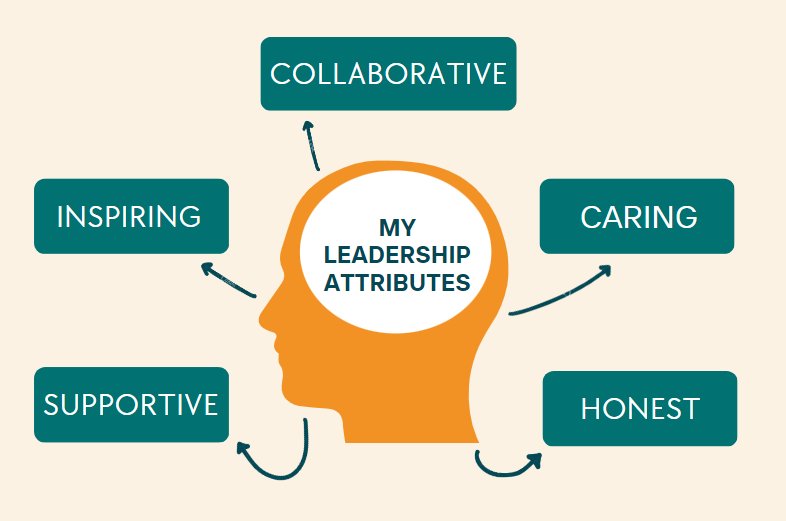
For this blog, we were tasked to write about leadership reflections and what we believe are the essential attributes of a leader working in a digital learning environment. I found this activity interesting because my answers were mostly the same before and after the readings when we were asked to complete a worksheet to list a leader’s most important to least important attributes. What I noticed was that my top five all embodied human connection. Being a leader is such an important role, and it should not be taken lightly. However, saying that, it was tough for me to pick just a few attributes, so I listed five important ones.
According to Workman and Cleveland-Innes (2012), the main goal of a leader is to inspire, develop, support, and guide their followers toward success. In a rapidly advancing digital learning environment, leaders must possess certain essential qualities to be effective. Based on my reading and personal beliefs, in my opinion, the five most crucial attributes are caring, honesty, supportiveness, inspiration, and the ability to foster collaboration.
Caring: A caring leader recognizes the significance of building relationships and creating a positive learning environment for their followers. They understand that education is about people and strive to create an atmosphere of trust and respect. Castelli (2016) notes that a leader must foster openness and trust to inspire others to perform at their best and feel a sense of belonging in the learning community.
Honesty: Honesty is crucial in building trust and credibility as a leader. Honest leaders are transparent and truthful in their communication and actions. As stated by Julien et al. (2010), integrity and honesty are highly valued leadership qualities necessary to gain employees’ trust and create a collaborative and successful working environment.
Supportiveness: Effective leaders in the digital learning environment must be supportive. They understand that success is often the result of teamwork and strive to create an inclusive culture that encourages collaboration. They provide resources and support to help individuals succeed and recognize their successes. According to Castelli (2016), a supportive leader empowers their team while maintaining performance expectations.
Inspiration: Inspiring leaders can motivate and inspire their followers to reach their full potential. They have a clear vision and communicate it effectively to their team. Julien et al. (2010) claim that inspiring others is a critical leadership ability that fosters an open and trusting environment for exchanging ideas.
Collaboration: Creating a collaboration culture is crucial for any organization’s success. Collaboration involves working together to achieve a common goal and fosters a sense of community. Workman and Cleveland-Innes (2012) state that collaboration and shared goals are the foundation of transformational leadership. By prioritizing collaboration, leaders can encourage a sense of ownership among all members of the organization.
In conclusion, leaders in the digital learning environment must possess a combination of caring, honesty, supportiveness, inspiration, and the ability to foster collaboration. By prioritizing these attributes, leaders can build strong relationships, foster trust, and drive success in a rapidly changing technological landscape.
References:
Castelli, P. (2016) Reflective leadership review: a framework for improving organizational performance. Journal of Management Development, 35(2), 217-236. https://doi.org/10.1108/JMD-08-2015-0112
Julien, M., Wright, B., & Zinni, D. M. (2010). Stories from the circle: Leadership lessons learned from aboriginal leaders. The Leadership Quarterly, 21(1), 114–126. https://doi.org/10.1016/j.leaqua.2009.10.009
Workman, T., & Cleveland-Innes, M. (2012). Leadership, personal transformation, and management. International Review of Research in Open and Distance Learning, 13(4), 313–323. https://doi.org/10.19173/irrodl.v13i4.1383
I really enjoyed reading your post about leadership, Michal. Your visual was also a great addition!
Your experience is interesting, as you mentioned that your leadership characteristics remained steadfast even after our readings. Would you say that your group also experienced this?
How would you say the leaders in your organization embody your respective traits? In your role, how would you implement them?
Thanks again,
-Terry
Hi Terry,
Thanks for reading my blog. I would say that some of our team members’ answers changed after the reading. However, after the reading, we were all aligned on our top five and bottom five.
Regarding how my leaders today embody those traits, I would say they align with mine. We did a team project on this a few months back, something very similar to what we did for this activity, and it was so refreshing to see that most of the team was aligned on leadership attributes.
I genuinely believe in treating people the way you want to be treated. Therefore, if my expectations from my leaders are to embody certain leadership characteristics, then I need to do the same with my team. If I had to this exercise 10 or more years ago, my answers would probably be way different. However, as I mature (more so emotionally :)), I understand and realize that being caring, honest, supportive, inspiring and collaborating with your team can lead to unbelievable things.
🙂 Michal
Hi Michal,
I enjoyed your thoughtful blog post on essential attributes for leaders in digital learning environments. I agree with your five attributes: caring, honesty, supportiveness, inspiration and collaboration, and how you associated them with human connection. In activity two, I found that my top five were also related to human connection when ranking leadership traits. Kotter (2001), as cited in Workman and Cleveland-Innes (2012), claims:
“Motivation and inspiration energize people, not by pushing them in the right direction as control mechanisms, but by satisfying basic human needs for achievement, a sense of belonging, recognition, self-esteem, and feeling of control over one’s life, and the ability to live up to one’s ideals” (p. 319).
This quote resonated with me, as I feel if leaders focus on the needs and wants of their followers, they have a better opportunity for positive outcomes. In addition, if followers feel involved and valued in processes, they will, in change, be more motivated. Is there a particular scenario where you felt more motivated when a leader in your space focused on human connection, specifically, your own needs?
Thank you!
Giulia
References
Workman, T., & Cleveland-Innes, M. (2012). Leadership, personal transformation, and management. International Review of Research in Open and Distance Learning, 13(4), 313–323. https://doi.org/10.19173/irrodl.v13i4.1383
Hi Giulia,
Thanks for taking the time to read my blog. The quote that you shared resonates with me as well. Motivating and inspiring people is an essential skill a leader should have.
There are many different reasons why I am taking the MALAT program. However, one of the biggest reasons I am here today, taking this course, is because of my leader. As most of you who worked with me on different team projects know, I don’t have much confidence in myself. However, I work with a couple of leaders that keep pushing me, motivating me, and inspiring me every day to achieve what they see in me that I don’t always see in myself. These leaders believe in my potential; they see my passion for this field and are always there to support me whenever I need it.
🙂 Michal
Hi Michal,
I really like the graphic you created to illustrate the top characteristics! We have a lot in common with the ones we ranked …I also appreciated how you broke them down. I found myself nodding a lot! I did find that after reading I was reflecting on how I was working with my classmates on my team…have the readings influenced how you approach leadership so far? (Maybe it’s too early to gauge?!) Thanks again for sharing your thoughts 🙂
Hi Alex,
Thanks for taking the time to read my post. Yes, I also noticed we have a lot in common regarding how we ranked leadership. I would say that my ranking, for the most part, was the same before and after I did my readings. However, the reading did help emphasize more and also made me look at some of the other attributes differently, like “Fair-Minded.”
🙂 Michal
Hi Michal,
Thanks for your thoughtful reflection, I appreciated how you honed in on attributes that are impactful for educational environments. I think there is something there about how being a leader in these spaces requires a level of care, openness and supportiveness. I also appreciated your highlighting the role of mentorship – and how leaders can play such a big role in empowering and supporting people in their growth. I mentioned this in my own introduction – I have been very lucky to have some very good leaders who acted as mentors, and it was an excellent way to build confidence and get feedback. So nice to hear how your story of how that support and mentorship has helped in your learning journey.
Thank you, Michelle. If not for the support and understanding from my current leaders and some of my cohort team members, I might not have continued in the MALAT program. Their inspiring, caring, honest, and supportive attributes genuinely resonate with me on a deep level. I am grateful to have leaders in my life who embody these qualities and make a positive impact on my journey. Therefore, I also want to incorporate these same qualities as a leader.