Our team embarked on a critical inquiry into the intriguing concept of chatbots teaching our children. The cutting-edge innovation of an AI-enabled tutor or chatbot guiding students as highlighted by Singer (2024), sparked our interest. However, our journey was not without its challenges. We encountered difficulty accessing AI-enabled tutors and chatbots through open educational resources (OER).
Our team learned that teacherbot technology was previously employed in a MOOC, using the #edcmooc to generate feedback from a pre-programmed AI teacher, affectionately known as “Botty” (Bayne, 2015). Bozkurt et al. (2018) referenced this study suggesting teacher bots or bot-teachers could be viewed as “learning assistants on the side,” like tutors (p. 55). However, the MOOC was discontinued, and Botty retired. While there is no shortage of teacherbots on the market, we were challenged to find any incorporated into free, accessible courses.
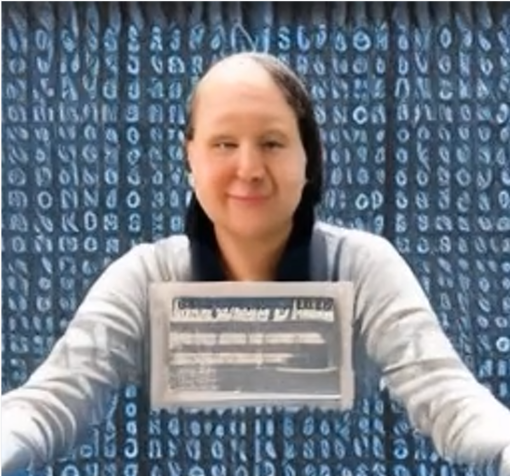
As a team, we made a conscious decision to pivot into the complex layers of technology and human interaction behind creating AI Agents and completed the 6-step “Demystifying AI” Middlebury College (2024) professional development free activity. We each created a mixed-media character, made it move, gave it a voice, and made a critical inquiry into the process.
This generated some unattractive AI Agents, leading us to delve deeper into the ‘uncanny valley’ (UV) effect, a theory by Masahiro Mori (1970). As machines and other artificial objects become more human-like, they trigger a sense of unease and disgust (Mori, 1970). There are many theories behind the cause, such as the perceptual mismatch theory attributing UV to mixing human and non-human features which humans see as a violation of the natural order of things (Weis & Wiese, 2017, p. 1599) or Mori’s original hypothesis that human-like robots remind us of corpses (2017, p.5). Our understanding of this effect further deepened our insight into the complexities of AI technology.
As the critical inquiry ensued, we learned that prompting has a significant impact on results. We found that AI-enabled tools categorize individuals into groups; therefore, diverse samples are not produced unless specific criteria are identified (Wald, 2021, p. 2). For example, we noted an inherent male-presenting bias when gender was unspecified, and the term ‘disability’ often generated pictures of people in wheelchairs. As a result, we discovered that carefully crafted prompting generally yields better outputs.
The discovery of free versions of these tools is sophisticated and capable of improving human quality and performance by 40% (Dell’Acqua et al., 2023). To put that into perspective, steam power, one of the most significant industrial revolution developments, only increased quality and productivity by 18-22% (HILT, 2023). The findings indicated legitimate concerns about what happens to our cognitive skills when we rely on these agents too much (Bai et al., 2023).
Ultimately, our critical inquiry has posed many questions requiring further exploration, beginning with the initial question of should we use AI Agents? We want to continue this discussion with you on our blog as a team:
-Would you prefer to be tutored with AI Agent imagery, or would text-only engagement suffice?
– Does uncanny valley create enough of an emotional distraction for you that it negates the benefits of AI agents?
-Who should be responsible for ensuring AI-generated media is diverse and representative – those entering the data prompts, or those managing the data sets?
-Do you think that students who don’t embrace AI in their learning will get left behind?
Please feel free to share your thoughts.
References
Bai, L., Liu, X., & Su, J. (2023). ChatGPT: The cognitive effects on learning and memory. Brain‐X, 1(3), e30. https://doi.org/10.1002/brx2.30
Bayne, S. (2015). Teacherbot: interventions in automated teaching. Teaching in Higher Education, 20(4), 455–467. https://doi.org/10.1080/13562517.2015.1020783
Bozkurt, A., Kilgore, W., & Crosslin, M. (2018). Bot-teachers in hybrid massive open online courses (MOOCs): A post-humanist experience. Australasian Journal of Educational Technology, 34(3). https://doi.org/10.14742/ajet.3273
Brink, K. A., Gray, K., & Wellman, H. M. (2019). Creepiness creeps in: Uncanny valley feelings are acquired in childhood. Child development, 90(4), 1202-1214.https://srcd.onlinelibrary.wiley.com/doi/pdf/10.1111/cdev.12999?casa_token=LB7eFMbBxYUAAAAA:wmpI5L_is9zjSXZGWV_ZkedryYdCBe30D8Bz0QuqElOc7fUxuKZRzqgOxu56PSO3qyWX4eIfHgI3Qw
Dell’Acqua, F., McFowland III, E., Mollick, E. R., Lifshitz-Assaf, H., Kellogg, K., Rajendran, S., Krayer, L., Candelon, F., & Lakhani, K. R. (2023). Navigating the Jagged Technological Frontier: Field Experimental Evidence of the Effects of AI on Knowledge Worker Productivity and Quality (SSRN Scholarly Paper No. 4573321). https://doi.org/10.2139/ssrn.4573321
Harvard – Office of the VPAL. (2023, October 18). 2023 HILT Conference: “Forecasting the Role of Generative AI on the Future of Higher Education.” https://www.youtube.com/watch?v=qUX8UMLUn3g
Middlebury College. (2024). It’s not AI, It’s Memorex AI – Demystifying AI. https://dlinq.middcreate.net/detox-2024/activity/not-live/
Mori, M. (1970). The uncanny valley: the original essay by Masahiro Mori. Ieee Spectrum, 6, 1-6.https://web.ics.purdue.edu/~drkelly/MoriTheUncannyValley1970.pdf
Singer, N. (2023, June 8). New A.I. Chatbot Tutors Could Upend Student Learning. The New York Times. https://www.nytimes.com/2023/06/08/business/khan-ai-gpt-tutoring-bot.html
Wald, M. (2021). AI Data-Driven Personalisation and Disability Inclusion. Frontiers in Artificial Intelligence, 3, 571955. https://doi.org/10.3389/frai.2020.571955
Weis, P. P., & Wiese, E. (2017, September). Cognitive conflict as possible origin of the uncanny valley. In Proceedings of the Human Factors and Ergonomics Society Annual Meeting (Vol. 61, No. 1, pp. 1599-1603). Sage CA: Los Angeles, CA: SAGE Publications. https://journals.sagepub.com/doi/pdf/10.1177/1541931213601763?casa_token=9XUHhDkwNOEAAAAA:XdWfU72c7TWjmaA7TADOC12zxUCBPPnhGrx-O5lPgNKmG78e3b3m1IKbq6fALTVKvoGumSxHxX
May 28, 2024 at 3:29 pm
Hi Jessica. I really enjoyed your team presentation and learning about the uncanny valley theory. With regards to your questions that you invite us to reflect on, I personally haven’t had very much experience as a learner using AI teacherbots or education assistants. I think I’m still having flashbacks to Clippy, the paperclip-esque character that so ‘helpfully’ popped up each time you opened a new Word document! If given the option I would turn these tools off. My preference is to engage in the materials by myself without AI generated personas, and if there is a (human) instructor in the course, connect with an instructor directly. With regards to my own threshold for uncanny valley, I think I’d have to have high confidence in the accuracy, quality, and specificity of the AI teacherbot to find it helpful and worthwhile.