Last Minute Change
While working on Assignment 1 Part 2, I thought I had my presentation well under way since I had exchanged comments back and forth with the instructor, and we both coincided in that Localisation was a good and interesting approach. It was indeed outlined in the preliminary work of Assignment 1 Part 4, required as a draft for which I received useful feedback. The term Localisation usually refers to accommodating content to cultural and/or national boundaries (Amiel, Squires, & Orey, 2009, p. 29). My presentation used Localisation to incorporate local elements that reinforced the learning from the Khan Academy’s videos selected as the instance for the assignment.

And speaking of instance, during our team sessions, a doubt appeared concerning what the terms instance, issue, and aspect mentioned in the directions meant. We could take the usual meaning of those words but they seemed to be used interchangeably, which caused some confusion to the team. We needed to be on the safe side because our team’s video was still to be produced and the clock was ticking.
The instructor’s clarification came as a much needed directive: All team members must work on one and the same instance. This did not affect my colleagues’ work but, in my case, I was doing the Localisation of a supplementary Geometry resource to the Khan Academy online educational videos, so I had to shift the focus to the instance of the Introductory courses to HTML (Hyper Text Markup Language) and CSS (Cascading Style Sheets) (Khan Academy, 2018). In the end it worked out fine, although the extra time the change required could have been used to do some final fine-tuning.
Summary
The teams’ selections provided a diverse set of presentations allowing the audience to gain some insights to a variety of modalities. Among these were the Massive Open Online Curses (MOOCs) which, honoring their name, are widely dispersed throughout 196 countries and across multiple networks. Their content offerings cover a vast range of topics, and being open and online have helped them gain popularity among both universities and individual learners alike (Adamopoulos, 2013). Coursera and edX belong in this category, and their specific weight in the trend comes from large universities and organisations including them in their staff development options (Daniel, 2012; Noer, 2012).
Another modality was the curated video library represented by Lynda.com. This case’s story precisely depicts what being in the right place at the right time is, besides posessing the knowledge people needs to learn at hand. Having started with the topic of how to develop a web site, triggered by the absence of accessible resources in the market, Lynda.com then grew not only adding topics but also going through uncertainty, both financially and technologically speaking (Porter, 2015).
To summarise the sampling, the infographic Khan Artists prepared illustrates how the modalities selected by the teams fit in the grid comparing competency versus course based, and paid versus free options.
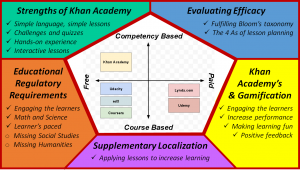
It is interesting to see that Khan Academy’s online educational videos contrast with the rest by being competency oriented, which corresponds completely to the origin of these tutorials: Sal Khan aimed to help his niece to become competent on specific topics (Bhatt et al., 2014).
Conclusion
The vastness of resources available in the education field is impressive. One of the best approaches an educator may take is to be open considering as many resources as feasible to give the students access to learning. Such variety of options might as well help solve the need of differentiated instruction, which at times can be challenging for the teacher.
References
Adamopoulos, P. (2013). What makes a great MOOC? An interdisciplinary analysis of student retention in online courses.Retrieved April 12, 2018 from http://pages.stern.nyu.edu/~padamopo/What%20makes%20a%20great%20MOOC.pdf
Amiel, T., Squires, J., & Orey, M. (2009). Four strategies for designing instruction for diverse cultures: Context and localization of learning objects. Educational Technology 49(6). 28-34. Retrieved from http://www.jstor.org/stable/44429738
Bahador, M., Doyle, S., Keddie, J., MacGregor, A., & Rimke, K. (2018, May). Khan artists. Presentation prepared in fulfilment of the part 2 of assignment 1 of the LRNT526 course, MALAT programme of Royal Roads University, Victoria, CA.
Bhatt, Grozdev, Hackney, Love-Davis, Stankiewicz, & Walters. (2014). Student case study: Khan Academy. Retrieved from http://fletcher.tufts.edu/~/media/Fletcher/MIB/pdfs/B236%20Student%20Case%20Studies/Khan%20Academy%202014.pdf
Daniel, J. (2012). Making sense of MOOCs: Musings in a maze of myth, paradox and possibility. The Journal of Interactive Media in Education. Retrieved from https://www-jime.open.ac.uk/articles/10.5334/2012-18/
Khan Academy. (2018). Retrieved from https://www.khanacademy.org/
Noer, M. (2012). One man, one computer, 10 million students: How Khan Academy is reinventing education. Forbes. 1-8. Retrieved from http://www.prisim.com/wp-content/uploads/2013/12/One-Man-One-Computer-10-Million
-Students-How-Khan-Academy-Is-Reinventing-Education-Forbes.pdf
Porter, J. (2015). From near failure to a $1.5 billion sale: The epic story of Lynda.com. Fast Company. Retrieved May 30, 2018, from https://www.fastcompany.com/3045404/from-near-failure-to-a-15-billion-sale-the-epic-story-of-lyndacom
Hi Alfonso,
Thank you for your informative post! I am also impressed by the number of resources available in the education field and as an instructor, I have been exploring many of them to check if they can be helpful for my students. For example, I use tutorial videos form: https://www.gcflearnfree.org/ in my computer courses, this is an amazing resource, and their videos are simple to understand and most importantly not too long.
Thanks again for your post!
May
Hello May,
You are welcome, and thank you as well for taking the time to read my post. You are right, the quantity of resources and information available is by far more than any educator might wish to have… I doubt there is anyone able to use up all that is out there, and it keeps increasing by the minute!
Browsers are a great tool too. We would be drawning in an ocean of information if not for them. Google gets about 85% of all the searches people do, and the first five or six results displayed get around 70% of the “hits” of any online search. This statistic just arrived in my cellphone via WhatsApp… technology is amazing, as long as it does not fail!
Cheers!
Hi Alfonso,
I enjoyed your post, especially your conclusion that “The vastness of resources available in the education field is impressive. One of the best approaches an educator may take is to be open considering as many resources as feasible to give the students access to learning”.
I fully agree that the vastness of educational resources is impressive, I would, however, also add that it can be overwhelming and daunting for inexperienced educators. In my previous role in faculty PD and training I would often encounter two types of faculty, those that became frustrated with the overwhelming amount of information and therefore gave up on incorporating it into their teaching and those that tried to incorporate all of the information they could find into their courses thereby overwhelming their students.
I think educators need to be trained in effectively organizing and utilizing the resources they find so as not to overwhelm themselves or their learners.
Do you find that those that work with you get overwhelmed at times?
Cheers
Steve
Hi Steve! Thanks for stopping by and commenting on my post. I just think of the variety of ideas that might sprout from our cohort with every assignment we are asked to work on… if a fraction of those ideas make it to a classroom, what a difference would the student experience?
Cheers!