Shifting perspectives
Generally speaking, getting together may not be a new thing for any student, but attending a particular session which provides insights related to the student’s interests deserves additional attention. One of the two key aspects of such a gathering is the topics covered, much of the session might be captured by the student’s memory due to the highly interesting content it entails, although taking notes ensures the relevant details are jotted down for later use. The people to meet there is the second key aspect, and on this regard taking notes will not do because of the dynamics of the event.
Providing the student with a digital resource that helps them building a contacts network was the goal I set to attain in the beginning. Research showed there are a number of means that partially deal with the task, and the scope I was considering included a two-way traffic of data. I was planning to capture student data that usually remain unregistered (see Figure 1), in order to provide universities and companies with missing information. Knowing aspects like time spent off-school; switching programs; returning to the same or different school would allow the universities to take new and proactive measures which will benefit the students, as well as students’ parents and tutors, the universities themselves, and even companies needing to fill vacant posts.
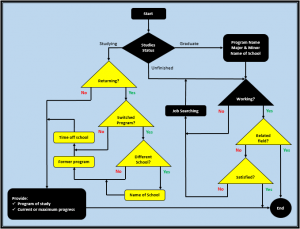
The metamorphosis of this project has been unprecedented. From a two-way application to a network-recording tool to an awareness-tool, having diverse input along the way from young adults, students, and senior teachers while researching options and support.
The digital resource I decided to build includes components that already exist. My proposal is to provide a springboard from where to create awareness in any given student about the existence of those components. The information obtained through the use of the digital resource can be relevant enough to help the student make better decisions that will shape the student’s future.
Being the proposal a digital resource there are authors that considered computerized means just like vehicles to convey instruction (Clark as cited by Ally, 2008), while others sustained that the medium has an impact on learning (Kozma as cited by Ally, 2008) because computers’ features allow for real-life and simulations to be more effective on the learner.
I expect my proposal to align with Kozma’s standpoint since it will invite the student to access specific information on the web, as well as foster the student’s curiosity to further investigate options that somehow connect with the student’s goals and motivations.
References
Ally, M. (2008). Foundations of educational theory for online learning. In T. Anderson (Ed.), The theory and practice of online learning (pp.15-44). Edmonton, AB: AU Press.