Below is my initial understanding of the design challenge I’ve chosen to undertake for course LRNT527:
Design Challenge
Overview
A large Canadian tax software company on boards about 7500 temporary employees every year in preparation for tax season. These employees need to complete the company’s mandatory learning and development program as part of their onboarding process.
During onboarding, information needs to flow from PeopleSoft (the company’s HR payroll system) to Cornerstone On Demand (its LMS). Because the company implemented its LMS before its HR system, there are a number of challenges with getting the two systems to “talk” to one another. Both implementations were somewhat rushed, so capabilities the systems and the impact to end users were not fully considered.
Design Rationale
Even something as simple as setting up a user ID for new employees to log into the LMS and complete required training is a painful process. The company would like to create a more “integrated and seamless experience” for employees who need to use Cornerstone.
Problem Scenario
How might a digital learning resource improve the onboarding experience for employees who need to use Cornerstone?
Success Determinants
Success will be determined by the degree to which the design solution alleviates the “pain and suffering” that employees who log on to Cornerstone for the first time are currently experiencing. A good design solution will explore and leverage unused capabilities of the LMS and HR systems.
Parameters
The design solution will be constrained by timing (two weeks for a needs assessment and three weeks for prototype development), budget ($0), technology (LMS and HR systems), and resources (no more than one hour per resource, no more than three resources).
Empathy Methods
To address this design challenge, I chose to undertake a number of different empathy methods.
Individual Phone Interview
I began by conducting a phone interview with the Associate VP of People & Culture at the company to develop my initial understanding of the design challenge (outlined above). Together, we identified additional individuals who it would make sense for me to meet with.
Group In-Person Interview
I then met in-person with both the AVP and a Business Solutions Specialist who works closely with Cornerstone. Interviewing the Business Solutions Specialist allowed me to refine my design challenge further, focusing specifically on how we might resolve issues with duplicate records being created.
Journey Map
Based on this conversation, I roughly sketched out a journey map (below) to pinpoint where different technologies and issues were occurring and which people or roles were involved at each step.

Video Conference/Observation
Using this journey map, I met with the Team Lead of Learning Coordination and Administration using Skype for Business. During the call, I received a demonstration of how learners initially log in to Cornerstone and how they are able to modify their data once their account has been created.
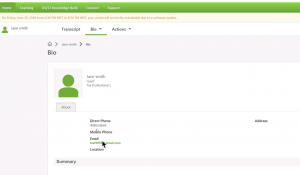
Collectively, these methods allowed me to gain much deeper insight as to the issues the company, instructors, and end users experience when trying to get learners to access Cornerstone for the first time.
Challenges
One challenge I encountered while using these empathy methods was that each subject matter expert had a limited view of the issue, so I need to speak to multiple people to piece together the full scope of the problem. Given the ethical constraints of this course, which limited my involvement to speaking with three people, and for no more than an hour each, I was not able to interview an HR/payroll representative, an instructor, anyone from the technology department, or any new or returning end users.
Another challenge I encountered was a level of resistance from one subject matter expert, who did not want me to explore specific lines of questioning, and defensiveness from another subject matter expert who felt the need to justify previous business decisions. Neither were open to the possibility that other solutions may be available than those implemented in the past, though the AVP mentioned how useful it was to have a fresh set of eyes on the problem.