
Rationale
My top five facilitation strategies focus on social presence because I have a strong tendency toward introversion. Knowing how essential social interactions are for learning (Boettcher, 2013), developing my social presence as an educator would benefit learners by reducing transactional distance with learners during online facilitation (Dunlap & Lowenthal, 2018).
My first facilitation strategy focuses on interactivity. Learner-instructor interaction is of three interactions essential to learning. Digital learning environments create opportunities for educators to interact with learners in ways not possible through face-to-face, in-person facilitation (Boettcher, 2013). An educator’s efforts to develop his or her social presence should not detract from opportunities for learners to interact with their peers or instructional content (Dunlap & Lowenthal, 2018).
The second strategy focuses on connection. Educators can connect with learners at the start of a course and then help learners connect with one another as the course progresses (Salmon, 2018; Bull, 2013). The role of educators is changing from that of an instructor who delivers knowledge to that of a facilitator who encourages learners to take an active role in their learning.
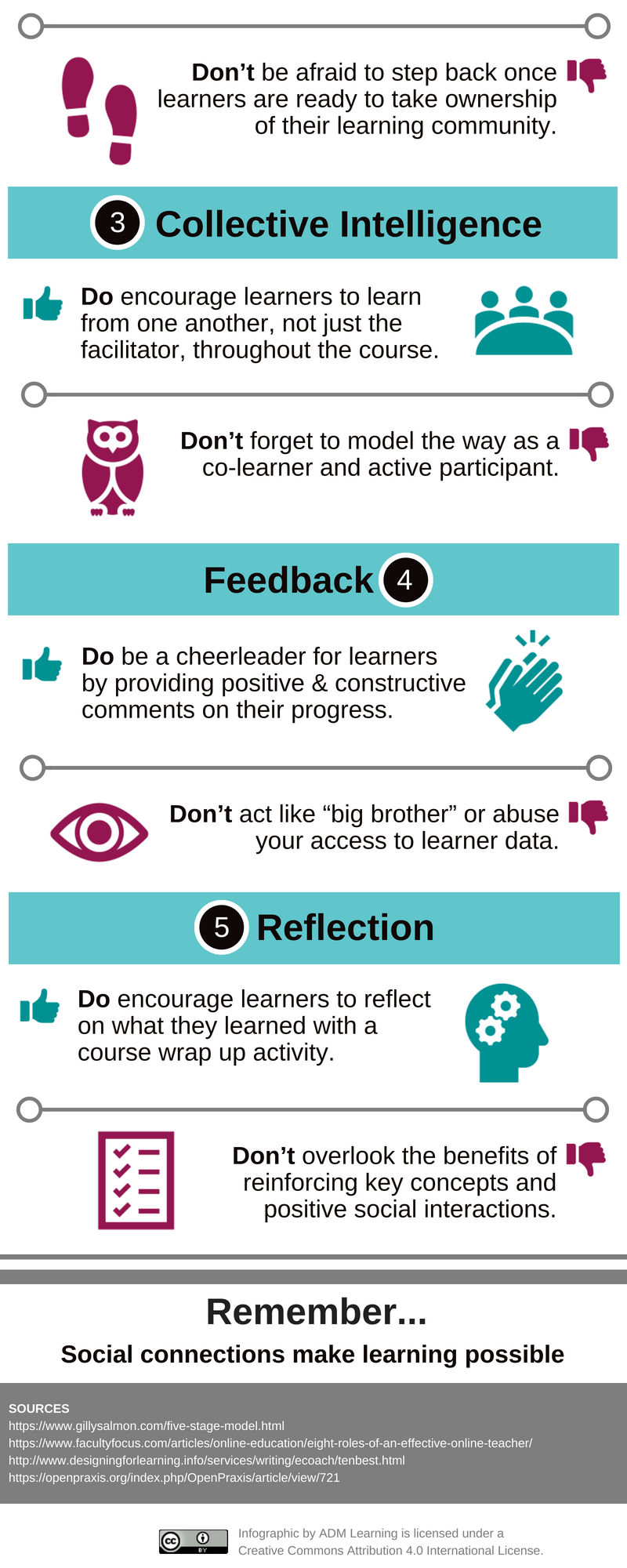
Next, educators can bring together a group to benefit from their collective intelligence (Dunlap & Lowenthal, 2018). Educators offer only one perspective to learners, but adult learners have a wealth of skills and life experiences to share with others (Dunlap & Lowenthal, 2018). By creating opportunities for learners to learn from one another, and by being life-long learners themselves (Bull, 2013), educators can deepen the learning experience for everyone.
The fourth facilitation strategy focuses on feedback. Learners need to feel supported throughout the learning process (Dunlap & Lowenthal, 2018). They need sometimes need external motivation such as words of encouragement from facilitators to stay engaged (Bull, 2013). Learners benefit when educators offer feedback that is timely, constructive, and positive. Educators may have access to learner data that can guide their feedback to learners; at the same time, educators need to make sure they use learning analytics ethically and without abusing power (Bull, 2013).
Lastly, the final facilitation strategy focuses on reflection. Educators who create wrap-up activities to reinforce key concepts encourage learners to reflect on their experiences and relate them to their own lives (Boettcher, 2013). Learners also benefit when educators highlight the positive interactions that occurred throughout the learning experience (Boettcher, 2013).
Ultimately, social connections make learning possible, and there are many facilitation tips and strategies that educators can and should leverage to develop their social presence. Given my natural inclination toward independent, self-directed learning, I focused on strategies for developing my social presence as an area of improvement for my own facilitation skills.
References
Boettcher, J. (2013). Ten Best Practices for Teaching Online Quick Guide for New Online faculty. Retrieved September 15, 2018, from http://www.designingforlearning.info/services/writing/ecoach/tenbest.html
Bull, B. (2013). Eight Roles of an Effective Online Teacher. Retrieved September 15, 2018, from http://www.facultyfocus.com/articles/online-education/eight-roles-of-an-effective-online-teacher/
Dunlap, J. C., & Lowenthal, P. R. (2018). Online educators’ recommendations for teaching online: Crowdsourcing in action. Open Praxis, 10(1), 79–89. https://doi.org/10.5944/openpraxis.10.1.721
Salmon, G. (2018). The five-stage model. Retrieved September 15, 2018, from https://www.gillysalmon.com/five-stage-model.html