The topic of copyright is something that has so many unique elements that it becomes quite a topic of discussion in the world of academics and education. Through my time in education I learned about many of the different elements and then previously in marketing I learned about them as well. It was in a collaborate session from Melanie Wrobel (2016) that I was able to further build my knowledge about copyright. Melanie is the copyright manager of Royal Roads University, so her insight was very valuable when looking at academic copyright.
Copyright came from the Berne Convention (http://www.wipo.int/treaties/en/ip/berne/) which was created in 1886 to protect the works and rights of creators. This convention defines terms of protection, public domain, law of the land and fair uses of copyright works.
An interesting element of the copyright that Wrobel (2016) discussed was that ideas are not copyright and it is simply the unique expression of that idea that is copyright and that while a citation is enough to avoid plagiarism it may not be enough to avoid copyright infringement.
The discussion also turned to defining Public Domain which means that the copyright of a work has expired. The current Canadian law is the year the author dies plus 50 but if the TPP passes then that 50 will likely increase to 70.
That said there are multiple exception for copyright including:
“fair dealing, educational exceptions, exceptions for persons with perceptual disabilities, exceptions for libraries, archives and museums, ‘Mash-ups’ and personal back-up copies.” (16:57)
The fair dealing policy was the portion that I found the most interesting and how it relates to education. To further illustrate this Wrobel (2016) shared this information on the RRU fair dealing policy which is based on the Universities Canada guidelines:
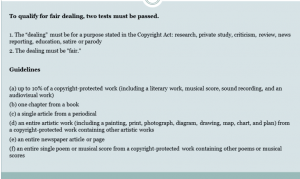 (17:24)
I have always found that Creative Commons (https://creativecommons.org/) and open source (https://opensource.org/) are the most interesting elements of copyright as there are so many different levels of how you can use these tools, images or works and the freedom you have to be able to use it.
I have used the Creative Commons information quite a bit myself and often use the Creative Commons 0 for my images (including for this blog). There are great sites such as Unsplash (https://unsplash.com), Pexels (https://www.pexels.com/) and Pixabay (https://pixabay.com/) that give these images where citation and copyright is not needed as the authors have completely given their work for use by others.
- (n.d.). Beautiful Free Images & Pictures | Unsplash. Retrieved from https://unsplash.com/
Berne Convention for the Protection of Literary and Artistic Works. (n.d.). Retrieved from http://www.wipo.int/treaties/en/ip/berne/
Free high quality photos · Pexels. (n.d.). Retrieved from https://www.pexels.com/
News. (n.d.). Retrieved from https://opensource.org/
Pixabay · Stunning Free Images. (n.d.). Retrieved from https://pixabay.com/
Wrobel, M. (presenter). (2016). LRNT 522 [webcast]. Retrieved from https://moodle.royalroads.ca/moodle/mod/page/view.php?id=279464

August 19, 2018 at 5:52 pm
Jeff,
I enjoyed your clear discussion of key points from Melanie Wrobel’s recording on Canadian copyright. Thanks for the links to good sites for free images.