Design Thinking Reflection and Design Principles
The educational landscape is once again being impacted by the rapid spread of the newest COVID variant. While many sectors asked employees to continue working remotely and numerous post-secondary institutions began the winter semester with virtual classes, provincial governments in Canada took varied approaches to the return of K-12 students. Although some provinces and territories delayed the return to in-person classes and moved K-12 online, students and teachers in other jurisdictions, including British Columbia and Alberta, returned to the classroom for in-person learning (O’Donovan, 2022). These varied approaches occurred amid a very public debate in the news and social media about the benefits of virtual versus in-person learning for K-12 students. Although one could argue for or against either side of this debate, it is important to recognize the critical role of meaningful and intentional design:
I have done whole degrees both online and in person. My online courses were much better. But they were intentionally designed and are continually improved. Design is what is important. The modality is part of it. Not the totality of it. (Noel, 2022)
Instructional designers have the opportunity to design powerful and engaging learning experiences, and thus have the responsibility to advocate for learning in digital environments. Engaging in design thinking and being mindful of the principles informing design decisions has the potential to lead to human-centred, meaningful, and transformative learning designs that may be utilized in a variety of educational settings.
The Design Thinking Process
While Omicron wrought havoc in Canada and across the globe, I serendipitously had the opportunity to work through the design thinking process. My partner and I utilized the d.School design thinking process (Doorley et al., 2018) to develop a design which was ”focused on creating human centered, agentive spaces for learning in digital environments” (Donahue & Keating, 2021, para. 1). Although my partner and I worked in different industries and with learners of different ages, we quickly found common ground and were pleasantly surprised by the similar realities and challenges of our different contexts. It was immediately clear we both firmly agreed with Weller’s (2020) assertion that education “is a fundamentally human experience” (p. 159). We used our common understanding to drive the guiding principles of our design, which focused on building connections, creating spaces for connection and collaboration, encouraging mentorship, valuing learning for learning through ungrading, and applying gamification to encourage engagement (Donahue & Keating, 2021). Our goal was to create a design that could be applied in both of our contexts: with adult learners in virtual settings and middle school students in both digital and in-person environments.
My experience of working through the design thinking process was incredibly rewarding. After my partner and I finished creating our design solution, I pondered my experiences as an educator and instructional designer. I reflected on my role as a middle school teacher and the core beliefs at the heart of the decisions I make. Cable (2015) defined a good design principle as something that “should fundamentally allow you to make a design decision” (para. 12) and advised instructional designers writing design principles to “ask yourself if it will help you make a decision, if not, ditch it” (para. 12). Taking this advice to heart, contemplating my experiences as a K-12 teacher, and reflecting on the experience of working through the design process led me to refine my design principles.
Mrs. D’s Design Principles
Mrs. D’s design principles are intended for educators and designers working in K-12 digital environments, but may be adapted to fit other educational environments and contexts.
Figure 1
Mrs. D’s Design Manifesto
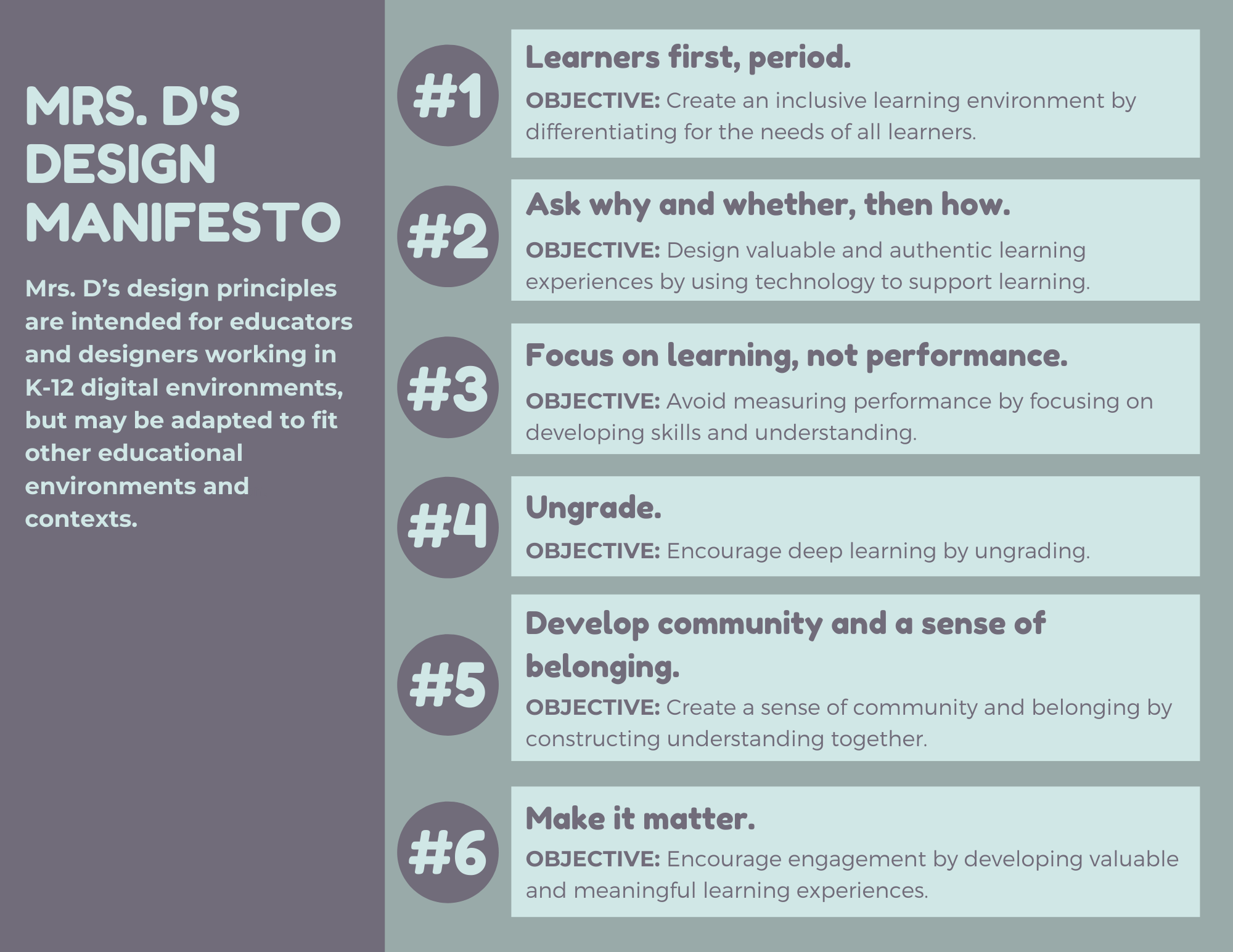
Design Principle #1: Learners first, period.
OBJECTIVE: Create an inclusive learning environment by differentiating for the needs of all learners.
CAST, the Center for Applied Special Technology, created the Universal Design for Learning (UDL) guidelines, which “offer a set of concrete suggestions that can be applied to any discipline or domain to ensure that all learners can access and participate in meaningful, challenging learning opportunities” (CAST, n.d., para. 1). The UDL guidelines provide educators with strategies to differentiate through multiple means of engagement, representation, and action and expression, thereby creating more accessible and equitable learning experiences for all learners.
Design Principle #2: Ask why and whether, then how.
OBJECTIVE: Design valuable and authentic learning experiences by using technology to support learning.
Morris (2018) advised instructional designers to take a critical view and ask critical questions about technology use. Learning, as Morris asserted, is an act of “engaging in a process of becoming conscious” (para. 11) and thus requires deliberate thought on the part of the instructional designer about how each and every technological tool contributes to the development of this consciousness. By asking critical questions about why technological tools should (or should not) be used before asking how technological tools may be used, designers can incorporate appropriate tools which complement learners’ strengths and needs.
Design Principle #3: Focus on learning, not performance.
OBJECTIVE: Avoid measuring performance by focusing on developing skills and understanding.
Werdmüller (2022) suggested that society’s perception around educational systems is focused on “showing that we have educated people. It’s not about holistically helping to give people the tools to really succeed in life … but much more about showing that we’ve hit our Key Performance Indicators for society …” (para. 4). Although the act of evaluating learner performance is an entrenched practice in education, researchers are questioning the value of grading as an accurate reflection of learning. Stommel (2018) argued that “the work of grading is framed less in terms of giving feedback or encouraging learning and more as a way of ranking students against one another” (para. 4), and validates education’s “culture of evidence” (Shavelson, 2007, p. 28) which does not necessarily lead to progress and deep learning. Learners are best served by learning experiences designed with a focus on learning, not performance.
Design Principle #4: Ungrade.
OBJECTIVE: Encourage deep learning by ungrading.
Ungrading is defined by Moore (2021) as “eliminating grades from the teaching and learning environment to the greatest extent possible” (para. 2). Stommel (2018) provided several ungrading practices that may be utilized including: learner self-assessments, process letters, student created rubrics, formative feedback, and contract grading. By applying ungrading as a design principle, designers may avoid the pitfalls of assigning arbitrary levels of achievement and instead focus on the intrinsic value of learning.
Design Principle #5: Develop community and a sense of belonging.
OBJECTIVE: Create a sense of community and belonging by constructing understanding together.
Educational research recognizes the significance of the social constructivist and connectivist models of learning. Vygotsky’s social-constructivism pointed to the role of people in learning and the social construction of knowledge. Connectivism proposed that learning occurs while navigating the connections in both human and non-human networks (Dron, 2014). Designers are encouraged to be aware of the social-constructivist and connectivist elements of learning and recognize that “instructional design is as much a human endeavor as face-to-face teaching …” (Osguthorpe et al., 2003, para. 8). By designing learning experiences that prioritize the human element of learning, learners will have the opportunity to collaboratively construct knowledge and understanding in a community of connection and belonging.
Design Principle #6: Make it matter.
OBJECTIVE: Encourage engagement by developing valuable and meaningful learning experiences.
Instructional design as a means for “improving teaching and learning” (Osguthorpe et al., 2003, para. 23) requires designers to adopt Papert’s (n.d.) idea of hard fun, the challenge of “finding kinds of work that will harness the passion of the learner to the hard work needed to master difficult material and acquire habits of self-discipline” (para. 1). Learners are well served by designs that include both the element of fun and the challenge to engage in rigorous thought and knowledge construction.
Thoughtful instructional design has the potential to provide learners with meaningful and transformative learning experiences. Design thinking and design principles may be utilized by instructional designers to develop learning experiences that equip learners with the competencies necessary for life in the digital age.
References
Center for Applied Special Technology. (n.d.). The UDL Guidelines. https://udlguidelines.cast.org/?utm_source=castsite&lutm_medium=web&utm_campaign=none&utm_content=aboutudl
Cable, S. (2015, June 18). Design principles – a guide. Cxpartners. https://www.cxpartners.co.uk/our-thinking/design-principles
Donahue, A., & Keating, E. (2021, December 30). Design Thinking Challenge: The Solution Paper. Amber’s Blog. https://malat-webspace.royalroads.ca/rru0202/
Doorley, S., Holcomb, S., Klebahn, P., Segovia, K., & Utley, J. (2018). Design Thinking Bootcamp Bootleg. Adapted from Hasso Plattner Institute for Design, Stanford University. dschool.stanford.edu/resources/design-thinking-bootleg
Dron, J. (2014). Innovation and Change: Changing how we change. In O. Zawacki-Richter, & T. Anderson (Eds.), Online distance education: Towards a research agenda (pp. 237-265). Athabasca University Press. https://www.aupress.ca/books/120233-online-distance-education/
Moore, C. (2021). #Ungrading: A Digital Ethnography. [Doctoral dissertation, Oakland University]. https://sites.google.com/view/christinamoorework/ungrading-a-digital-ethnography
Morris, S. M. (2018). Critical Instructional Design. In An Urgency of Teachers. Pressbooks. https://criticaldigitalpedagogy.pressbooks.com/chapter/critical-pedagogy-and-learning-online/
Noel, N. [@nicknoel721]. (2022, January 7). I have done whole degrees both online and in person. My online courses were much better. But they were intentionally [Tweet]. Twitter. https://twitter.com/nicknoel721/status/1479524299459506178
O’Donovan, C. (2022, January 3). Concerns rise as Saskatchewan students return to class while out-of-province peers stay home. GlobalNews. https://globalnews.ca/news/8485985/concerns-rise-omicron-saskatchewan-students/
Osguthorpe, R. T., Osguthorpe, R. D., Jacob, W. J., & Davies, R. (2003). The moral dimensions of instructional design. In R. West (Ed.), Foundations of learning and instructional design technology (1st ed.). EdTech Books. https://edtechbooks.org/lidtfoundations/
Papert, S. (n.d.). Hard fun. The Daily Papert. http://dailypapert.com/hard-fun/
Shavelson, R. J. (2007). Assessing student learning responsibly: From history to an audacious proposal. Change: The Magazine of Higher Learning, 39(1), 26-33.
Stommel, J. (2018). How to Ungrade. https://www.jessestommel.com/how-to-ungrade/
Weller, M. (2020). 25 Years of Ed Tech. Athabasca University Press. https://read.aupress.ca/projects/25-years-of-ed-tech
Werdmüller, B. (2022, January). The perfomative demonstration of education. Ben Werdmüller. https://werd.io/2022/the-perfomative-demonstration-of-education