Design Thinking Challenge: The Solution Paper
Reimagining digital learning environments to realize the potential of critical instructional design is a necessity for all instructional designers as education systems evolve to prepare learners for the 21st century. Morris (2017) defined critical instructional design as “an early, emerging attempt to get at some concrete methodologies for creating agentive spaces in online and hybrid learning environments” (para. 22). By engaging in the d.School design thinking process (Doorley et al., 2018), we developed a design solution focused on creating human centered, agentive spaces for learning in digital environments. Our solution, as shown in Figure 1, includes five guiding principles: 1) facilitating peer connections prior to course beginning, 2) creating an open and common space for connection and collaboration, 3) building a peer mentorship program, 4) moving towards ungrading and valuing learning for learning, and 5) encouraging engagement through gamification.
Figure 1
Design Thinking Solution
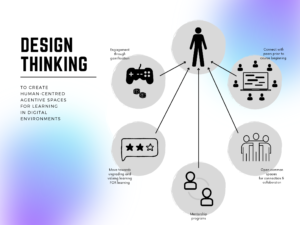
Facilitating Peer Connections
The first guiding principle of our design solution incorporates an introductory padlet forum at the beginning of the program design. One challenge of a digital learning space is the ability for learners to recognize each other as people, real people, and relate to each other as such. Weller (2020) wisely reminded us that education “is a fundamentally human experience” (p. 159), and our aim was to recognize and celebrate the lives and people behind the screens. Learners begin the course by completing a questionnaire answering questions about themselves, their interests, characteristics, and other personal information that would be shared in an open space such as Padlet. In doing so learners may gain an idea of who their classmates are as individuals, and develop an identity as a group. Sharing characteristics of each learner such as height or favourite food may help classmates relate to each other. Connections between learners may be made as the unique characteristics and traits that may not otherwise be visible are discovered.
Creating an Open Common Space for Connection and Collaboration
The second guiding principle of our design solution focuses on connectivist learning theory: the theory that knowledge exists in the connections or relationships had with others and learning is not an individual activity (Siemens, 2005). Digital platforms such as Collaborate, Google sites, Microsoft Teams, or Gather.Town can be utilized to construct virtual common rooms that provide a common space for learners to gather, problem solve, and connect on academic and personal levels. Creating this open, common space for those connections to be made may increase the collaboration and overall cohesiveness of the group, and give learners an opportunity to engage in a digital version of campus life outside of the classroom (Rogers et al., 2021).
Building Peer Mentorship Programs
The third guiding principle of our design solution incorporates a peer mentorship program as an integral component of our course structure. Peer mentorships can be defined as a relationship between a more experienced peer and less experienced peer(s) who are close in age and position, with the more experienced peer providing support (Marshall et al., 2021). Research has shown that learners who are part of peer mentorships are supported both academically and personally, as many students struggle with stressors and issues that are not academic in nature (Rosenthal & Shinebarger, 2010). Having the ability to go to an experienced peer mentor for advice may result in improved levels of understanding course content, higher achievement, and higher levels of comfort and belonging (Marshall et al., 2021). Our design solution includes assigning small groups of students to an experienced peer mentor who has already completed the course. Mentor and mentee meetings will initially be set by the instructor and will take place in the course’s common open space. As the relationship between the mentor and mentees develops, mentees will be encouraged to reach out to their mentor when needed, and mentors will regularly check in with their mentees. By building a peer mentorship program, learners will be able to make personalized connections and develop supportive peer relationships, which will in turn result in deeper levels of engagement and learning.
Ungrading
The fourth guiding principle of our solution is moving towards ungrading. Ungrading began trending on Twitter in 2016, and quickly developed a following of educators who were committed to “eliminating grades from the teaching and learning environment to the greatest extent possible” (Moore, 2021). An examination of the history of grading makes it evident that grading is entrenched in a culture of establishing evidence, but as Shavelson (2007) argued, “cultures of evidence do not automatically lead to educational improvement if what counts as evidence does not also count as education or counts as only part of it” (p. 28). Stommel (2018) further argued that “the work of grading is framed less in terms of giving feedback or encouraging learning and more as a way of ranking students against one another” (para. 4). Our design solution is based on a philosophy of ungrading in order to encourage students to engage in learning for the joy of learning itself, not to receive grades or arbitrarily assigned evidence of levels of learning achieved. By providing formative feedback, engaging in dialogues with learners, encouraging self-reflection and self-assessment, learners will have the opportunity to see the intrinsic value of learning as opposed to the extrinsic reward of receiving grades.
Encouraging Engagement Through Gamification
The final principle of our design solution revolved around the use of gamification in learning. Well designed, computer-based games have been shown to improve engagement and motivation, and lead to improved knowledge retention and overall learning (Sanchez et al, 2020; Whitton, 2011). Gamification can be utilized by all fields and can be designed to be highly adaptable to fit varying levels of education, including higher education (Whitton, 2011). Gamification as a central principle of our course design may lead to increased levels of engagement, collaboration, and risk-taking. Crichton and Carter (2017) refer to Papert’s idea of “hard fun” (p. 40) and explore the benefits of bringing designing thinking into classrooms by encouraging innovation and creativity in a safe environment that supports risk-taking. By incorporating gamification into the learning design learners benefit from a highly stimulating and engaging learning environment.
Instructional designers would be well-served by being mindful of the needs of 21st century learners. Technology is increasingly connecting people around the globe across time and distance, and as such, the skills needed to engage are evolving. By focusing our design solution on creating human centred, agentive spaces for learning in digital environments, learners will be empowered with the skills and confidence to be agents of change in a brave new world.
References
Crichton, S. & Carter, D. (2017). Taking Making into Classrooms Toolkit. Open School/ITA.
Doorley et al. (2018). Design Thinking Bootcamp Bootleg. Adapted from Hasso Plattner Institute for Design, Stanford University. dschool.stanford.edu/resources/design-thinking-bootleg
Marshall, M., Dobbs-Oates, J., Kunberger, T., & Greene, J. (2021). The peer mentor experience: benefits and challenges in undergraduate programs. Mentoring & Tutoring: Partnership in Learning, 29(1).
Moore, C. (2021). #Ungrading: A Digital Ethnography. [Doctoral dissertation, Oakland University]. https://sites.google.com/view/christinamoorework/ungrading-a-digital-ethnography
Morris, S. M. (2017). A Call for Critical Instructional Design. https://www.seanmichaelmorris.com/a-call-for-critical-instructional-design/
Rogers, Y., Lettieri, P., & Meunier, B. (2021, March 30). Life beyond Zoom and Teams: Students are ready for next gen online spaces. THECampus: Part of Times Higher Education. https://www.timeshighereducation.com/campus/life-beyond-zoom-and-teams-students-are-ready-next-gen-online-spaces
Rosenthal, K. I., & Shinebarger, S. H. (2010). Peer mentors: helping bridge the advising gap. About Campus, 15(1), 24–27.
Sanchez, D. R., Langer, M., & Kaur, R. (2020). Gamification in the classroom: Examining the impact of gamified quizzes on student learning. Computers & Education, 144. https://doi.org/10.1016/j.compedu.2019.103666
Shavelson, R. J. (2007). Assessing student learning responsibly: From history to an audacious proposal. Change: The Magazine of Higher Learning, 39(1), 26-33.
Siemens, G. (2005). Connectivism: A learning theory for the digital age. International Journal of Instructional Technology and Distance Learning (ITDL). Retrieved from http://citeseerx.ist.psu.edu/viewdoc/download?doi=10.1.1.1089.2000&rep=rep1&type=pdf
Stommel, J. (2018). How to Ungrade. https://www.jessestommel.com/how-to-ungrade/
Weller, M. (2020). 25 Years of Ed Tech. Athabasca University Press.
Whitton, N. (2011). Game Engagement Theory and Adult Learning. Simulation & Gaming, 42(5), 596–609. https://doi.org/10.1177/1046878110378587