The topics we have explored during this course have been: leadership, initiating change, leading change, data driven change, and implementing a project plan for a change in our own organization. One of the most interesting topics I found was the idea of leadership from within an organization. When I think about the characteristics of leaders, I reflect on the team exercise requiring us to rank traits of admired leaders in order of most important to least important. I was not surprised by how different our rankings were, as it is debatable what the definition of an ‘admired leader’ even is. I was however, surprised that we all identified the attribute “independent” as almost last, myself ranking it 17 out of 20.
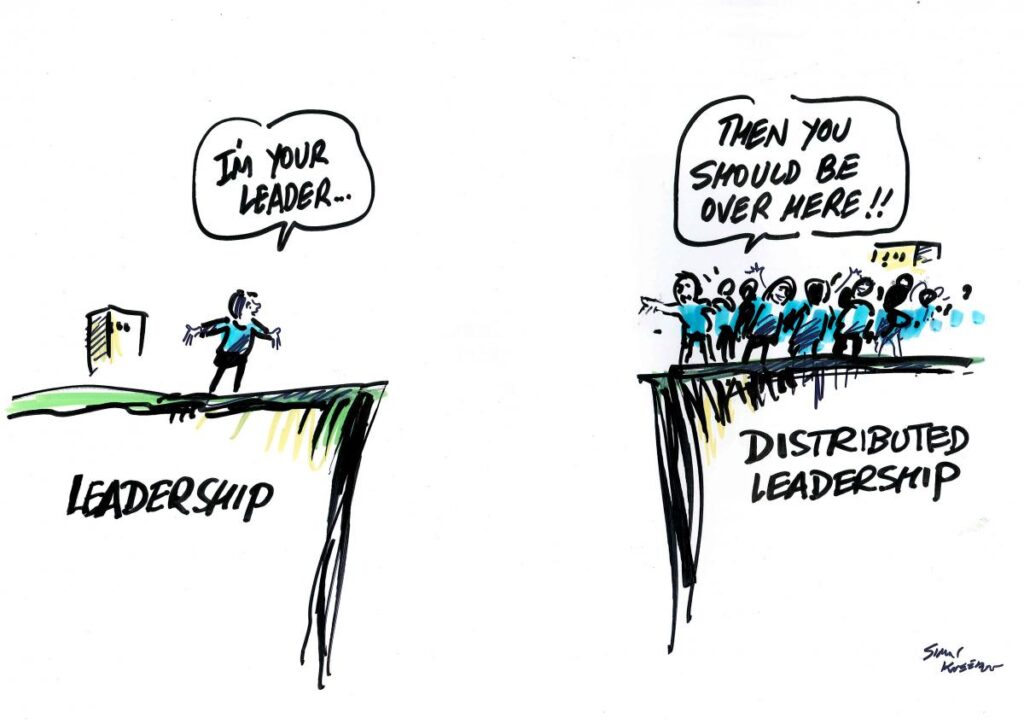
The idea of distributed leadership was a new definition to me. I align myself most with the idea of distributed leadership, or shared management. This sharing of roles, responsibilities and knowledge resonates with the values I ranked the highest; inspiring, honest, supportive, mature, broad minded. In sharing the role of leader, we not only benefit from the expertise of many, we hold our leaders to task. Independence is not a good quality in a leader. In order to be a leader we should act with the best interest of the organization and each other.
Initiating change in a digital learning environment is a great environment for distributed leadership to take hold. Collaboration between instructional designers, facilitators, students and all other stakeholders is important to meet the needs of the ever-changing landscape of digital education. This can be a great way to enhance a shared vision. Leading does not mean stepping ahead, it can be as simple as keeping the forward momentum.
My organization was recently challenged by the need to track the increasing volume of patients that were being treated while recovering from occupational injuries. The need arose as the volume of patients increased, and the previous paper system of tracking and filing these patients was becoming insufficient. A streamlined, digital solution was needed. The need for change was driven by several factors:
An increase in patients limited the time that could be spent reviewing each case as they came in
Patients were at varying levels of rehabilitation and treatment and required individual case management, often this needed to be updated and reviewed each visit
The addition of new staff required a new process that could be easily communicated and followed
A streamlined system was needed that could be easily referenced and shared with medical oversight
The benefits of a new digital system included the patients, medical staff, and the overseeing client, and were identified as follows:
The patients would receive rapid care with limited need for redundant paperwork and assessments
Reduced time reviewing the cases would reduce the cost-time to the client
Digital charting on case management would limit time spend on paper charting, as repetitive information could easily be copied from one visit to the next
Resources and handouts could be attached to each patient case file and retrieved electronically
Media such as photos could be scanned into the case review file for tracking of injuries and progress
Data regarding each case could be clearly obtainable and used for monthly reports if required
The project plan was initially developed as a digital file system with an assessment template that was filled in by the practitioner during each patient visit. Each previous visit was attached to the patient’s file by date for reference. Once the case was closed a discharge review was done and the patient case file was uploaded to the patient’s main medical file. The team provided input during the development of the system such as which templates to include, and which critical data would be visible in the file summary for ease of identifying where the patient was in their plan; for example, the initial date of injury, and their next appointment.
The project plan initially had some barriers. Staff were comfortable with the paper recording of each patient and had previously physically communicated the patient treatment plan with each other. A lot of information on each case was mentally stored by the practitioner themselves and was lost when that staff member was not on shift, or the patient was seen by another practitioner. Change is successful when people value the change (Weiner, 2009). The first barrier to overcome was to achieve support of the people who would be using it. This stared with the leadership supporting the use of the new system, and supporting the learning process for staff to become comfortable with the system. Leading by example is heavily dependent on the leadership, and increases the organization’s ability to achieve successful, long term change (Antwi et al, 2014). Once staff started to work with the program we realized it made our assessments easier for everyone. Conner (1998, as cited in Al-Haddad et al, 2015) stated the drivers of change are connected, and has a chain reaction that affects the organization as a whole.
One challenge was the team that worked during the day had more support than the night shifts, and this caused some staff to revert back to paper charting without management present to support them. Technical issues such as poor internet connection caused some staff working remotely to have challenges uploading their files.
Changes to be made:
An inclusive meeting with all staff during the brainstorming phase would have given a chance for everyone to make suggestions prior to rolling out the program. I believe this would have gotten more support from the staff if they felt they were a part of the change development. This is supported by the Participatory Action Research (PAR) model discussed by Al-Haddad et al (2015), and states that input gathered by the people undergoing the change makes them feel more involved and responsible for making sure the change succeeds.
Teaching sessions should be made available to all staff prior to rolling out the program to allow everyone to start using it at once, rather than only those who had been trained. This would prevent staff from feeling left out and not supporting the change by reverting back to paper charting. Hopefully this would alleviate some technical issues that came up when staff were working alone on night shifts.
Overall the program worked well and was eventually supported by all the team members. For a larger team the program may have to be re-evaluated as more feedback is given on the efficiency of the program. For the patient type most seen, the file system works, however if the patient type changes, or requires additional forms, procedures, or referrals, the templates may need to change.
References:
Al-Haddad, S., & Kotnour, T. (2015). Integrating the organizational change literature: a model for successful change. Journal of Organizational Change Management, 28(2), 234-262. https://doi.org/10.1108/JOCM-11-2013-0215
Weiner, B. J. (2009). A theory of organizational readiness for change. Implementation Science, 4(67). https://implementationscience.biomedcentral.com/articles/10.1186/1748-5908-4-67
Education is changing, and with change comes a responsibility to make strategic decisions about where the future of education is heading. Data has been used to drive improvements and planning in school systems since the 1970’s (Massell, 2001, as cited in Marsh et al, 2006). Recently, more and more institutions have employed learning analytics and the use of data to assist in navigating challenges faced by a changing educational landscape.
The amount of data collection is staggering. Information on enrolment, curriculum development, student performance, and student satisfaction, to name a few, are collected from teachers, students, principles, and administrators at a startling rate; you name it, someone is collecting data on it somewhere. But where does all this data go? And is it driving change in the right way?
There are many things to consider when interpreting and using data:
Who are we collecting data from? There is an argument that data used to drive change should be obtained from the people who are affected by the change, those who are in a position to provide the most reliable, relevant data or who have insight into the issue being examined. There are however, moral issues to consider when obtaining data from a student group, especially in the field of healthcare. This has led many institutions to create policies addressing the collection and use of data for learning analytics.
Is the data representative of the question asked? For example, when obtaining data on performance, do test scores accurately reflect students’ knowledge, or does it reflect the curriculum objectives? (Marsh et al, 2006). Data collection is only useful if it is done with purpose (Zettelmeyer, 2015).
Is the data recent and applicable to the current situation? Data collection takes time and can be less useful when used to make decisions that need to be made swiftly or in response to a change in the environment. Time lag between data collection, processing, and application can create a mismatch between data and decision making (Marsh et al, 2006).
In my field of healthcare, there are many privacy concerns that arise when collecting data, especially personal data. To facilitate the development of ‘better business’ in teaching healthcare, it is important to have privacy policies in place surrounding the collection of data. The results of data driven change is also important to include when developing change. Reviewing the results of data driven change ensures the change is actually working.
Ultimately, choosing the problems that need to be solved is important, but the data collected has to match the specific problem needing to be solved. As stated by Zettelmeyer (2015, para 13), all data needs to be viewed with caution as “analytics is no substitute for understanding the business.”
A leader is commonly thought of as an inspiring individual who will rally their team, support the members, and move everyone towards progress. A leader can lead a team or group of people, such as a political figure or head of an organization, or a leader can be an individual in a field, such as healthcare or education. In education, multiple leadership theories have yet to define what creates a successful leader, or for that matter, what leadership is (Workman et al, 2012). Specifically for digital learning environments, characteristics of a leader are many, and we must first look at what leadership is defined as in this field. Workman et al (2012) argue that the definition of true leadership is defined by the outcomes rather than the inputs. If the measurement of leadership in digital learning environments is the outcome, one can assume a good leader must be able to achieve progress. To avoid a tangly mess of definitions, I will move forward with my own perspective on leadership in the field of education specifically in digital learning environments. To me, a leader in digital learning environments means a key player in the field of technological education.
Digital learning environments (DLE’s) are dynamic. Constant reflection, learning, and self development are required to simply remain current in the field. To be a leader you need to be the tip of the spear, innovating, developing, and providing a path for others to follow and expand upon. Reflective leadership can lead to new insights, improved organizational performance, and is often associated with good judgement and wisdom (Castelli, 2016). Reflective leaders trust their own intuition and are often good problem solvers and critical thinkers, internal qualities that are just as important in a leader as external qualities such as knowledge or experience (Castelli, 2016). In DLE’s, I believe a reflective leader will be more mindful of their thought process and able to see success or failure as a process not an isolated event. Reflecting on the developments or changes in the field of DLE’s allows the leader to move towards successful progress, and therefore, be more apt to create more successes in the future.
Not all qualities of a successful leader are as retroactive as reflection. A leader in DLE’s also needs to be innovative. Understanding the needs of the digital environment helps to develop innovative solutions, but sometimes success comes from left field. A visionary leader develops a new ‘story’ that can be conveyed to others, fostering inspiration and personal drive (Gardner, 2011, as cited in Workman et al, 2012). Innovation is required to see changes that need to happen in the field of education and DLE’s. “If there is no grand vision upon which to base change in education, little will happen (Workman et al, 2012, p.320). Innovation in a leader can lead to new perspectives on challenges within the field of education and possibly new solutions.
The most important characteristics for leadership in digital learning environments are reflection and innovation. Workman et al (2012) discuss the importance of innovation in leadership to facilitate and support change, the need for reflection to support personal transformation, without such, leadership is simply put, management (p321). If the goal is to remain constant, then management is required; if growth is required, leadership is required. DLE’s require leaders who are innovative, reflective, and visionary to drive change in education, especially digital learning education environments.
References:
Castelli, P. A. (2016). Reflective leadership review: A framework for improving organisational performance. The Journal of Management Development, 35(2), 217-236. doi:http://dx.doi.org/10.1108/JMD-08-2015-0112
Workman, T., & Cleveland-Innes, M. (2012). Leadership, personal transformation, and management.The International Review of Research in Open and Distributed Learning, 13(4), 313-323. https://doi.org/10.19173/irrodl.v13i4.1383