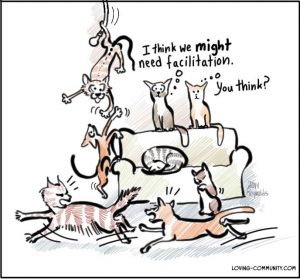
Facilitating Digital Environments: Activity 1

My initial thoughts on facilitation in a digital environment center around my own experiences with online learning. There have been some highs and lows in regards to online learning, and many of my so-called challenging experiences have come from what I interpret as poor facilitation. 

3 initial thoughts I have about facilitation in digital environments

  • Facilitation is a continuous process: A good facilitator is present often (sometimes daily), keeping the conversations going and responding to students in a timely matter. I find this maintains momentum of the learning environment and creates trust in the process. 
  • Maintain a social connection: It can be challenging to see each other as people in digital environments. Facilitating a group of people requires everyone to see each other as people, and not an avatar or username in a chat room.
  • Be a model user: A facilitator is responsible for maintaining the standard for behaviour within the group, and this can be a challenge with large groups or among varied backgrounds. It’s important for the facilitator to set the standard for conduct, participation, and overall tone of the digital space.

2 questions about digital facilitation

  • How do you keep everyone at the same speed in a digital learning environment or online course?
  • How do you gauge participation from students who are more observers than contributors? (and is observing an equal participation?)

1 metaphor I have for digital facilitation

  • “It’s like herding cats….”

The Value of Reflection

Reviewing Session 2 of the OpenLearn UK course Succeeding in Postgraduate Study, what stood out to me was the use of the terms reflective thinking, reflective learning, and reflective practice.  Reflective thinking needs to focus on the process not the outcome; reflecting during the learning (reflection-in-action), and after the learning (reflection-on-action). For me, the idea of reflective thinking had been a cyclic process eventually coming back around to the issue I am reflecting on. What I have discovered is that reflection does not necessarily have to lead to a conclusion. It is a dynamic, often non-linear process that does not start and stop, but rather re-start and pause, then start again.  

Being a reflective learner rather than reflection being something we do suggests reflection can be integrated into the way we learn in general, helping us set appropriate goals, evaluate our success, and identify barriers.

There are many models available that illustrate reflection, and some may or may not be useful for the purpose of one’s reflection, however they are just tools. True reflection comes from changing the way we think and relate to challenges. This stood out to me when I think about reflective practice; it is important to appreciate the role reflection has in many factors of our life from work, school, or personal life. 

Reflecting on my progress through the MALAT program one of my measures of reflection has been this blog site. On these pages are visual reminders of my journey through this program. Reflecting on my progress allows me to step back and see the program in its entirety, how each course builds on its predecessor and fits into the bigger picture. Reviewing my progress through the program allows me time to pause and refocus on my goals of completing the program itself and how I want to use the knowledge going forward.

References

Addae-Kyeremeh & Rezaie (n.d.) OpenLearn UK course. Succeeding in Postgraduate Study. https://www.open.edu/openlearn/mod/oucontent/view.php?id=51386&section=6

Reflection on Design Process for 527

image source

Reflecting on the design process for creating my digital resource, one of the most important elements to my design was for it to be user friendly. During the empathy stage of my design, ‘ease of use’ was a term that came up often in feedback from intended users. Although this was expected, one theme that presented itself was “what seems easy to one person, may not be easy to another.” It was important for me to gather a wide assessment of what ‘ease of use’ actually meant to the users, as we all interpret this differently. 

During the design process, I ended up changing the platform for my digital resource to more accurately reflect this concept, switching from a less known collaborative wiki to GoogleDoc in order to reach more users and make the resource more accessible. 

In the past I have created many digital resources and curriculum content that is within my field of healthcare and paramedic practice. Using the design process for this content has been relatively straightforward because I am familiar with the material and the intended use of the resource within the field of paramedicine. In the future, I would like to use the design process to design resources that have content I am not familiar with. I feel the design process will be a successful map I can follow to evaluate the needs of the user, develop strategies to relay information, and develop material that reflects content that is new to me.