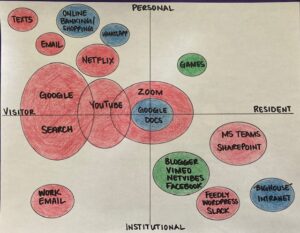
This week’s reading from Weller (2020) took me on a ed tech journey through 2002-2011 which I found fascinating as I reflected on where I was at the time. The chapter on Twitter and social media was interesting as it gave me a better understanding of how Twitter had initially been used and the Between the Chapters: Twitter & Social Media podcast (Pasquini, 2021) just solidified it. Listening to Sue Beckingham and Chrissi Nerantzi share their personal experiences about figuring Twitter out to discovering how they were able to create online networks which formed into online connections/relationships and then the experience of meeting these connections face to face illustrates the positive aspects during those early years compared to the challenges facing Twitter at present time.
Weller (2020) mentions the blurring of the lines between professional and personal on social media and this is an issue that continues to be challenged in my profession that our regulatory college had to create a Social Media interpretation guideline (2018) for its registrants. These new ways of connecting online outside of our clinics posed new challenges. Many of us form close relationships with our patients because we see them on a regular basis and personal information is disclosed at those appointments that they become “friends” or seem like “family” so then how do you NOT accept invites to follow or be followed? Or how do you decline a “friend” who is asking you to follow them so they can share information about their personal views on topics such as anti-fluoride which do not align with your practice philosophy? On the other hand, what happens if a dental professional blogs or tweets against fluoride yet continues to work in a profession where the evidence clearly supports the use of fluoride in the prevention of cavities? Misalignment of practice philosophies can have serious consequences for the professional and the dental office they work at.
Weller (2020) makes the point of how Twitter was able to democratize the academic space. I believe this to be the case for some disciplines but not all especially in those highly specialized disciplines where there is value placed on your training, experience and research. At dental conferences, speakers bring their clinical and research experience to share with colleagues and will share their social media links to connect and answer questions. Twitter or social media is used to connect those using new techniques or to discuss individual cases. However, challenges around professionalism, confidentiality and ethics can arise when posting and sharing online. In addition, I believe that because there is value placed on your training that many of these institutions are less than willing to re-imagine how their programs could be moved to a more open and less regulated one.
References
College of Dental Hygienists of British Columbia. (2018). Interpretation guidelines: Social media. https://www.cdhbc.com/Practice-Resources/Interpretation-Guidelines/Social-Media.aspx
Pasquini, L. (Host). (2021, March 24). Between the chapters #16 being in community on Twitter & social media with @suebecks & @chrissinerantzi. [Audio podcast episode]. 25 Years of Ed Tech: The Serialized Audio Version Bonus. https://25years.opened.ca/2021/02/28/between-the-chapters-twitter-social-media/
Weller, M. (2020). 25 Years of Ed Tech. Athabasca University Press.