Leadership in Change
Change is essential for organizations to be able to grow or even maintain status quo (Al-Haddad & Kotnour, 2015). In my discussion with Moira Walsh, Director of People at SOLAS, Further Education & Training Authority, she explains that change can create fear for many people and that fear often leads to resistance which can result in failure to implement the change effectively (Walsh, 2023).
It is important to have capable leaders to manage change. Leading change does not need to come from the senior level in an organization. Many models call for change champions (Sedmak, J, 2021). It is important to engage these people early in the change process. In my discussion with Mitchell Green, Research and Medical Education Specialist, Royal Victoria Regional Health Centre, he explains that leaders cannot accomplish any change in an organization on their own and they need to enlist others, early on, with the expertise and established relationships to help the employees through the anxiety that inevitably comes with change (Green, 2023). This sentiment is echoed by Christina Jones (n.d.), who explains that leadership in change is integral, but does not need to come from those in a leadership role. If desired behaviours are modeled, then change can be championed by any person at any level of an organization.
I do not believe that leading change in digital learning environments is much different than leading change in any other context. With the exception of digital literacy, the characteristics of effective leadership and the important considerations for successful change do not vary much based on the industry (Sheninger, 2019, Al-Haddad & Kotnour, 2015 ).
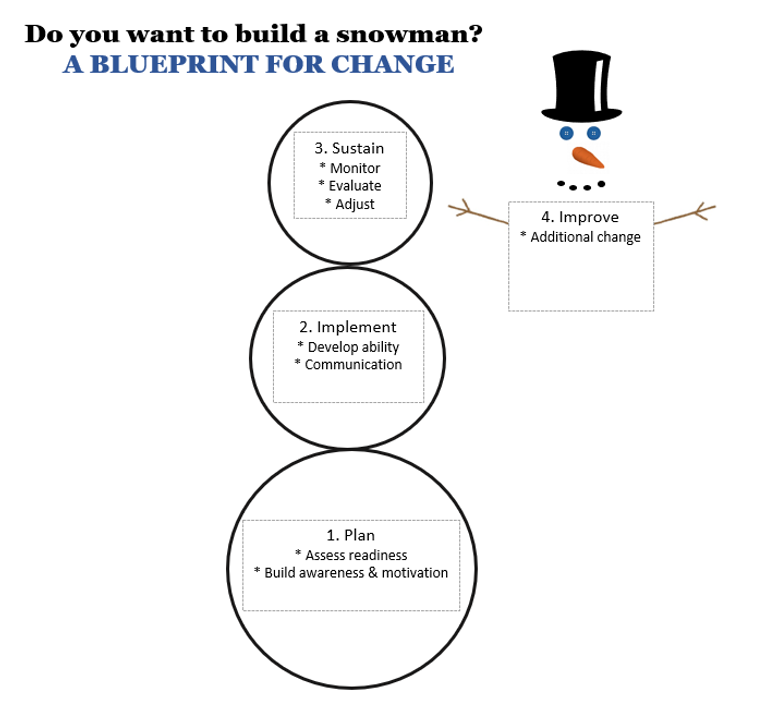
As vital as leadership is to managing change, so too is having a plan and incorporating a change model, or multiple models, into developing a change plan. I propose using a snowman blueprint to lead change. There are four main parts of building a solid snowman: the base, the body, the head and the adornments. These parts correspond to the following stages for change management: plan, implement, sustain, and improve. Each stage, with some corresponding key considerations, is outlined below.
Base: Plan
The largest part of a snowman is the base. This is because you need a solid base to be able to support the other parts. In relation to change management, the largest amount of time should be spent in the planning stage so that there is a solid foundation in place to support the other stages of the change. This is an established practice outlined in most change models such as the PDSA model, the Judson Method, and Hamel’s Insurrection Model (Al-Haddad & Kotnour, 2015).
The first, and important, step of planning is to assess your organization’s readiness for change. You need to make sure that the organization’s conditions are ready for the change, has the resources to support and sustain the change, and that its members believe in the need and value the change, and that there is the capacity to carry out the change (Weiner, 2009). Much like you wouldn’t try to build a snowman on a summer day, you shouldn’t try to implement change if your organization is not ready because it will not be successful.
During the planning stage it is also important to build awareness and motivation about the change. Many models, like Kotter and Luecke’s, indicate that this is key for those people who will ultimately carry out the change to feel invested and engaged in the change (Al-Haddad & Kotnour, 2015).
When building a snowman, you need to make sure you have a solid base before you can move on to the body. When implementing change, you need to remove roadblocks before you can move onto the next step (Boyce, n.d).
Body: Implement
Once you have developed a robust plan, you can build upon that work to move onto the next stage and start implementing the plan and the change.
One key consideration during this stage is to develop the ability of the organization’s members to be able to carry out the initiative. It is imperative that people have the education and training required to be able to feel confident in their abilities to make the change necessary. Many models speak about ability, but one model specifically recognizes training and education as essential in the process is the Canada Health Infoway Change Management Framework (Antwi & Kale, 2014).
Throughout the planning stage, it is very important to always maintain clear, open, and honest communication with the organization’s members. This helps to preserve the motivation established and to keep team members engaged in the change. As Moira Walsh indicated, change can often encounter resistance because of fear. Individual’s ability can be affected by their personal circumstances, but when safe spaces, using open communication, are created to hear individual concerns, they can be addressed as needed to maintain their ability (Boyce, n.d).
Now that the body has been built and placed on the snowman successfully, you can move onto to building the head, and once you have successfully implemented the change, you can look at beginning to sustain the change.
Head: Sustain
Models like Judson Jick & Kanter and Stein’s and the Insurrection Model speak to institutionalizing change, which can also be seen as sustaining the change across the organization (Al-Haddad & Kotnour, 2015). To sustain change, it is vital to always be eliciting feedback, monitoring and measuring outcomes, and adjusting processes as needed based on the information you garner. (Weiner, 2009). If the change implemented is not lasting, you must continue to monitor, evaluate, and make the adjustments required so that the change is sustainable.
Adornments: Improve
Only once you are done building the structure of the snowman can you add on accessories and make it look nice. As suggested in Kotter’s Leading Change Method, only once the change is sustained for a prolonged period can you strengthen the change by making improvements and ultimately embark on more changes. (Al-Haddad & Kotnour, 2015).
References
Al-Haddad, S., & Kotnour, T. (2015). Integrating the organizational change literature: a model for successful change. Journal of Organizational Change Management 28(2), 234-262. https://doi.org/10.1108/JOCM-11-2013-0215
Antwi, M., & Kale, M. (2014, January). Change management in healthcare: Literature review. Monieson Centre for Business Research in Healthcare, Queen’s University, 1-35.
Boyce, C. (n.d.). Interview with Christy Boyce: Leadership and managing change. [Audio Podcast]. In Voices. Welcome to LRNT 525 – Leading Change in Digital Learning. https://malat-coursesite.royalroads.ca/lrnt525/schedule/voices/
Jones, C. (n.d.). Interview with Cristina Jones: Unique Challenges. [Audio Podcast]. In Voices. Welcome to LRNT 525 – Leading Change in Digital Learning. https://malat-coursesite.royalroads.ca/lrnt525/schedule/voices/
Michel, A., Todnem By, R. and Burnes, B. (2013), “The limitations of dispositional resistance in relation to organizational change”, Management Decision, Vol. 51 No. 4, pp. 761-780. https://doi.org/10.1108/00251741311326554
Sedmak, J. (2021, October 19). Change management process: Kotter or Prosci, which is better? Strategy Management Consulting. https://www.smestrategy.net/blog/change-management-process-kotter-prosci
Sheninger, E. (2019, December 19). Pillars of digital leadership. International Centre for Leadership in Education. http://www.leadered.com/pdf/LeadingintheDigitalAge_11.14.pdf
Weiner, B.J. (2009, October 19). A theory of organizational readiness for change. Implementation Science, 4(67). https://doi.org/10.1186/1748-5908-4-67
02/21/2023 at 4:34 pm
Thanks for your informative post Rebecca. Your diagram was festive and fit for the weather and identified some key aspects for successful change!
You discuss in your post the significant need for “change champions” (Sedmark, 2021). Do you see much of this in your current organization? Have you ever been a change champion? I am also wondering if ‘challengers-to-change’ would be beneficial here too. I ask this as sometimes I feel in my career that we have ‘change for change’s sake’: a clear purpose or reason for change is also critical.
Terry
02/22/2023 at 4:35 am
Hi Terry,
I know the feeling a “change for change’s sake” for sure. I work in healthcare and while, most changes are needed into to create efficiencies or keep up with advancements, there have been times where it seems a new process has been started, and often not sustained, simply because it was the “in” thing to do. I can say that we now have been better with planning change and we do use change champions at my work. I have had this role in a few projects, most notably our new electronic medical record (EMR) software for our 500+ plus physicians. It is helpful because we, as champions, get a background of the project, the “whys”, and to pilot the software so that we can help usher in the change for our respective groups.