Making Digital Learning Inclusive with a Universal Design for Learning (UDL) Perspective

“UDL is not just about providing tools for students to access learning experiences and managing your classroom. It’s about eliminating barriers so every student can succeed” (Novak, 2022).

The foundation of UDL is built on three principles – Engagement, Representation, and Action & Expression. Within these three principles, the goal of UDL is to provide students with choices within these areas. In order to design UDL type courses, the advancement of technology and digital tools can make it easier for instructors to develop. It is just a matter of meaningfully choosing the tools and reflecting on the purpose of your choices and learning goals (Rao, 2021). 

Positive Impacts of UDL and Online Learning: 

-Student variability is considered right away when designing courses (Rao, 2021),  the goal of UDL is to make sure different methods and technology are offered in order to “provide equal access to learning for all students, not just those with disabilities” (Sowell, 2023, p. 3)

-Student feedback shows that they had positive thoughts about participating in a course that was designed with UDL in mind and enjoyed the multiple choices that were offered to help their learning (Bryans Bongey et al., 2010). They found they would choose a course with UDL principles over a course that does incorporate UDL. 

-With the increase in digital tools and technology, instructors have more resources to help implement UDL within their classrooms and therefore can make their courses more accessible (Rao, 2021). 

-UDL is meant to be designed already accessible to most students, but educators make sure to still  include any student  Individualized Education Program (IEP) as well which helps the students whose direct needs to be met (Rao, 2021). 

-The three principles are seen as positive as instructors are meant to provide various means to help students within these areas (Sowell, 2023). 

Barriers Discovered using the 3 UDL Principles

These barriers were outlined by renowned UDL educator Katie Novak, EdD (2022):

-Challenges understanding the goal of a lesson

-Socially or emotionally struggling to understand

-Incorrect learning levels for assignments and tests

-Unrelatable assignments with no value to students

-Recall, attention, and memory struggles 

-Keyboarding or handwriting skills

-Test-taking anxiety

-Lack of test-taking strategies

-Misunderstanding instructions

-Difficulty with lectures for auditory or hearing impaired

-Lack of understanding vocabulary

-Visual impairment

-Text decoding

-Reading grade levels and stamina

In conclusion, while UDL shows to impact the online learning environment in various positive ways, there are still barriers that must be addressed. For instance, one barrier that does not revolve around the three principles would be the consideration of funding or lack thereof (Hersh, 2020). While these barriers may seem like a lot, we feel that the positive impact UDL has within the sphere of digital learning outweighs them. UDL offers students the opportunity to choose and gives them the “freedom and self-management” (Ryberg et al., 2010) which is a main motivator in deciding to participate in courses that are embedded in UDL principles.

References

Bryans Bongey, S., Cizadlo, G., & Kalnbach, L. (2010). Blended solutions: using a supplemental

online course site to deliver universal design for learning (UDL). Campus-Wide 

Information Systems, 27(1), 4-16.

Blended solutions: Using a supplemental online course site to deliver universal design for 

learning (UDL) | Emerald Insight

Hersh, M. (2020). Technology for inclusion. Global Education Monitoring Report 

Inclusion and Education Background Paper. United Nations Educational, Scientific

And Cultural Organization, 1-53.

Technology for inclusion – UNESCO Digital Library

Novak, K. (2022). UDL now! A teacher’s guide to applying universal design for learning. 3rd ed. 

MA: CAST Professional Publishing.

Rao, K. (2021). Inclusive instructional design: applying UDL to online learning. Journal of 

Applied Instructional Design, (10)1, 1-9.

(PDF) Inclusive Instructional Design: Applying UDL to Online Learning 

(researchgate.net)

Ryberg. T., & Georgsen, M. (2010). Enabling digital literacy. Nordic Journal of Digital Literacy

2(5), 88-100.

Enabling Digital Literacy | Nordic Journal of Digital Literacy (idunn.no)

Sowell, J. (2023). Making learning inclusive in digital learning environments. English Teaching 

Forum, 1-13.

ETF 61/1 pg02-13 (state.gov)

By Catherine and Marni

A short reflection on community

Veletsianos (2016) touches upon the idea of community in education and the importance of designers considering this when creating learning environments. For me, the community is not just those within the education system; it includes the environment around them, the public spaces, the student’s families and other community members. Reading about the importance of this aspect reminded me of the time during my internships when I was tasked with creating a unit plan that involved the community in three tiers: within the school, within the home and the student’s surroundings.

This unit plan allowed me to reflect upon how a lesson might work within those three tiers. I figured out how to encourage the students to take part in learning with the help of the community and, at the same time, have the community participate in the lessons. I must confess it was not the easiest of tasks to complete, but in the end, it showed me how vital the community is to students, especially primary-age students. This unit lets the students create connections with the environment outside of the classroom, and they are better for it as they gain a better understanding of who is a part of their world outside of school.

Thus, I tip my hat to educational designers, who need to consider many different aspects of education. I continue to grow my understanding of creating lessons and look forward to better understanding the design process.

References

Veletsianos, G. (2016). Digital learning environments. In N. Rushby & D. Surry (Eds), Handbook of Learning Technologies (pp. 242-260). UK: John Wiley & Sons. 

Visually Mapping my Networks

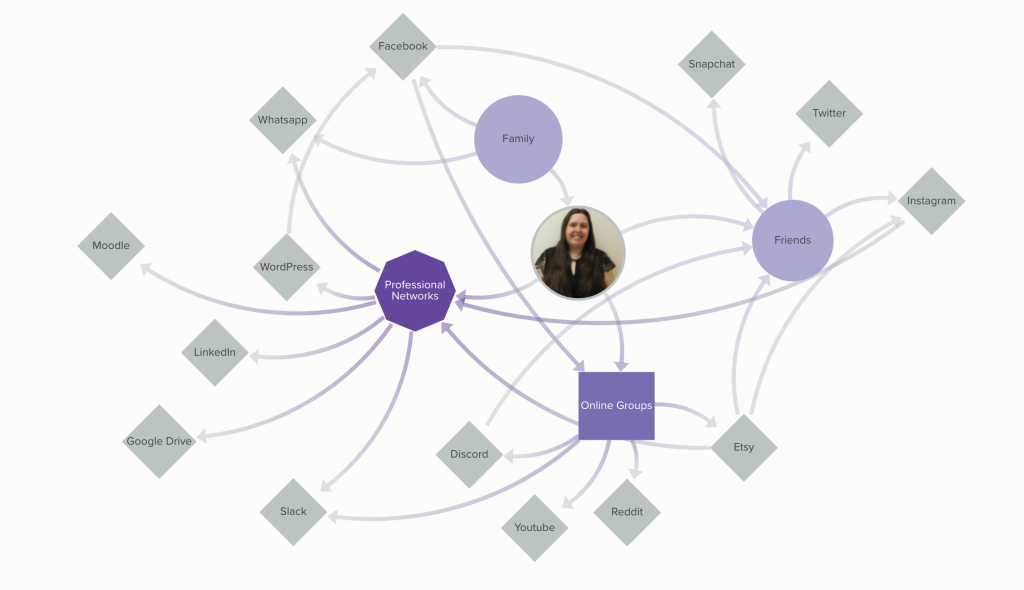
My networks mapped out

When making this visual version of my networks, it allowed me to reflect further on how these are interconnected with varying parts of my life. Using Kumu, I situated myself in the middle of the map, I decided to keep it to four categories that fanned out from the centre: family, friends, online groups, professional networks.

For the category of family, that is pretty self-explanatory, it revolves around parents, cousins, aunts, etc. This is where I use the most personal types of networks that involved instant messaging through Facebook or WhatsApp in order to stay in contact with them.For me, the circle visualizes my inner circle so to speak, that they are one of my more important networks and therefore should be seen as such with a larger circle and close to myself in the centre of the map.

Next would be the category of friends, here they are still in the shape of a circle because they are part of my day to day life. Here is where I started to see a bit of a shift of the networks on the map as we use quite a few different ones to communicate depending on the need of our conversations. We tend to use more types of social media than anything in order to get in touch with each other. I think that the reason is because we grew up with all of these different types of networks when they first started out, and we liked to experiment a bit with all of them. While I use some less than others now, it still stays the same that we do not really use phones or other forms of communication in order to connect with one another.

As we continue to go around the map, the next group is online groups. These are the people I have met through forums on discord or by joining groups in other social media websites. I felt the need to change the shape of the connection as while I have things in common with them, they are people who I have not yet to meet in person. Interestingly enough, there are still some networks that interconnected from this category into my inner circles. For example, when COVID hit my friends and I tended to use Discord in order to play games or connect online sometimes.

My final category on my map would be professional networks. This area is where I combined both my coworkers and current cohort at RRU. These are two areas that are part of my professional world and where I use various different networks in order to connect with them. Since where I work is quite small in comparison to some, it was quite easy to either communicate in person or through WhatsApp. On the other hand, being part of RRU has allowed me to expand on my use of networks to include, Slack, Moodle and more.

Once I finished my map, I took the time to look at the connections and loops made there were some connections that did not surprise me, and some that did. That is to say, there were some connections that were more interconnected into my networks than I thought they would. I am sure as this program continues this map will contain even more connections and new networks, and am looking forward to seeing it expand and grow.

Since I had some surprises, I am curious if anyone else did too? Did you have things more interconnected than you thought?