In my second blog about user experience with AI for personalized language learning, I discussed some issues about the feedback or lack thereof that I have received. Since that blog, I have been using Duolingo Max, which I got a free trial for. Since starting this free trial, I have received better feedback and more personalized lessons. For example, I am now able to get explanations for my mistakes, and it explains the grammar rules so I understand not to make them again. In some of my research on using Duolingo, some users expressed frustration with the cost of either Super Duolingo or Duolingo Max (Anderson & Charaf, 2020). If I did not have a free trial, Duolingo would cost around $20 a month, and I am unsure if it would be worth it. While there is more personalization in that I get feedback and can roleplay and practice previous mistakes, $20 a month can be costly, depending on various financial situations. I like using ChatGPT, as I can get more personalization and feedback for free.
As I continued to use ChatGPT, I added a microphone extension. Similarly to role-playing through Duolingo Max, I can decide on a theme, prompt the bot to converse with it, and then receive feedback based on my pronunciation. As of yet, I have not had issues with speech recognition that some articles have discussed their students having experienced (Godwin-Jones, 2024). This could be due to some inherent bias that the machine has for countries that have different accents than North America.
If I compare these two AI-powered tools for personalized language education, I am still unsure which one is more advantageous. On one hand, you have Duolingo, which is more gamified and constantly sends out reminders, so you keep practising (Shortt et al., 2021). On the other hand, you have ChatGPT, where you are more in charge of your learning. Thus, to answer my previous question on how effective either one of these tools is, it depends on what one is looking for.
References
Anderson, P., & Charaf, A. (2020). The reviews of users of the duolingo application: Usability and objectivity in the learning process. International Journal of Research – Granthaalayah. https://doi.org/10.29121/granthaalayah.v8.i9.2020.1326
Godwin-Jones, R. (2024). Distributed agency in second language learning and teaching through generative ai. ArXiv (Cornell University). https://doi.org/10.48550/arxiv.2403.20216
Shortt, M., Tilak, S., Kuznetcova, I., Martens, B., & Akinkuolie, B. (2021). Gamification in mobile-assisted language learning: A systematic review of duolingo literature from public release of 2012 to early 2020. Computer Assisted Language Learning, 36(3), 1–38. https://doi.org/10.1080/09588221.2021.1933540
In my initial post about researching AI for personalized learning, I wanted to investigate the credibility and accuracy of using these tools for language learning. My idea was to use both Duolingo and ChatGPT to compare the information given to me when learning French. However, while I have a basic understanding of French, it would be difficult to test the credibility and accuracy of the information, so I decided to switch my topic to user experience instead.
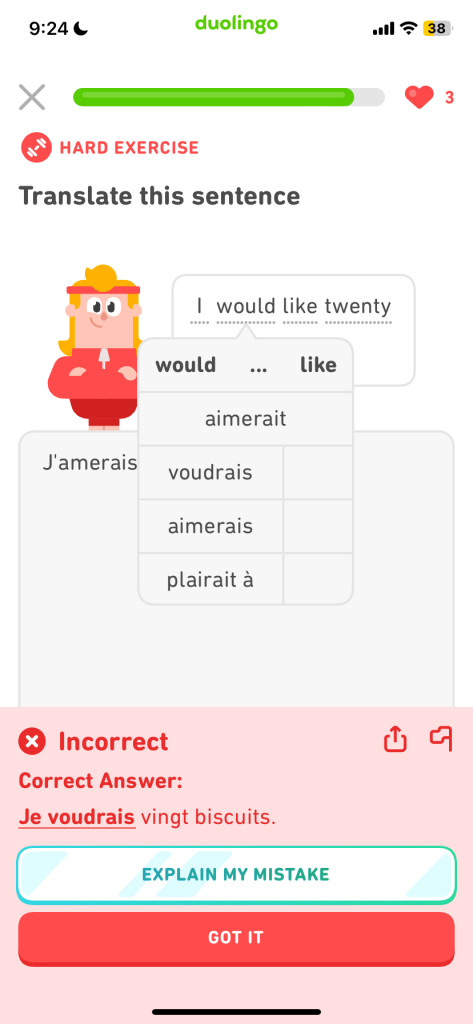
The mobile application Duolingo is not new to me; I have used it but have never taken the time to examine it as a user critically. As Anderson and Charaf (2020) pointed out, when looking at user reviews in the Google Play Store, many people discussed that paying a monthly subscription fee is the best use of the app. There are now two tiers of a paid subscription: Super Duolingo and Duolingo Max. While both tiers offer unlimited hearts and practice, DuolingoMax is where you can get a lot more personalized learning, as it will explain your answers or mistakes. You can roleplay (Duolingo Team, 2023). I currently only use the free version, and so far, there are things I enjoy, such as being easy to navigate (Munday, 2015); gamification is a motivator as it reminds me to keep practicing and gives me points. The downsides are limited lives, inability to practice mistakes, and inability to get explanations for my mistakes. To get the whole experience with Duolingo, near the end, I will use the free trial of Duolingo Max.
A mistake I made in Duolingo, but I cannot get an explanation
I have also been using ChatGPT to learn French. When using a tool like ChatGPT, it is essential to be mindful of wording your prompt (J.White, personal communication, April 12, 2024). My first time using the tool, I wanted a refresher on conjugating verbs to the proper tenses but in a more engaging way. After a few prompts, I decided to try a bingo game; ChatGPT would give me a conjugated verb, and I would have to write the tense in which it is. While the game was simple enough, I did catch some errors, such as inputting the wrong tense, but the program told me the answer was correct. While Huang and Li (2023) mentioned that using this tool can weaken people’s abilities to self-correct, I used it to double-check my answer with a verb conjugation website: https://leconjugueur.lefigaro.fr/. Thus, while using ChatGPT is not perfect, it allows me to check my work, and then I can correct the program by letting it know my answer was incorrect. A positive thing about using this tool is that I immediately get instant feedback and explanations, which I do not do with Duolingo.
An answer I gave to the verb “jouerai” ChatGPT telling me my answer is correct (passé composé) when it was not (futur simple)
As I continue to use these tools, I will also be critically aware of the potential for mistaken information and the program’s biases (Huang & Li, 2023). Further, I have yet to try using speech recognition with ChatGPT; there have been studies where students experienced tools like this needing help with speech recognition (Jeon, 2022), so this is something else I will explore. I have a question: How effective are AI-empowered applications in personalizing language learning?
References
Anderson, P., & Charaf, A. (2020). The reviews of users of the duolingo application: Usability and objectivity in the learning process. International Journal of Research – Granthaalayah. https://doi.org/10.29121/granthaalayah.v8.i9.2020.1326
Huang, J., & Li, S. (2023). Opportunities and challenges in the application of chatgpt in foreign language teaching. International Journal of Education and Social Science Research, 06(04), 75–89. https://doi.org/10.37500/ijessr.2023.6406
Jeon, J. (2022). Exploring ai chatbot affordances in the efl classroom: Young learners’ experiences and perspectives. Computer Assisted Language Learning, 37(1-2), 1–26. https://doi.org/10.1080/09588221.2021.2021241
Munday, P. (2015). The case for using duolingo as part of the language classroom experience. RIED. Revista Iberoamericana de Educación a Distancia, 19(1). https://doi.org/10.5944/ried.19.1.14581
By Ano Gwesu, Asha Khan, Catherine Mcfee, Radhika Arora, Tracy Tang
In the dynamic landscape of modern education, the integration of artificial intelligence (AI) has opened up exciting possibilities to revolutionize how students learn. Our journey into the realm of personalized learning has been one of exploration as we seek to understand how AI can tailor educational experiences to meet the diverse needs of learners. However, amidst the promises of enhanced learning outcomes, we have encountered significant challenges and ethical considerations that demand careful attention.
Exploring AI’s Educational Potential
At the core of our inquiry lies the intersection of AI and personalized learning, where algorithms analyze individual learners’ goals, strengths, and progress to deliver tailored content and feedback (Vetter et al., 2024). Through platforms like Udemy and Coursera, we have explored different courses, each offering unique insights into the application of AI in education. From practical guides for educators on leveraging AI in the classroom to innovative approaches utilizing AI technologies like ChatGPT, we have observed the transformative power of AI in shaping the future of learning.
Comparing Platforms: Understanding Education
Our investigation has led us to compare platforms such as Udemy and Coursera, each offering distinct advantages and learning experiences. Udemy’s emphasis on flexibility and accessibility allows learners to progress at their own pace, while Coursera’s structured approach offers academic rigour and accreditation options. We have gained valuable insights into the diverse online learning ecosystem by examining the course content, platform features, and instructor expertise.
Enhancing User Experience in AI-Personalized Learning
Our exploration underscored the critical role of precise prompts when utilizing platforms like ChatGPT for tailored learning experiences. This significance is further underscored in the course materials and West-Soley’s (2023) book, “AI for Language Learners,” which delves into techniques like capitalizing specific words to emphasize key concepts (West-Soley, 2023).
There are notable advantages to user experience. For instance, Duolingo boasts a free-to-use model, a user-friendly interface, and gamification elements that effectively motivate learners (Munday, 2015). Moreover, the platform offers accessibility and engagement for many users.
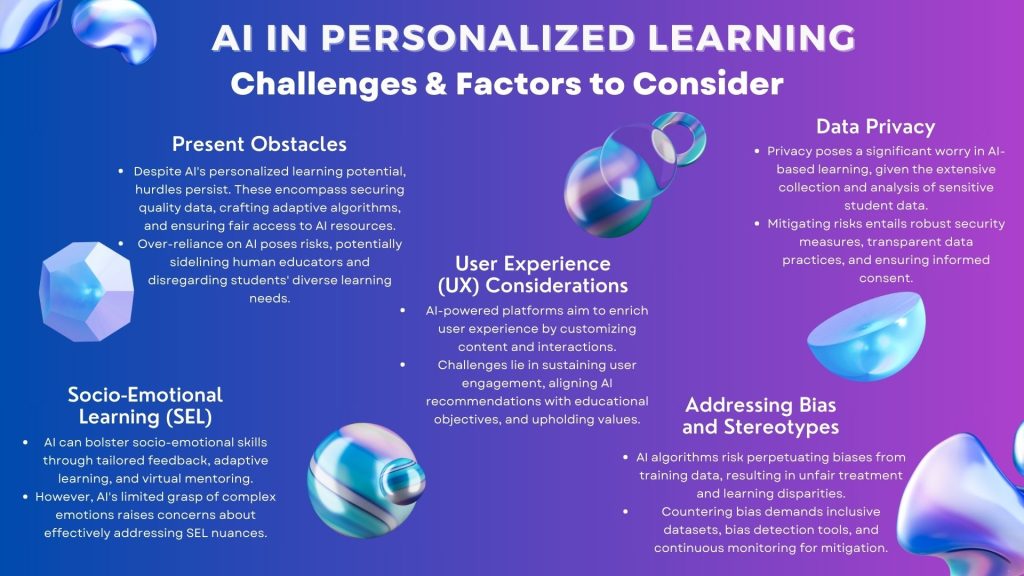
However, amidst these advantages, certain limitations also emerge. For instance, Duolingo’s personalization features are accessible only to paid members, and some learners report finding the lessons repetitive (Anderson & Charaf, 2020). Additionally, while ChatGPT offers the promise of tailored learning experiences, occasional errors have been observed, suggesting room for improvement in its implementation.
Challenges: Equity and Ethics
Nevertheless, as we delve deeper, we face pressing challenges that warrant our attention. The promise of AI-driven personalized learning must be tempered with a commitment to equity and inclusivity. We recognize that not all students have equal access to technology or the digital skills necessary to fully engage with AI-powered platforms (Warschauer & Matuchniak, 2010). Moreover, it must be acknowledged and understood by users of AI tools that large language models reflect all the racial and gender biases of the datasets on which they have been trained (Gordon, 2023). As we tread the path of AI-driven education, we must prioritize fairness, transparency, and accountability to ensure that technology is a force for good in education.
Empowering Teachers
Amidst the excitement surrounding AI in education, we must not lose sight of the indispensable role of educators. While AI can enhance learning experiences, it cannot replace the human connection and subtle understanding that teachers provide (Warschauer & Matuchniak, 2010). We advocate for a holistic approach that combines AI-driven tools’ strengths with educators’ expertise and empathy. By empowering teachers with AI technologies and fostering collaborative learning environments, we can ensure students receive personalized support and guidance tailored to their unique needs.
Balancing SEL and Privacy
In our exploration of AI in education also highlights its potential to enhance socio-emotional learning (SEL) by providing personalized feedback and insights (Vetter et al., 2024). However, we must tread carefully to ensure that these insights are leveraged ethically and responsibly. While AI can offer valuable feedback on emotional triggers and interpersonal skills, we must prioritize the privacy and autonomy of learners (Cavoukian & Jonas, 2012). By designing inclusive systems that uphold the dignity and agency of students, we can harness the transformative potential of AI to foster holistic growth and well-being.
Personalized Education with AI
We are excited about the endless possibilities ahead as we wrap up our exploration of personalized learning and AI. By addressing equity, privacy, and ethics issues with care and empathy, we can shape a future where education is accessible and uplifting for everyone. Let us seize this chance to leverage AI’s potential and ensure every learner can flourish. Moving forward, we will delve deeper into specific aspects of AI in personalized learning through our individual research endeavours.
References
Anderson, P., & Charaf, A. (2020). The reviews of users of the duolingo application: Usability and objectivity in the learning process. International Journal of Research – Granthaalayah. https://doi.org/10.29121/granthaalayah.v8.i9.2020.1326
Cavoukian, A., & Jonas, J. (2012). Privacy by Design in the Age of Big Data.
Munday, P. (2015). The case for using duolingo as part of the language classroom experience. RIED. Revista Iberoamericana de Educación a Distancia, 19(1). https://doi.org/10.5944/ried.19.1.14581
Vetter, M. A., Lucia, B., Jiang, J., & Othman, M. (2024). Towards a framework for local
interrogation of AI ethics: A case study on text generators, academic integrity, and composing with ChatGPT. Computers and Composition, 71, 102831–102831. https://doi.org/10.1016/j.compcom.2024.102831
Warschauer, M., & Matuchniak, T. (2010). New technology and digital worlds: Analyzing
West-Soley, R. (2023). A.I. for language learners: Over fifty exciting prompt ideas for creating your own perfect learning assistant. Rich West-Soley, 2023.