Reflecting on My Design Principles

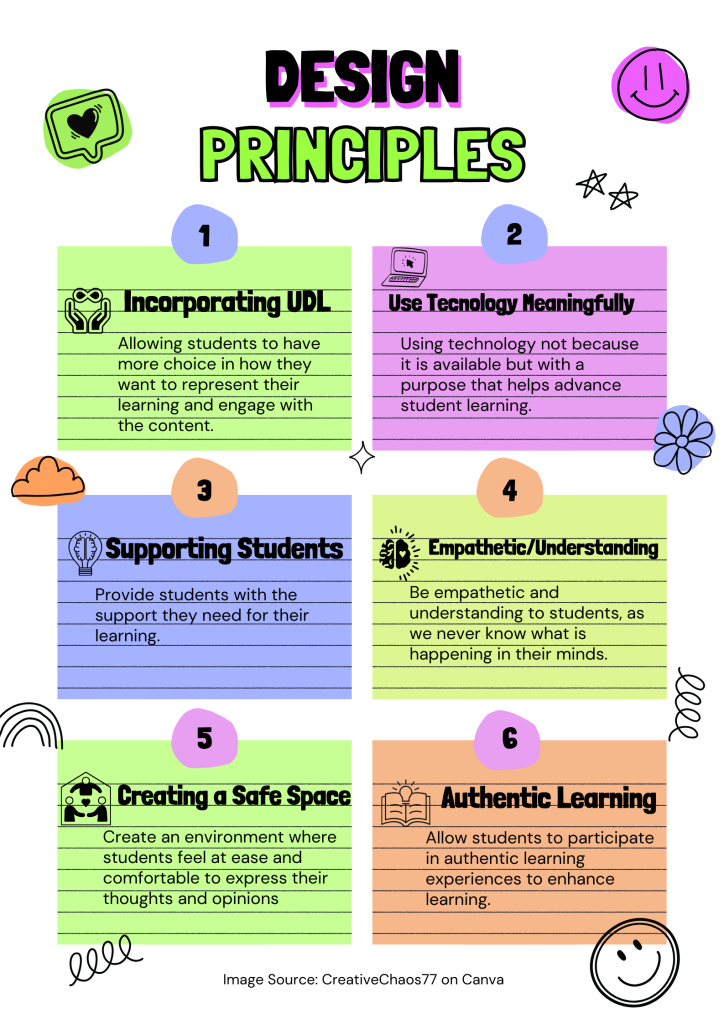
A poster showing the six design principles with short explanation text
To get a closer look at the image, use Catherine’s Design Principles

For this assignment, we were asked to think of some design principles that fit our context. The six design principles I have developed are linked to my current working context in an early childhood education setting but could also be used in future contexts, such as elementary school classrooms. Here are my six design principles. 

  1. Incorporating UDL: It is important to allow children and students to have the opportunity to show their understanding and learning in various ways. Not every student learns or shows their knowledge the same way; many diverse students are in the class. That is why I chose to incorporate UDL as one of my design principles because of their three principles of multiple means of engagement, representation, action and expression (Rao, 2021). These three principles give students more flexibility in their learning. 
  2. Use Technology Meaningfully: I mentioned in a previous blog post that I felt that technology in the classroom should have clear intentions behind it, and I still believe that is the case. Much potential for technology use in early childhood settings still needs to be explored in my context. Minds, O.O (2008) discussed various ways technology can be used in an early childhood setting, and some examples included using digital microscopes, tablets, and interactive whiteboards. While they gave examples of technology, they also emphasized that the “teacher’s intentional instructional planning” (Minds, O.O, 2008, p. 50) makes technology useful in children’s learning. Thus, while the technology is available, reflecting on why you want to use it is essential. 
  3. Supporting Students: Where I currently work, we are lucky enough to have behaviour and language specialists who come and work with the children who need extra help. To ensure that the children continue progressing, we communicate with these specialists and use their recommendations to help them in the classroom. 
  4. Being Empathetic and Understanding: When completing the design thinking process, the empathy phase was one of the more important ones. It made me reflect that these students are young; they could use more empathy and understanding as they may not be able to express their thoughts as eloquently as adults. When showing them empathy, the classroom environment tends to be more positive (Owen, 2015), and it is also equally important to teach them to be more empathetic to their classmates as it helps them build relationships with their peers. 
  5. Creating a Safe Space: Students spend the majority of their day at the daycare or in school; it is imperative that they feel comfortable and safe in this environment. Some ways to create a safe space would be to show students books with diverse characters, modelling proper ways to hold discussions and validate their feelings (Fierve, 2021). This principle can be connected to supporting students and being empathetic and understanding. If these principles are seen, the students could be more comfortable in the class and be more open to participating and contributing to the learning. 
  6. Authentic Learning: When the students participate in projects or assignments, it is beneficial to make it so their learning can be more authentic. What I mean when I say authentic is that they can relate it to their experiences and actively participate in their learning (Pappas, 2023). In my context, the students can be exposed to authentic learning through a large project once a year spanning from January to March, where they create posters/dioramas and present them to the class. For example, this year, the focus is on the ocean, so they will have to research their ocean animal, create a visual and present it to their class. Some other examples of projects are space, community workers, cultures worldwide, and more. Thus, they have been exposed to different themes and were able to bring their knowledge and experience to the projects.

References

Fievre, M. J. (2021, October 26). Cultivating the classroom as a safe space. Edutopia. 

https://www.edutopia.org/article/cultivating-classroom-safe-space/

Minds, O. O. (2008). Meaningful Technology IntegraƟon in Early Learning Environments. Young 

Children, 49. https://ecdc.cofc.edu/documents/naeyc-youngchildren-200809.pdf

Owen, L. (2015, November 11). Empathy in the classroom: Why should I care?. Edutopia. 

https://www.edutopia.org/blog/empathy-classroom-why-should-i-care-lauren-owen

Pappas, C. (2023, April 20). Authentic learning model: Creating meaningful learning experiences. eLearning Industry.

https://elearningindustry.com/authentic-learning-model-creating-meaningful-learning-experiencs

 Rao, K. (2021). Inclusive instructional design: applying UDL to online learning. Journal of 

Applied Instructional Design, (10)1, 1-9.

(PDF) Inclusive Instructional Design: Applying UDL to Online Learning 

(researchgate.net)

Augmented Reality: An Innovative Technology in Language Education?

For this blog, we were tasked with researching a learning innovation, and one that often appeared was the idea of augmented reality (AR) in education. While there are many definitions for AR, Maas and Hughes (2020) described it as virtual objects overlapping with objects in the real world and that they co-exist. While this article discussed AR in various subjects within education, there was a specific subject I wanted to explore as it interests me, and that is the idea of using AR in language education. Thus, this blog aims to look at AR in language learning. 

While augmented reality (AR) was not a technology that was readily available to all, with recent advances, there are many apps available on smartphones and computers that involve AR (Zhang et al., 2020). Augmented reality applications have become more popular, especially in science classes (Karacan & Akoğlu, 2021). A recent trend in education research is how AR can be used in language education. Karacan and Akoğlu (2021) mentioned that AR applications are not created with classroom use in mind; instead, it is up to the teacher to implement them effectively while keeping their learning objectives at the forefront. Some ways that teachers can use AR to help in language education are to implement AR flashcards and an application called Letters Alive, in which students can read vocabulary as they use 3D animations (Karacan & Akoğlu, 2021). Furthermore, there is an application called Metaverse where students can create their own stories, allowing them to practice writing and storytelling. While these applications help students learn English, the question remains: What kind of technology is needed for classrooms to support this software? 

Maas and Hughes (2020) discussed concerns about how some classes or schools may need access to computers or smart devices to implement this type of software. Similarly, Karacan and Akoğlu (2021) discussed having students bring their smartphones from home into the classroom, but that could be difficult as some students may not have their devices. Furthermore, it is not just access to these devices that schools need, but also to be aware of the storage the software will take up, whether they can maintain using it, and whether they have enough internet access. Therefore, while it is easy to say that the devices students need are more popular to have personally, that is not always the case. If schools want to implement AR software into language education, they need to be able to still provide students with the means to access it within the school and not require them to use it at home. Another aspect to reflect upon is if schools have access to similar applications mentioned above, what impact do they have on student learning? 

As mentioned above, AR applications cannot be used alone as a learning tool (Karacan & Akoğlu, 2021). Zhang et al. (2020) mentioned that AR mobile games specifically benefit student learning as they can move from just being in the classroom to providing students with the opportunity to collaborate and more context for their learning. When looking at AR specifically in language education, Karacan and Akoğlu (2021) agreed that mobile or game-based AR positively impacted student learning. For instance, the authors discussed that students were more motivated using an AR pop-up book. Furthermore, when students were using AR in their learning environment, they could experience more authentic learning, allowing them to participate in meaningful discussions. Some studies that Karacan & Akoğlu (2021) researched discussed that students were able to retain more content as the students were able to make connections “between theory and practice” (p. 71). Other studies mentioned that students showed better learning outcomes when AR was used in the classroom. For instance, when using AR to teach animal vocabulary to students learning English as a foreign language, they showed more progress than traditional means.

On the other hand, Frietas & Campos (2008), as cited in Karacan & Akoğlu (2021), mentioned that students with good academic success did not show any improvements, and students with lower academic success did. Finally, Zhang et al. (2020) also pointed out that AR does not consider learner differences. Thus, it might not be helpful to students who have learning difficulties, and teachers should remain the facilitator when implementing AR in their English language classrooms. 

To conclude, while AR is considered a technology with much potential to be implemented in the classroom, improvements still need to be made. For example, if the AR software cannot consider learner differences, the teacher should reflect on the application’s usability in their class to help students with learning differences. Furthermore, when considering using AR in the classrooms, schools should discuss how they feel about using it with teachers. Some teachers may think the AR software is overly complicated and are nervous to use it (Karacan & Akoğlu, 2021). Finally, there is some criticism of using AR in the language classroom as there is little theoretical support (Zhang et al., 2020). Thus, some main things to consider before implementing AR software into the class are to reflect on whether you have the technological capacities to use it, how it will impact students in the classroom, can teachers use it effectively in the class to help with language learning, and what kinds of theories support the use of AR.


References

Karacan, C. G., & Akoğlu, K. (2021). Educational augmented reality technology for language learning and teaching: A comprehensive review. Shanlax International Journal of Education, 9(2), 68-79. https://doi.org/10.34293/Education.v9i2.3715

Maas, M. J., & Hughes, J. M. (2020). Virtual, augmented and mixed reality in K–12 education:  A review of the literature. Technology, Pedagogy and Education, 29(2), 231–249. https://doi.org/10.1080/1475939x.2020.1737210

Zhang, D., Wang, M., & Wu, J. G. (2020). Design and implementation of augmented reality for english language education. Augmented Reality in Education, 217–234. https://doi.org/10.1007/978-3-030-42156-4_12