While writing my introduction and thinking about my research question and sub-questions, I was interested in two main theoretical frameworks. Velestianos and Russell’s article (2013) highlighted social cognitive theory and cognitive load theory that I think would connect to my research question:
How might integrating pedagogical agents equipped with natural language processing capabilities enhance the effectiveness of language learning platforms for Canadian non-native speakers of English or French in virtual or remote learning?
Learning is inherently social; you have classmates and teachers, you can receive instant feedback and ask questions with quick replies, and most importantly (especially with language learning), you can have conversations. Thus, the social cognitive theory is the first framework I would like to investigate further regarding research using pedagogical agents for language learning.
Bandura initially developed the social cognitive theory, emphasising social interactions’ role in learning (Schunk & DiBenedetto, 2023). When using pedagogical agents, they can take on the role of teacher or peer and provide the social interaction needed in learning environments (Velersianos & Russell, 2013). Further, they can model, provide examples, and help when asked, taking on similar roles of human teachers or peers. As social interaction is critical in learning environments, whether in person or virtual, this is one framework I would like to use as I continue my research.
The cognitive load theory is the second framework I would like to use. This theory examines how using different technologies in tasks can impact one’s working memory (Veletsianos & Russell, 2013). When using this theory connected to my research questions, I want to see the impact that using pedagogical agents could have on students’ mental load when learning a new language. Would an animated agent be distracting? Does the design cause one to feel strange, like when thinking about the idea of an uncanny valley? The concern with using pedagogical agents in this framework is that the students focus on unnecessary stimuli that detract from their learning and follow more critical information.
These are just two theories I am considering. If any other theories may be better suited to my research and topic, I would love to hear more feedback!
References
Schunk, D. H., & DiBenedetto, M. K. (2023). Learning from a social cognitive theory perspective. International Encyclopedia of Education(Fourth Edition), 22–35. https://doi.org/10.1016/b978-0-12-818630-5.14004-7
Veletsianos, G., & Russell, G. S. (2013). Pedagogical agents. Handbook of Research on Educational Communications and Technology, 759–769. https://doi.org/10.1007/978-1-4614-3185-5_61
Since starting the MALAT program, I have been exposed to several ways to disseminate research. As we get closer to starting our research, I have begun to reflect on how I would like to share my upcoming Applied Research Project (ARP). While my ambition is to publish in a journal, I also have other ideas.
Using Social Media
In LRNT 527, I created a toolkit available to the public called aifork12andbeyond.ca. This toolkit showcases various ways to use artificial intelligence tools in many subject areas. I would post my research on my website and share it with those who could use it to help their students, such as on LinkedIn and other social media sites (Ross-Hellauer et al., 2020).
Presenting my Findings
I want to present my findings to stakeholders and people who may find them helpful in the research, such as teachers and companies that use AI for language acquisition. I could do this through workshops and presentations, such as one day submitting a proposal to present at ETUG through the BC Campus or any local seminars.
Developing Tools and Resources
Further, another ambition besides publishing in a journal is to create resources that can be helpful to educators new to using AI. I want to develop a tool besides my website, perhaps a guide to my own AI tool, using what I have learned that teachers can use to help in their classrooms.
These are just a few ideas I have to disseminate my research. As I research and get started on my project, my ideas may shift or be added to, and I will continuously reflect on how I want to share my research.
References
Ross-Hellauer, T., Tennant, J. P., Banelytė, V., Gorogh, E., Luzi, D., Kraker, P., Pisacane, L., Ruggieri, R., Sifacaki, E., & Vignoli, M. (2020). Ten simple rules for innovative dissemination of research. PLOS Computational Biology, 16(4), e1007704. https://doi.org/10.1371/journal.pcbi.1007704
In my initial blog post about digital facilitation, I had three thoughts:
There is an emphasis on community in online learning
Providing choice to learners is critical
Facilitating online requires a different skill set than in-person
Reflecting on my experience in this course as a learner and facilitator, I still agree with these points. The synchronous sessions were particularly valuable, where we gathered to discuss our thoughts and experiences with the week’s topic. They underscored the importance of community in online learning, as our collective exploration and understanding of the topic significantly enriched the learning experience.
The second point was important for both roles. As a learner, I appreciated the chance to choose what to read or experiment with as I could connect more to it. For example, when exploring Team Yellow’s VR/AR topic, I enjoyed that they provided different resources that would fit the needs of my learning and working context. With those choices, I could explore AR resources that could be used in a classroom context. Since I like choices as a learner, it felt important as a facilitator to provide our learners with the same opportunity as the goal to find ways to use the AI tools within their context.
Regarding my role as a facilitator, I still need a different skill set to teach online versus in person. When teaching face-to-face, you can see your learners’ faces and expressions to determine if they understand what is being asked. With online learning and digital facilitation, you only get that feedback if a student reaches out or during a synchronous session. What was helpful was the YouTube video provided by Team Orange that discussed the 12 best practices, and I plan to continue to develop these skills even if I primarily facilitate in person.
As mentioned above, I primarily practice in-person facilitation as an educator. Looking back on my two questions, I better understand how to incorporate the CoI framework in a K12 context. After learning about the best practices for online facilitation, I realized that some still work in face-to-face teaching. For instance, understanding your role and knowing your students are critical skills, whether you teach online or in person.
Finally, when looking back on my metaphor, I still consider digital facilitation a road map. There are twists, turns, and sometimes unexpected roadblocks, especially as a facilitator. While you try to predict and plan for everything in your teaching journey, you can only sometimes predict what will happen on the road. You must be flexible and go with the flow, especially when things get out of your control.
Before starting this week, I had a basic understanding of AR from using it with a preschool group; my knowledge of AR and VR tools has been further developed with the help of Team Yellow’s activities, where we explored different tools. Dick (2021) outlined many other ways that AR or VR can be used in a K-12 setting, and I enjoyed many of their ideas and saw the potential of using it cross-curricularly.
The most surprising thing I learned throughout the week was how far back this technology goes. Like much of what I learned in the MALAT program, ED Tech is not as new as some think. These tools have been around for a long time but are getting more advanced, so they are popping up more, especially in K12 education and students with learning disabilities (Dick, 2021). While they are becoming more popular, they still require a lot of outside technology, such as tablets, computers or headsets, which are resources that may only be available in some schools. Thus, while they are great ways to offer more immersive learning, not every student or school has the means to use these tools. Further, many of these applications are not free, another barrier for schools to use with students.
If the school had access to AR or VR resources, it would be an excellent way for educators to offer students a more interactive way to learn. From my experience using Quiver, I see a lot of potential, as this website and application provide various resources and activities that cover many school subjects. More examples of how I would use such tools would be to find ones that offer virtual field trips so students can explore history, art and other subjects in which they expand their worldview without needing to leave the classroom. These are just some initial ideas; as I mentioned in the discussion, I was intrigued by these tools and plan on further exploring them and finding free ones that can be used, as I believe they have many uses in the classroom.
Reference
Dick, E. (2021, August 30). The promise of immersive learning: Augmented and virtual reality’s potential in education. Itif.org. https://itif.org/publications/2021/08/30/promise-immersive-learning-augmented-and-virtual-reality-potential/
In preparation for Team Green’s facilitation week, Catherine and Marni met to brainstorm and plan an engaging learning experience for our participants. The unit content focuses on learning to use AI as a Digital Resource Assistant to determine best facilitation practices.
Learning Objective
Learners will be able to use AI to support facilitation strategies and enhance engagement and collaborative learning within the Community of Inquiry framework.
Timeline
Date
Mode
Facilitators
Learners
Sunday, October 6th 2024
Asynchronous
Introduce the module and resources.
Watch the introduction video and explore the resources.
Tuesday, October 8th 2024
Asynchronous
Create a Padlet for learners to share their thoughts.
Share which tool they have chosen and why. Reference readings.
Wednesday, October 9th 2024
Asynchronous
Respond to Padlet
Start creating a helpful resource for facilitation using the AI tool chosen using the CoI framework.
Thursday, October 10th 2024
Synchronous
Facilitate discussion for sharing the resource created by taking notes and asking questions.
Share the CoI strategy resource and one tip takeaway learned from the activity.
Friday, October 11th, 2024
Asynchronous
To summarize the learning based on previous Zoom meetings and post on Moodle.
Look over the summary and provide any additional comments.
Saturday, October 12th 2024
Asynchronous
Gather feedback
Provide feedback
Schedule for facilitation week
Learning Resources
Team Green plans to use the following resources to foster learning during the facilitation week:
Desjardins, D., Drought, B., Fischl, B., Frampton, S., Giannios, M., Jodrey, H., Korchinski, K., MacDowell, P., Moser, S., Moskalyk, K., Neibrandt, J., Neufeld, P., Peters, A., Otegbade, T., Schindelka, A., Tide, D., Tilford, L., Tooke, K., & Washlowsky, M. (2023). AI-Enhanced Instructional Design. University of Saskatchewan.https://openpress.usask.ca/etad873aienhancedinstructionaldesign
The following resources will be provided as optional supplemental resources:
Celik, I., Dindar, M., Muukkonen, H., & Järvelä, S. (2022). The promises and challenges of Artificial Intelligence for teachers: A systematic review of research. TechTrends,66, 616–630. https://doi.org/10.1007/s11528-022-00715-y
Mollick, E. R., & Mollick, L. (2023). Using AI to implement effective teaching strategies in classrooms: Five strategies, including prompts. The Wharton School Research Paper.http://dx.doi.org/10.2139/ssrn.4391243
Squalli Houssaini, M., Aboutajeddine, A., Toughrai, I., & Ibrahimi, A. (2024). Development of a design course for medical curriculum: Using design thinking as an instructional design method empowered by constructive alignment and generative AI. Thinking Skills and Creativity, 52. https://doi.org/10.1016/j.tsc.2024.101491
Asynchronous Activity
Before our synchronous session, we have some activities that will be done asynchronously.
Read and Watch: There are four readings on using AI tools as assistants; learners will choose two of the four they want to read. At the start of the module, learners will watch an introductory video.
Explore: Learners will explore the general education section of the AI toolkit and the tools outlined in that section. They can also explore different AI digital assistant tools they would like to use for the rest of the activities.
Discuss:Using Padlet, learners will discuss which AI tool they want to use and connect their responses to the readings. They will also respond to at least one other learner’s post.
Reflect: Using another Padlet, learners will share their initial ideas about the resource they want to create, their chosen strategy, and why.
Create: Using the AI tool they have chosen, learners will create a helpful facilitation resource based on their CoI infographic using one of their favourite strategies.
Synchronous Activity
Proposed date and time: Thursday, October 10th, 2024, 17:00 PST/ 20:00 EST
10 minutes
Introduce the session by presenting the module and using AI tools for facilitation.
10 minutes
Discuss the asynchronous activities (exploration, readings, and creation of their resource).
20-25 minutes
Share the resources they created using the AI tools and how they connect to the CoI framework, concluding with one tip/takeaway from the process.
5 minutes
We will conclude the session by summarizing the discussion and providing instructions for what comes next.
Learning Technologies
Moodle will be used as the Learning Management System (LMS) during the facilitation week. This platform allows hosting learning resources like readings and activities, such as sharing experiences using Padlet. Team Green chose this LMS and Padlet due to their ease and familiarity. The same familiarity applies to Zoom, which was selected to host the synchronous session. Team Green will continue to explore whether other learning technologies are required for the learning experience.
Learning Experience
The Community of Inquiry (CoI) framework has three presences that encompass the learning experience for students in online learning: Cognitive Presence, Social Presence, and Teaching Presence (Garrison et al., 1999). Team Green will facilitate these activities throughout the week using these presences as follows:
Presence
Activity
Indicators
Cognitive Presence
Learners will use Padlet to share their thoughts and comment on each other’s posts (Boettcher, n.d.).
Creating a helpful facilitation resource using one of their strategies.
Learners’ comments will be meaningful and thought-provoking.
Learners will share their initial ideas in another Padlet, making connections to their infographic.
Social Presence
Learners will share the resources they created in the Zoom session (Dunlap & Lowenthal, 2018).
Learners participate in the Zoom session and share their process and tip(s).
Teaching Presence
Provide clear expectations for activities and deadlines (Lalonde, 2020). Creating an interactive activity to start our synchronous session and spark discussion (Garrison et al., 2007).
Moodle metrics confirming logins and instructional video-watching
Learners are engaged with the activity and participate in discussion.
Dunlop, J. C., & Lowenthal, P. R. (2018). Online educators’ recommendations for teaching online: Crowdsourcing in action. Open Praxis, 10(1), 79-89. https://doi.org/10.5944/openpraxis.10.1.721
Garrison, D. R., Anderson, T., & Archer, W. (1999). Critical inquiry in a text-based environment: Computer conferencing in higher education. The Internet and Higher Education, 2(2), 87–105. https://doi.org/10.1016/S1096-7516(00)00016-6
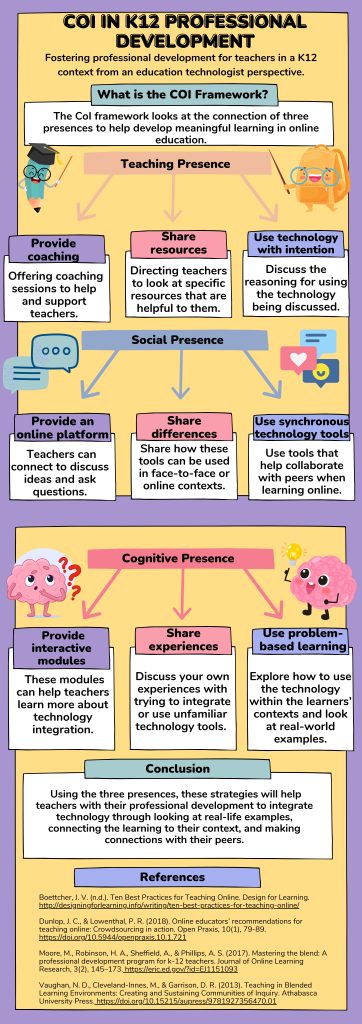
The CoI framework was developed to underscore the connection between three presences: teaching, social, and cognitive. Its primary goal is to cultivate ‘an engaged online learning community’ (Dunlap & Lowenthal, 2018, p.81). Using the Community of Inquiry (CoI) framework, this infographic will provide strategies to help K12 teachers integrate technology into the classroom from an education technologist’s perspective. As they are responsible for coaching teachers, the strategies are targeted to education technologists to help with teacher professional development (Reid, 2018).
Teaching Presence
Teachers can be unfamiliar with integrating new technology into the classroom (Moore et al., 2017), so providing them with coaching, whether in person, online through Zoom, or Microsoft Teams, is essential. Through coaching, it is crucial to guide the teachers using the technology tool and offer support when they need help. These coaching sessions can also be done individually or in groups. As teachers participate in these training sessions, it is imperative to share extra resources (Vaughan et al., 2013). These resources help bring more context to how these technologies can be used in their classrooms. While it is great to use technology in class, it is vital to use it intentionally (Dunlap & Lowenthal, 2018). There needs to be a reason for teachers using this technology (will it help students? Help with busy work?).
Social Presence
After coaching teachers, they may need extra help or want to discuss it with their colleagues. By providing an online platform, they can connect, ask questions, share ideas and examples of technology use, and more (Boettcher, n.d.). Further, teachers need to know how these technologies can be used either for online or face-to-face learning, so one strategy is to share the differences and provide examples of how they can be used for either context (Vaughan et al., 2013). Finally, when training online, use synchronous technology tools to help foster engagement and connections with the participating teachers. These tools can help break the ice and help learners become more comfortable contributing to the discussion.
Cognitive Presence
When training teachers, interactive learning modules should be included, as this can help them increase their technology skills, further develop their knowledge, and, therefore, be more likely to adapt classroom practice to incorporate what they have learned (Moore et al., 2017). In these learning modules and when providing coaching, create problem-based learning activities to allow teachers to connect to their classrooms and teaching styles and, therefore, have more context on how the technology can be used (Vaughan et al., 2013). Finally, it can be challenging to build relationships online, so be sure to share experiences with learners, as this can help them feel more comfortable sharing their own and thus learn more from each other (Vaughan et al., 2013).
These strategies help create a teacher community where teachers can learn from education technologists and each other to incorporate new technology meaningfully in the classroom, whether online or face-to-face.
Dunlap, J. C., & Lowenthal, P. R. (2018). Online educators’ recommendations for teaching online: Crowdsourcing in action. Open Praxis, 10(1), 79. https://doi.org/10.5944/openpraxis.10.1.721
Moore, M., Robinson, H. A., Sheffield, A., & Phillips, A. S. (2017). Mastering the blend: A professional development program for k-12 teachers. Journal of Online Learning Research, 3(2), 145–173. https://eric.ed.gov/?id=EJ1151093
Vaughan, N., Hrastinski, S., & D. Randy Garrison. (2013). Teaching in blended learning environments: Creating and sustaining communities of inquiry. https://doi.org/10.15215/aupress/9781927356470.01
Much like in-person teaching, online teaching places a significant emphasis on community. As Dunlap and Lowenthal (2018) and Boettcher (n.d.) discussed, establishing a community in an online class is crucial. It helps students form connections and allows them to be social in ways that mirror a face-to-face classroom. Whether students are learning in person or online, the social aspect of learning remains a vital component.
Providing students with choices is a fundamental aspect of education. The concept of UDL in online learning, as highlighted by Dunlap & Lowenthal (2018), is a powerful tool. It empowers students to demonstrate their understanding in ways that suit their learning style and meet the course requirements. This adaptability makes students feel comfortable and allows them to connect their experiences with their learning (Boettcher, n.d.).
While there are similarities to in-person and online teaching, there are differences in how to facilitate online classes as they may require a different set of skills. Bull (2013) discussed eight roles of an online facilitator. While some can be found in an in-person facilitator, such as a cheerleader and co-learner, some are more for online courses like Big Brother, where everything is documented, and teachers can see when students are online and guide them to the appropriate resources or course content.
In my initial thoughts, I discussed the similarities between in-person and online teaching. I still have some questions I would like to explore as I go through this course, especially regarding how to use these skills in a K12 setting.
2 questions
K-12 education is primarily done in face-to-face classrooms; which skills and roles discussed in facilitating digital environments can be transferred to in-person teaching?
In connection with the first question. If there are skills from teaching online courses that can be transferred to K12 in-person settings, how can we use these skills when we are not facilitating online?
1 Metaphor
Through reading about digital facilitation, a metaphor that goes well with my thoughts and questions is an image of a road map. Teaching and learning is a journey, and as Bull (2013) pointed out, we are here to guide our students throughout. While the path may not be straight, and mistakes may be made, the journey and learning along the way are what matters.
Credit: Image by coolboy on Freepik
References
Boettcher, J. V. (n.d.). Ten best practices for teaching online. Design for Learning. http://designingforlearning.info/writing/ten-best-practices-for-teaching-online/
Bull, B. (2013). Eight roles of an effective online teacher. Faculty Focus. https://www.facultyfocus.com/articles/online-education/eight-roles-of-an-effective-online-teacher/
Dunlap, J. C., & Lowenthal, P. R. (2018). Online educators’ recommendations for teaching online: Crowdsourcing in action. Open Praxis, 10(1), 79-89. https://doi.org/10.5944/openpraxis.10.1.721
In my second blog about user experience with AI for personalized language learning, I discussed some issues about the feedback or lack thereof that I have received. Since that blog, I have been using Duolingo Max, which I got a free trial for. Since starting this free trial, I have received better feedback and more personalized lessons. For example, I am now able to get explanations for my mistakes, and it explains the grammar rules so I understand not to make them again. In some of my research on using Duolingo, some users expressed frustration with the cost of either Super Duolingo or Duolingo Max (Anderson & Charaf, 2020). If I did not have a free trial, Duolingo would cost around $20 a month, and I am unsure if it would be worth it. While there is more personalization in that I get feedback and can roleplay and practice previous mistakes, $20 a month can be costly, depending on various financial situations. I like using ChatGPT, as I can get more personalization and feedback for free.
As I continued to use ChatGPT, I added a microphone extension. Similarly to role-playing through Duolingo Max, I can decide on a theme, prompt the bot to converse with it, and then receive feedback based on my pronunciation. As of yet, I have not had issues with speech recognition that some articles have discussed their students having experienced (Godwin-Jones, 2024). This could be due to some inherent bias that the machine has for countries that have different accents than North America.
If I compare these two AI-powered tools for personalized language education, I am still unsure which one is more advantageous. On one hand, you have Duolingo, which is more gamified and constantly sends out reminders, so you keep practising (Shortt et al., 2021). On the other hand, you have ChatGPT, where you are more in charge of your learning. Thus, to answer my previous question on how effective either one of these tools is, it depends on what one is looking for.
References
Anderson, P., & Charaf, A. (2020). The reviews of users of the duolingo application: Usability and objectivity in the learning process. International Journal of Research – Granthaalayah. https://doi.org/10.29121/granthaalayah.v8.i9.2020.1326
Godwin-Jones, R. (2024). Distributed agency in second language learning and teaching through generative ai. ArXiv (Cornell University). https://doi.org/10.48550/arxiv.2403.20216
Shortt, M., Tilak, S., Kuznetcova, I., Martens, B., & Akinkuolie, B. (2021). Gamification in mobile-assisted language learning: A systematic review of duolingo literature from public release of 2012 to early 2020. Computer Assisted Language Learning, 36(3), 1–38. https://doi.org/10.1080/09588221.2021.1933540
In my initial post about researching AI for personalized learning, I wanted to investigate the credibility and accuracy of using these tools for language learning. My idea was to use both Duolingo and ChatGPT to compare the information given to me when learning French. However, while I have a basic understanding of French, it would be difficult to test the credibility and accuracy of the information, so I decided to switch my topic to user experience instead.
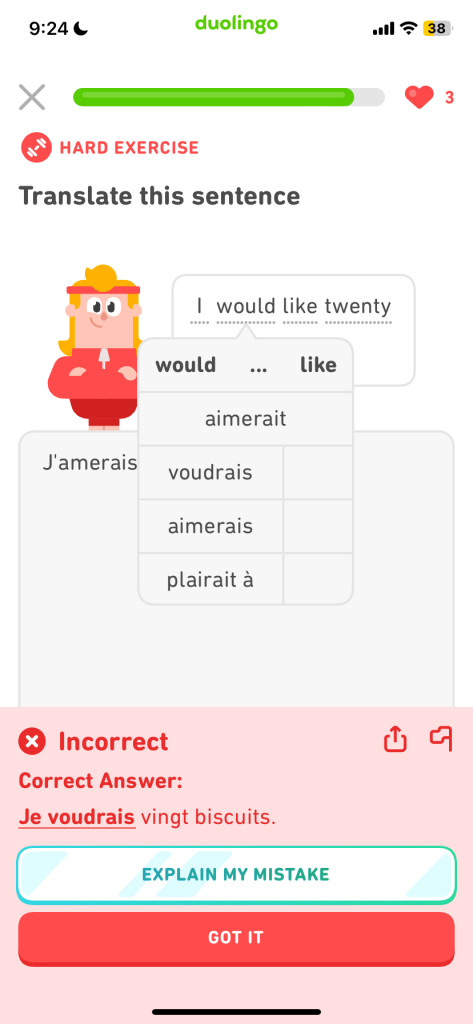
The mobile application Duolingo is not new to me; I have used it but have never taken the time to examine it as a user critically. As Anderson and Charaf (2020) pointed out, when looking at user reviews in the Google Play Store, many people discussed that paying a monthly subscription fee is the best use of the app. There are now two tiers of a paid subscription: Super Duolingo and Duolingo Max. While both tiers offer unlimited hearts and practice, DuolingoMax is where you can get a lot more personalized learning, as it will explain your answers or mistakes. You can roleplay (Duolingo Team, 2023). I currently only use the free version, and so far, there are things I enjoy, such as being easy to navigate (Munday, 2015); gamification is a motivator as it reminds me to keep practicing and gives me points. The downsides are limited lives, inability to practice mistakes, and inability to get explanations for my mistakes. To get the whole experience with Duolingo, near the end, I will use the free trial of Duolingo Max.
A mistake I made in Duolingo, but I cannot get an explanation
I have also been using ChatGPT to learn French. When using a tool like ChatGPT, it is essential to be mindful of wording your prompt (J.White, personal communication, April 12, 2024). My first time using the tool, I wanted a refresher on conjugating verbs to the proper tenses but in a more engaging way. After a few prompts, I decided to try a bingo game; ChatGPT would give me a conjugated verb, and I would have to write the tense in which it is. While the game was simple enough, I did catch some errors, such as inputting the wrong tense, but the program told me the answer was correct. While Huang and Li (2023) mentioned that using this tool can weaken people’s abilities to self-correct, I used it to double-check my answer with a verb conjugation website: https://leconjugueur.lefigaro.fr/. Thus, while using ChatGPT is not perfect, it allows me to check my work, and then I can correct the program by letting it know my answer was incorrect. A positive thing about using this tool is that I immediately get instant feedback and explanations, which I do not do with Duolingo.
An answer I gave to the verb “jouerai” ChatGPT telling me my answer is correct (passé composé) when it was not (futur simple)
As I continue to use these tools, I will also be critically aware of the potential for mistaken information and the program’s biases (Huang & Li, 2023). Further, I have yet to try using speech recognition with ChatGPT; there have been studies where students experienced tools like this needing help with speech recognition (Jeon, 2022), so this is something else I will explore. I have a question: How effective are AI-empowered applications in personalizing language learning?
References
Anderson, P., & Charaf, A. (2020). The reviews of users of the duolingo application: Usability and objectivity in the learning process. International Journal of Research – Granthaalayah. https://doi.org/10.29121/granthaalayah.v8.i9.2020.1326
Huang, J., & Li, S. (2023). Opportunities and challenges in the application of chatgpt in foreign language teaching. International Journal of Education and Social Science Research, 06(04), 75–89. https://doi.org/10.37500/ijessr.2023.6406
Jeon, J. (2022). Exploring ai chatbot affordances in the efl classroom: Young learners’ experiences and perspectives. Computer Assisted Language Learning, 37(1-2), 1–26. https://doi.org/10.1080/09588221.2021.2021241
Munday, P. (2015). The case for using duolingo as part of the language classroom experience. RIED. Revista Iberoamericana de Educación a Distancia, 19(1). https://doi.org/10.5944/ried.19.1.14581
By Ano Gwesu, Asha Khan, Catherine Mcfee, Radhika Arora, Tracy Tang
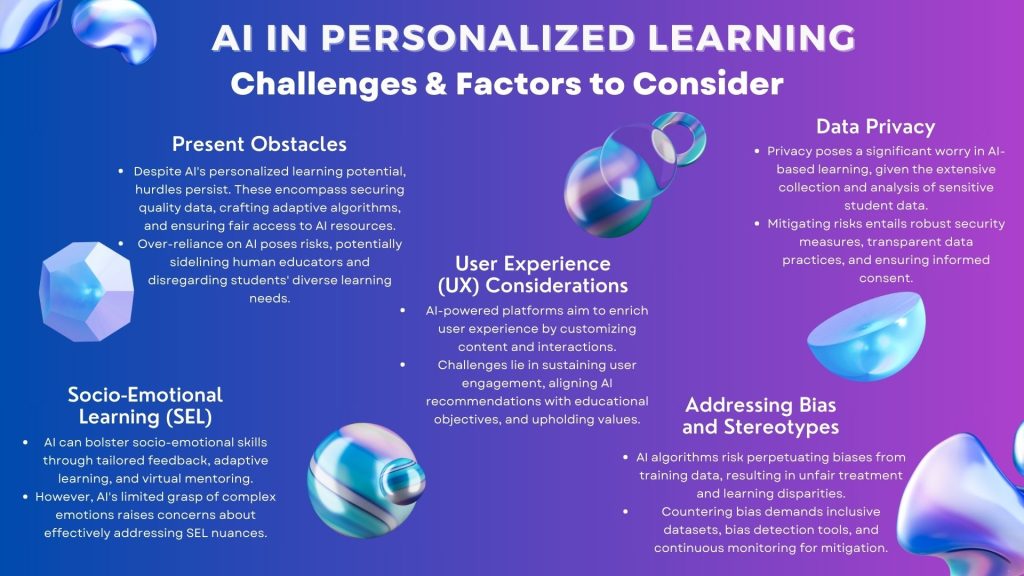
In the dynamic landscape of modern education, the integration of artificial intelligence (AI) has opened up exciting possibilities to revolutionize how students learn. Our journey into the realm of personalized learning has been one of exploration as we seek to understand how AI can tailor educational experiences to meet the diverse needs of learners. However, amidst the promises of enhanced learning outcomes, we have encountered significant challenges and ethical considerations that demand careful attention.
Exploring AI’s Educational Potential
At the core of our inquiry lies the intersection of AI and personalized learning, where algorithms analyze individual learners’ goals, strengths, and progress to deliver tailored content and feedback (Vetter et al., 2024). Through platforms like Udemy and Coursera, we have explored different courses, each offering unique insights into the application of AI in education. From practical guides for educators on leveraging AI in the classroom to innovative approaches utilizing AI technologies like ChatGPT, we have observed the transformative power of AI in shaping the future of learning.
Comparing Platforms: Understanding Education
Our investigation has led us to compare platforms such as Udemy and Coursera, each offering distinct advantages and learning experiences. Udemy’s emphasis on flexibility and accessibility allows learners to progress at their own pace, while Coursera’s structured approach offers academic rigour and accreditation options. We have gained valuable insights into the diverse online learning ecosystem by examining the course content, platform features, and instructor expertise.
Enhancing User Experience in AI-Personalized Learning
Our exploration underscored the critical role of precise prompts when utilizing platforms like ChatGPT for tailored learning experiences. This significance is further underscored in the course materials and West-Soley’s (2023) book, “AI for Language Learners,” which delves into techniques like capitalizing specific words to emphasize key concepts (West-Soley, 2023).
There are notable advantages to user experience. For instance, Duolingo boasts a free-to-use model, a user-friendly interface, and gamification elements that effectively motivate learners (Munday, 2015). Moreover, the platform offers accessibility and engagement for many users.
However, amidst these advantages, certain limitations also emerge. For instance, Duolingo’s personalization features are accessible only to paid members, and some learners report finding the lessons repetitive (Anderson & Charaf, 2020). Additionally, while ChatGPT offers the promise of tailored learning experiences, occasional errors have been observed, suggesting room for improvement in its implementation.
Challenges: Equity and Ethics
Nevertheless, as we delve deeper, we face pressing challenges that warrant our attention. The promise of AI-driven personalized learning must be tempered with a commitment to equity and inclusivity. We recognize that not all students have equal access to technology or the digital skills necessary to fully engage with AI-powered platforms (Warschauer & Matuchniak, 2010). Moreover, it must be acknowledged and understood by users of AI tools that large language models reflect all the racial and gender biases of the datasets on which they have been trained (Gordon, 2023). As we tread the path of AI-driven education, we must prioritize fairness, transparency, and accountability to ensure that technology is a force for good in education.
Empowering Teachers
Amidst the excitement surrounding AI in education, we must not lose sight of the indispensable role of educators. While AI can enhance learning experiences, it cannot replace the human connection and subtle understanding that teachers provide (Warschauer & Matuchniak, 2010). We advocate for a holistic approach that combines AI-driven tools’ strengths with educators’ expertise and empathy. By empowering teachers with AI technologies and fostering collaborative learning environments, we can ensure students receive personalized support and guidance tailored to their unique needs.
Balancing SEL and Privacy
In our exploration of AI in education also highlights its potential to enhance socio-emotional learning (SEL) by providing personalized feedback and insights (Vetter et al., 2024). However, we must tread carefully to ensure that these insights are leveraged ethically and responsibly. While AI can offer valuable feedback on emotional triggers and interpersonal skills, we must prioritize the privacy and autonomy of learners (Cavoukian & Jonas, 2012). By designing inclusive systems that uphold the dignity and agency of students, we can harness the transformative potential of AI to foster holistic growth and well-being.
Personalized Education with AI
We are excited about the endless possibilities ahead as we wrap up our exploration of personalized learning and AI. By addressing equity, privacy, and ethics issues with care and empathy, we can shape a future where education is accessible and uplifting for everyone. Let us seize this chance to leverage AI’s potential and ensure every learner can flourish. Moving forward, we will delve deeper into specific aspects of AI in personalized learning through our individual research endeavours.
References
Anderson, P., & Charaf, A. (2020). The reviews of users of the duolingo application: Usability and objectivity in the learning process. International Journal of Research – Granthaalayah. https://doi.org/10.29121/granthaalayah.v8.i9.2020.1326
Cavoukian, A., & Jonas, J. (2012). Privacy by Design in the Age of Big Data.
Munday, P. (2015). The case for using duolingo as part of the language classroom experience. RIED. Revista Iberoamericana de Educación a Distancia, 19(1). https://doi.org/10.5944/ried.19.1.14581
Vetter, M. A., Lucia, B., Jiang, J., & Othman, M. (2024). Towards a framework for local
interrogation of AI ethics: A case study on text generators, academic integrity, and composing with ChatGPT. Computers and Composition, 71, 102831–102831. https://doi.org/10.1016/j.compcom.2024.102831
Warschauer, M., & Matuchniak, T. (2010). New technology and digital worlds: Analyzing
West-Soley, R. (2023). A.I. for language learners: Over fifty exciting prompt ideas for creating your own perfect learning assistant. Rich West-Soley, 2023.
We were asked to choose a learning technology and an event in this course. After discussing interesting topics, we decided on artificial intelligence (AI) with personalized learning. Upon researching online courses, we initially chose a course from the Udemy platform; as we began the course, we found that it needed to be more informative. We then chose a class on Coursera called Innovative Teaching Through ChatGPT; this class gave more examples of how to personalize education using ChatGPT. However, this class was only the beginning of our research.
We each chose two articles or books to read to understand AI in personalized learning better. We found some similarities; for instance, both Selwyn (2019) and Magomadov (2020) discussed the importance of student-teacher relationships and how technology should not replace teachers but rather enhance their teaching and lessons. Each article discussed different benefits and challenges of using AI in personalized learning.
One promising aspect Van der Vorst & Jelicic (2019) discussed was how AI can revolutionize learning experiences by tailoring them to individual students’ unique needs and preferences. They also explored the potential and challenges of implementing AI-driven personalized learning approaches. Akgun and Greenhow (2021) further emphasized the benefits, including using AI with automated assessment and predictive analytics. They believe that leveraging AI in these areas can significantly alleviate the administrative burden on teachers. Murtaza et al. (2022) also examined the change from conventional e-learning to a more personalized learning approach emphasizing tailored content and individual assessment. The articles underscored these advantages and acknowledged the need to address the associated challenges.
We found various concerns in our research that had to do with ethics, privacy, and biases. For instance, Regan & Jesse (2019) pointed out that using AI raises questions about gathering data and how they are tracking and grouping students, which may be discriminatory. Further, the authors discussed that the interests of one group may overshadow those of different groups, specifically looking at vendors and educational technology programs. Yang et al. (2021) also mentioned the need for more governance as the lack of it, in combination with algorithm bias, could lead to further inequality. Al-Badi et al. (2022) looked into the perceptions that students and instructors had on using AI for personalized learning. The authors discovered mixed feelings as some found using these tools helpful to their learning. On the other hand, some were weary of using the technology as they expressed concern over privacy, trust, and the limited capabilities of using AI for personalized learning. These concerns and issues are all valid, and we will continue to address them throughout our research, looking at them in more detail.
Building on our initial research, we are committed to further exploring the use of AI in personalized learning through a critical lens, considering ethical, political, and cultural perspectives. As we delve deeper, we invite you to join us in pondering the following questions that we believe are crucial to our understanding of this complex topic:
How can AI-powered learning systems effectively engage individuals to obtain more precise data, facilitating the development of diverse learner personas that enable educators and researchers to gain deeper insights into individual attitudes and behaviours?
How can we ensure that the information given to students is credible and accurate when using AI for personalized learning?
What is the role of instructors and learning designers in improving the quality of personalized learning recommendations? Who is responsible for governing how these vendors operate?
Al-Badi, A., Khan, A., & Eid-Alotaibi. (2022). Perceptions of learners and instructors towards artificial intelligence in personalized learning. Procedia Computer Science, 201, 445–451. https://doi.org/10.1016/j.procs.2022.03.058
Magomadov, V. S. (2020). The application of artificial intelligence and big data analytics in personalized learning. Journal of Physics: Conference Series, 1691(1), 012169. https://doi.org/10.1088/1742-6596/1691/1/012169
Murtaza, M., Ahmed, Y., Shamsi, J. A., Sherwani, F., & Usman, M. (2022). AI-Based personalized e-learning systems: Issues, challenges, and solutions. IEEE Access, 10(1), 81323–81342. https://doi.org/10.1109/ACCESS.2022.3193938
Regan, P. M., & Jesse, J. (2018). Ethical challenges of edtech, big data and personalized learning: Twenty-first century student sorting and tracking. Ethics and Information Technology, 21(3), 167–179. https://doi.org/10.1007/s10676-018-9492-2
Selwyn, N. (2019). Should robots replace teachers? AI and the future of education. Polity Press.
van der Vorst, T., & Jelicic, N. (2019). Artificial intelligence in education: Can AI bring the full potential of personalized learning to education? Www.econstor.eu; Calgary: International Telecommunications Society (ITS). https://www.econstor.eu/handle/10419/205222
Yang, S. J. H., Ogata, H., Matsui, T., & Chen, N.-S. (2021). Human-centered artificial intelligence in education: Seeing the invisible through the visible. Computers and Education: Artificial Intelligence, 2, 100008. https://doi.org/10.1016/j.caeai.2021.100008
In this course, we have been tasked with deciding on a topic to look at more critically. My group has decided to research artificial intelligence (AI) in personalized learning. In a previous post, I discussed the idea of more people using AI to learn English or another language, and that continues to interest me. A topic that has interested me throughout my research has been the credibility and accuracy of the use of AI in personal learning with a lens of language learning. To begin, I took part in a course on Udemy that originally appeared helpful in the team topic. Still, it became apparent that it could have been more informative regarding personalized education and using AI. Instead, we found a Coursera class called Innovative Teaching with ChatGPT.
In this class, Professor Jules White discussed using ChatGPT to personalize lessons and topics to fit the students’ interests (J. White, personal communication, April 12, 2024). While he mentioned that this personalization could be done and that using ChatGPT could help teachers’ lesson plans, he also stressed the importance of reviewing what information you are given to correct errors before using it with students. He gave hints on how to write prompts into ChatGPT to get closer to the information I was seeking. It was great to begin researching the use of AI in the classroom. I also read the book Should Robots Replace Teachers? By Neil Selwyn (2019) to better understand the use of AI in education.
Upon reading the book, Selwyn (2019), much like White, stressed the importance of recognizing that AI is not a perfect tool and that we must also be aware of who the programmers are behind the software. As Selwyn (2019) and Akgun & Greenhow (2021) stressed, we should examine educational technology through a political, cultural, social, and ethical lens. I will keep this in mind as I continue to research AI, personalized education, and its credibility and accuracy in being used with students.
Looking back on my first reflection on leadership, I do not think that too many of my thoughts had changed except for one: my role in project or change management. In my original reflection, I discussed some essential characteristics of a leader, such as caring, competence, and communication. Those are things I would look for in a leader. Being communicative is an essential characteristic for me, especially with recent shifts happening at my work. There are a few new employees and others taking on newer roles, and sometimes there is miscommunication. As Shenigner (2022) pointed out, communication is one of the essential pillars of digital leadership. The last few weeks have shown me the importance of keeping communication open between leaders and employees and among colleagues, which I am working on, and it brings me to reflect on my role in digital leadership.
In another blog post, I discussed my thoughts on my work role. Initially, I reflected on my role as part of operations rather than on project management (Watt et al., 2014). Throughout the different assignments in this class, I have some characteristics that align with change management and digital leadership. For instance, I am adaptable and flexible when things change that are out of our control, which are traits of an adaptive leader (Khan, 2017). When completing our last assignment for this class, we had to think of a plan to incorporate a technology change. Upon researching and writing the plan for this assignment, I realized I have many ideas for incorporating technology into my organization for educators and children. For instance, when researching e-portfolios in early childhood settings, there were ideas on making portfolios more child-centred (Bedel et al., 2024), which I would like to incorporate. Thus, upon reflection, I have ideas that can benefit my work, and perhaps I have more leadership traits than I initially thought. I aim to continue discussing these ideas and incorporate them into my work one day.
References
Bedel, E. F., İnce, S., & Başalev Acar, S. (2024). Voices from the field: Integrating e-portfolios in early childhood education. Education and Information Technologies.
Khan, N. (2017). Adaptive or transactional leadership in current Higher Education: A brief comparison. The International Review of Research in Open and Distributed Learning, 18(3). https://doi.org/10.19173/irrodl.v18i3.3294
For this blog, we were asked to reflect on a recent project that we were involved in. Initially, I struggled with this as where I work, the educators are not entirely involved in the project management process but rather in the operation (Watt et al., 2014). When a change is being implemented, the ideas are brought by the daycare’s director to the educators and the board of directors. After an idea is approved, the change/project can begin. The person in charge of the project is usually the daycare’s director, and throughout the process, they inform the board of directors and educators on how the project is progressing. Thus, as I mentioned above, I am not part of managing a project but rather an operation.
An example of a project the director headed was creating a website for the daycare. Initially, the daycare needed an online presence; it took much work for potential parents or employees to find information about the daycare. The director decided we needed a website for a better online presence. The creation of the website was the project, and the maintenance of the site and the backend was the operation, as it is ongoing and repetitive (Knolscape, 2013). The website aimed for parents to access important documents, like schedules, lunch menus and photos of special events. The goal for potential employees is to look at the website to gain information on our philosophy and mission.
Once the website was created, it was up to the director to maintain it by continuously inputting the documents or photos. Because it is time-consuming to input these documents or images, I was appointed to be the person to do so. There were some barriers to the website as some parents were apprehensive about putting the children’s images online, making this barrier a cultural norm issue (Conway et al., 2017), as this website was new and parents were unsure of how it worked. Parents were given an account with a password to access these images to ensure this issue was resolved. Moreover, the parents are asked to sign a permission slip; if they still do not want their child on the site, we make sure not to use their photos. Implementing these accounts and permission slips made the parents feel more comfortable with the website. Another barrier is that I was initially the only one who could input these images or documents (causing a delay in updating if I was unable to input the new photos or documents), which would be a tame problem (Conway et al., 2017), as it had a simple linear solution: to train someone else to use the website. This specific barrier could have been avoided if more than one person had been trained at the outset.
To conclude, while I was not part of the project management, I am involved in the operation and maintenance of this website. Some methods I would use in my practices would be to continue to have ideas for implementing more digital resources for both teachers and students. Before initiating these ideas, I would communicate them with the director, staff, and board of directors to understand organizational readiness and apprehensions before beginning the project.
Reading about change management and the various models that could be used was mind-opening (Al-Haddad & Kotnour, 2015). Discussing change and change management with colleagues allowed me to narrow down four important key points for change. These four key points are planning, adapting, supporting, and educating.
Recently, the daycare has gone through a significant change in that it expanded and doubled the amount of children in the centre. Both colleagues I discussed with mentioned the planning it took the leader to make this change go as smoothly as possible (C. Bentivegna, personal communication, February 9, 2024).Because the expansion was happening while the rest of the daycare was open, the director ensured the children already enrolled could still come as we could not shut down. Thus, ensuring the daycare remained open took much organization and planning. Regarding technological change, each class has recently been supplied with laptops.
The provided laptops were to help educators plan activities, create a weekly schedule, and move towards creating the children’s portfolios using Microsoft Publisher instead of printing, glueing, and handwriting comments on paper. The provision of laptops also took much planning as the director needed to discuss the idea with the board of directors to get approval, and only then could the laptops and necessary software be provided. Of course, this was with some challenges, which brings up the idea that a leader must be adaptable.
My colleagues and I discussed the need to make adaptations during these changes. While the director was organized and had planned for the change, there were some setbacks. Some setbacks involved were the delayed delivery of the materials, causing the two new daycare rooms to not open on time while the children were still coming to the daycare. Thus, the educators and director needed to adapt by briefly having the children enter a different class (C. Bentivegna, personal communication, February 9, 2024). Regarding the laptop, the educators needed to adapt to that change as they were not used to using the software implemented to create the children’s portfolios (A.B. Reis, personal communication, February 14, 2024). These two changes were extensive and required the director to plan and adapt accordingly.
Both changes mentioned are on a large scale as they involve much planning, adapting, and vision (Al-Haddad & Kotnour, 2015). The board of directors was involved in both the expansion and the decision to provide the laptops, and the educators were asked for their input. While no formal change management method was mentioned, based on discussions and the strategies discussed by Al-Haddaded and Kotnour (2015), the organization seemed most similar to the Jick and Kanter method. This method has ten phases, and through the conversations I had with my colleagues, a few of them were brought up. The director analyzed the need for change, created a vision, developed a plan, communicated these ideas to the educators, and reinforced the change by providing necessary support.
The implementation of laptops was where employees expressed their apprehension the most. As one of my colleagues mentioned, they were worried about using laptops as they are not the most tech-savvy (A.B. Reis, personal communication, February 14, 2024). On the other hand, my other colleague was relieved as it helped to make planning, finding activities and making portfolios more efficient (C. Bentivegna, personal communication, February 9, 2024). These differing opinions on this change are reminiscent of Weiner’s (2009) idea about change valence, as one colleague saw the value in the laptops right away compared to the other who was unsure about using them. Thus, the question was, what did the educators need to be at ease with using this new software? How can the director help with those needs? The director saw this apprehension and offered support by providing them with informational sessions on using the software.
In order to support these educators, the strategy used was informational, where the educators were taught how to use the software through step-by-step workshops (Biech, 2007). If this session was not enough, she provided the educators with one-on-one sessions, which one colleague said was valuable to help increase their understanding of using the software (A.B. Reis, personal communication, February 14, 2024). The director still provides these informational sessions as new employees are onboarded throughout the year. These sessions are still valuable to employees, new and old, as the workshops are constantly evolving based on differing needs. Ultimately, the educators feel supported and more comfortable using the software.
To conclude, these four key elements are what my colleagues felt were essential to making successful changes in the daycare. What was interesting about coming up with these elements was the experience they each had at the daycare, one colleague having over thirty years and another having six. While the amount of experience here differs, they both discussed the need for a leader to plan, adapt, support and educate. Thus, it shows that these four elements are valuable for a leader during a change.
References
Al-Haddad, S., & Kotnour, T. (2015). Integrating the organizational change literature: A model
for successful change. Journal of Organizational Change Management, 28(2), 234–262.
For this blog, we were tasked with researching a learning innovation, and one that often appeared was the idea of augmented reality (AR) in education. While there are many definitions for AR, Maas and Hughes (2020) described it as virtual objects overlapping with objects in the real world and that they co-exist. While this article discussed AR in various subjects within education, there was a specific subject I wanted to explore as it interests me, and that is the idea of using AR in language education. Thus, this blog aims to look at AR in language learning.
While augmented reality (AR) was not a technology that was readily available to all, with recent advances, there are many apps available on smartphones and computers that involve AR (Zhang et al., 2020). Augmented reality applications have become more popular, especially in science classes (Karacan & Akoğlu, 2021). A recent trend in education research is how AR can be used in language education. Karacan and Akoğlu (2021) mentioned that AR applications are not created with classroom use in mind; instead, it is up to the teacher to implement them effectively while keeping their learning objectives at the forefront. Some ways that teachers can use AR to help in language education are to implement AR flashcards and an application called Letters Alive, in which students can read vocabulary as they use 3D animations (Karacan & Akoğlu, 2021). Furthermore, there is an application called Metaverse where students can create their own stories, allowing them to practice writing and storytelling. While these applications help students learn English, the question remains: What kind of technology is needed for classrooms to support this software?
Maas and Hughes (2020) discussed concerns about how some classes or schools may need access to computers or smart devices to implement this type of software. Similarly, Karacan and Akoğlu (2021) discussed having students bring their smartphones from home into the classroom, but that could be difficult as some students may not have their devices. Furthermore, it is not just access to these devices that schools need, but also to be aware of the storage the software will take up, whether they can maintain using it, and whether they have enough internet access. Therefore, while it is easy to say that the devices students need are more popular to have personally, that is not always the case. If schools want to implement AR software into language education, they need to be able to still provide students with the means to access it within the school and not require them to use it at home. Another aspect to reflect upon is if schools have access to similar applications mentioned above, what impact do they have on student learning?
As mentioned above, AR applications cannot be used alone as a learning tool (Karacan & Akoğlu, 2021). Zhang et al. (2020) mentioned that AR mobile games specifically benefit student learning as they can move from just being in the classroom to providing students with the opportunity to collaborate and more context for their learning. When looking at AR specifically in language education, Karacan and Akoğlu (2021) agreed that mobile or game-based AR positively impacted student learning. For instance, the authors discussed that students were more motivated using an AR pop-up book. Furthermore, when students were using AR in their learning environment, they could experience more authentic learning, allowing them to participate in meaningful discussions. Some studies that Karacan & Akoğlu (2021) researched discussed that students were able to retain more content as the students were able to make connections “between theory and practice” (p. 71). Other studies mentioned that students showed better learning outcomes when AR was used in the classroom. For instance, when using AR to teach animal vocabulary to students learning English as a foreign language, they showed more progress than traditional means.
On the other hand, Frietas & Campos (2008), as cited in Karacan & Akoğlu (2021), mentioned that students with good academic success did not show any improvements, and students with lower academic success did. Finally, Zhang et al. (2020) also pointed out that AR does not consider learner differences. Thus, it might not be helpful to students who have learning difficulties, and teachers should remain the facilitator when implementing AR in their English language classrooms.
To conclude, while AR is considered a technology with much potential to be implemented in the classroom, improvements still need to be made. For example, if the AR software cannot consider learner differences, the teacher should reflect on the application’s usability in their class to help students with learning differences. Furthermore, when considering using AR in the classrooms, schools should discuss how they feel about using it with teachers. Some teachers may think the AR software is overly complicated and are nervous to use it (Karacan & Akoğlu, 2021). Finally, there is some criticism of using AR in the language classroom as there is little theoretical support (Zhang et al., 2020). Thus, some main things to consider before implementing AR software into the class are to reflect on whether you have the technological capacities to use it, how it will impact students in the classroom, can teachers use it effectively in the class to help with language learning, and what kinds of theories support the use of AR.
References
Karacan, C. G., & Akoğlu, K. (2021). Educational augmented reality technology for language learning and teaching: A comprehensive review. Shanlax International Journal of Education, 9(2), 68-79. https://doi.org/10.34293/Education.v9i2.3715
Maas, M. J., & Hughes, J. M. (2020). Virtual, augmented and mixed reality in K–12 education: A review of the literature. Technology, Pedagogy and Education, 29(2), 231–249. https://doi.org/10.1080/1475939x.2020.1737210
Zhang, D., Wang, M., & Wu, J. G. (2020). Design and implementation of augmented reality for english language education. Augmented Reality in Education, 217–234. https://doi.org/10.1007/978-3-030-42156-4_12
Being in an early childhood and elementary setting, I have yet to be exposed to many Instructional Design (ID) models. I have more experience with teaching philosophies such as Reggio Emilia and Montessori, as these are the two approaches we use at work. Upon starting this course, I realised I have a slight knowledge of some IDs like Bloom’s Taxonomy (Heaster-Ekholm, 2020), where we discussed this model in my education psychology and child development classes during my bachelor’s. A more recent design I have been exposed to was the idea of Universal Design for Learning (UDL) (Takacs et al., 2021).
In my final internship before graduating, one project was creating a lesson plan while keeping UDL in mind. In the specific class I was in, a couple of students already had Individual Education Plans (IEPs); thus, I was somewhat used to differentiating instruction, and I was up to creating a lesson while keeping all the students in mind. The idea of UDL is not to eliminate students’ IEPs or accommodations but to design a lesson that maximizes learning for most students (Takacs et al., 2021). I decided to do a reading comprehension activity with them, where using the Smart Board, I found a read-aloud on YouTube that incorporated the captions so they could both hear and read along. Afterwards, I asked questions about the book, and the students discussed their answers in a group. The students were engaged and enjoyed doing this activity, and it worked well to meet the needs of several students. I was lucky to have access to that technology. Using technology in the classroom was meaningful, as I did not want to use it just because it was there.
Kale et al. (2020) discuss how teachers must understand how to integrate technology into their instructional design meaningfully. While it is great that schools now have access to different types of technology like Smartboard, laptops, tablets, and more, if it is not used meaningfully, it will not help students learn effectively. I was constantly encouraged to use technology during my internships when creating lesson plans. Thus, when coming up with my lessons, I reflected on ways to use technology, not just because it was there and I had access to it, but to help students understand the content and expand their knowledge. It was and still is important to me to reflect on the “why” I should use technology in this instance.
In the end, using UDL and its three principles of multiple means of engagement, representation, and action and expression (Gronseth & Hutchins, 2019), I am constantly reflecting on ways to incorporate technology and how to create lessons to meet the needs of most students at once.
References
Gronseth, S. L., & Hutchins, H. M. (2019). Flexibility in formal workplace learning: Technology
applications for engagement through the lens of Universal Design for Learning. TechTrends, 64(2), 211–
The year is 2030; Chloé, a Quebec university student with a background in tourism and history, struggles to learn English. Quebec has successfully reduced the amount of English spoken or taught in the province. Chloé, who is fluent in French, wants to have opportunities outside of Quebec but is struggling to find an English class, instructor, or even a tutor. She has decided to participate in an online class in Ontario. This class has weekly synchronous sessions over Zoom, where the teacher provides instruction in vocabulary, pronunciation, and sentence structure. Chloé worries about her progress; she does not know anyone in the class, and no one at home can help her practice as her family does not speak English. Setting up a meeting with her instructor, Chloé explains her concerns, and her instructor provides her with a Language Acquisition Mentor (LAM).
LAM is a tutor bot developed to help students learn a language, as it is equipped with various languages worldwide using Artificial Intelligence (AI). More specifically, it is an Intelligent Language Tutoring System (ILTS) designed to help with language learning (Tafalozi et al., 2019). In this case, Chloé will use LAM to help her practice English outside class. Chloé is excited to use LAM as she has heard that AI language bots are helpful for students. Back in 2023, applications such as Duolingo and Carnegie Speech were already in use, and the University of British Columbia was working on a project called Language Chatism (Pelletier et al., 2021; Stone et al., 2022). These applications were developed to help students with their language acquisition. Similar to those applications, the developers of LAM included Natural Language Processing (NLP) in order to help students like Chloé to have a conversation.
The instructor explained that because LAM has NLP, the AI tutor can understand Chloé when she speaks to it. Once the LAM has processed the information, it can appropriately respond to what was said (Son et al., 2023). Developers have created a more sophisticated form of NLP to be more effective when using an AI bot like LAM to help with language learning based on past research recommendations (Son et al., 2023). Chloé is intrigued; she had never thought she would be able to have an actual conversation with an AI tutor. Along with NLP, LAM has Automatic Speech Recognition (ASR). ASR helps LAM to understand both speech and written text. Chloé enjoys using this feature as she can have a more interactive learning experience. The great use of ASR is when Chloé dictates her notes to be transcribed, and she can review her mistakes and correct them (Son et al., 2023). LAM providing instant feedback is something that Chloé benefits from because she can work on her pronunciation and her written English, too, by being able to see her errors herself and learn to self-correct (Wang et al., 2022; Son et al., 2023). Finally, Chloé is excited about using something like LAM as she can choose her mentor’s appearance and virtual world, which makes her feel more motivated to learn as she feels a connection to her tutor (Shiban et al., 2015). While she enjoys her experience using LAM to help with learning English, some people are not convinced this type of tutor will work.
Hearing Chloé speaking to LAM, her parents sometimes tell her they still cannot believe that this is how she is learning a language and that they are sceptical that an application like LAM is helping her. Chloé explains to her parents that using an AI tutor helps to lessen her anxiety when speaking English as she does not feel judged (Yang & Kyun, 2022; Jeon et al., 2023). Since she cannot practice with her family or friends, and in Quebec, speaking English is not well received, this is the only way she can make progress. She continues to tell her parents that LAM, being an intelligent tutor and a goal-oriented chatbot, can personalize the learning to fit her learning style (Son et al., 2023; Huang et al., 2023). LAM can assess her mistakes, observe her English language ability, and tailor the activities to her needs. Finally, Chloé tells her parents that using a tutor such as LAM is very convenient for her; she can use it anywhere as it is downloaded onto her mobile devices (Yang & Kyun, 2022). While she understands her parent’s worries, she tells them that while LAM is there to help her outside of class, it does not replace her human instructor; LAM supports her learning but is not her primary teacher.
LAM, her teacher explained, is not there to be Chloé’s instructor but to be a helper outside of class. With the instant feedback that Chloé gets, the instructor can also see her progress in learning English and where her language abilities lie (Son et al., 2023). While there used to be concerns that AI will replace language education teachers, research showed that it is the combination of both her human teacher and the AI tutor bot that helps students like Chloé in their pursuit of learning another language (Yang & Kyun, 2022).
In the end, Chloé finds that there has been much progress in learning English. Using a tutor like LAM, she has been able to work on her pronunciation, sentence structure, and written work (Tafalozi et al., 2019). One of Chloé’s aspirations was to one day move out of Quebec, but she was worried about her lack of English language skills. With her newly acquired understanding of English, she is ready to branch out to look for job opportunities in other provinces and countries. Sending her resume to many different places, an international touring company has contacted her to work for them. With her being fluent in French and knowing English, they believe that her bilingualism will be an asset. She is delighted that she found a course that provided a tutor such as LAM; without it, she may not have been able to practice or progress in learning English. Now in Europe, Chloé is excited for the next step in her life as a tour coordinator. Chloé smiles as she takes the bus to work, “I would not have had this opportunity without the help of LAM.”
References
Huang, X., Zou, D., Cheng, G., Chen, X., & Xie, H. (2023). Trends, research issues and
applications of artificial intelligence in language education. Educational Technology &
Upon reading about the potential future of education and technology in the not-so-distant future of 2030, there were a few intriguing ideas. Swelyn et al. (2019) offer various scenarios in which they hope to spark debate. Bozkurt et al. (2023) also provide different speculative stories that focus more on AI while identifying themes and how they could potentially impact education.
A scenario that intrigued me was entitled “AI Kindred Spirits” ( Bozkurt et al., 2023, p.66), in which a student named Paloma is taking an English course at a university. Since the course is online and asynchronous, the professor uses an AI mobile app that helps the students practice their grammar and sentence structure and has voice recognition to help with pronunciation.
This scenario interested me as someone who is bilingual and did not grow up with this type of technology that could help me learn a second language. AI in education continues to grow, and as Pelletier, et al. (2021) mention, it is a key technology and could be used to help teaching and learning. Within this report, they discuss a project that the University of British Columbia is looking into called Language Chatsim, in which students can learn a language.
With AI continuing to grow, it is possible to believe that in 2030, there could be an increased use of AI in language education. Therefore, I would like to explore further the idea of using AI as a means to help students learn a language. The essay could be a continuation of Paloma’s scenario or could be expanded to include students in the k-12 sector and learning languages other than English.
References
Bozkurt, A., Xiao, J., Lambert, S., Pazurek, A., Crompton, H., Koseoglu, S., Farrow, R., … &
Jandrić, P. (2023). Speculative Futures on ChatGPT and Generative Artificial Intelligence
(AI): A Collective Reflection from the Educational Landscape. Asian Journal of Distance
Technology in education continues to become popularized as there are many learning options in or out of a classroom. Based on a survey of 2,000 parents, the majority agree that technology has had a role in enhancing how children learn (BusinessWire, 2021). As pointed out in the article, there is more than one correct way to learn, and technology allows children to learn based on their style. Furthermore, parents find many benefits to allowing their children to watch educational shows like Sesame Street, Mister Roger’s Neighborhood, and more.
Kirkorian et al. (2008) explored the effects of exposing children aged two or more to electronic media, specifically educational TV shows, and how it could impact their cognitive development. As highlighted by Kirkorian et al. (2008), benefits arise when content aligns with “… specific goal[s] to teach academic or social skills can be effective with potentially long-lasting effects” (p.47). For instance, they feature shows such as Blues Clues and Sesame Street, which benefit cognitive development.
There is a continuous debate on the uses of technology in early childhood or elementary education. Like Clark’s (1994) view on media in education, Kirkorian et al. (2008) discuss the idea of an adult viewing the show with the child to expand on their learning by asking and answering questions, which makes the instruction just as crucial as the content. Clark (1994) would then argue that television alone is not beneficial to learning, and Kirkorian et al. (2008) would agree. For example, Kirkorian et al. (2008) bring up several TV shows that do not have educational benefits, such as Teletubbies, as they use “baby language” (p.41) and, therefore, are negatively associated with language development. Comparatively, TV shows such as Blue’s Clues and Dora the Explorer offer content that helps develop language through repetition and asking questions and prompts to viewers, allowing them to reflect and respond using their problem-solving skills. These examples connect with Clark’s (1994) thoughts on the importance of instructional design, not just media use.
On the other hand, Kirkorian et al. (2008) finish their discussion on co-viewing by mentioning that children do not have to view the shows with an adult, as they still need the freedom to interact with the content independently. Kozma (1994) would agree with this statement as he thought media could allow for more active engagement and enhance problem-solving skills. Using educational television shows like Blues Clues and Dora the Explorer, Kozma (1994) would say that children can interact with the shows independently to enhance their learning abilities.
Fast forward decades later: robots and education
The types of media used in education have changed since the 1990s; there is more access to educational technology with the invention of mobile phones and tablets and the creation of applications. Continuing to look at media and educational technology in early childhood education (ECE), there has been an increased interest in apps that help children with programming, such as Matatalab.
Yang et al. (2021) used this app to study the efficiency of kindergarten children’s participation in robot programming compared to the traditional ECE block play activity. The results showed that the robot programming group experienced more significant gains in sequencing ability than the block play kindergarteners. Specifically, the robot programming with lower levels of self-regulation at baseline showed more extensive improvements in sequencing ability over time compared to the block play kindergartners.
Clark (1994) would argue that the instructional design and pedagogical approach are more important than the app. In his media comparison, Kozma (1994) might highlight the advantages of using robot programming over traditional block play activities. However, both researchers may agree upon the importance of considering individual characteristics and contextual factors such as children’s ages and self-regulation baseline levels.
Kirkorian, H. L., Wartella, E. A., & Anderson, D. R. (2008). Media and young children’s learning. The Future of Children, 18(1), 39-61. https://www.jstor.org/stable/20053119
Yang, W., Ng, D. T. K., & Gao, H. (2021). Robot programming versus block play in early childhood education: Effects on computational thinking, sequencing ability, and self-regulation. British Journal of Educational Technology. https://doi.org/10.1111/bjet.13215
Audrey Watters’ (2010a) comments about education technology in Weller’s book 25 Years of Ed Tech were intriguing and were why she was chosen to explore further. For instance, she is an ed tech critic, as pointed out in Weller’s (2020) book, and offers insight on various topics within the field of education technology.
Watters is mainly known as a writer and a spokesperson for education technology. In July 2010, shortly after becoming a technology journalist, Watters (2010b) created her blog Hack Education. Hack Education was created because Watters wanted a place to discuss educational technology, as she felt there was insufficient coverage. Furthermore, she has written various books such as Teaching Machines, a series called The Monsters of Education Technology (2014), and Claim Your Domain (2015). These books cover topics such as personalized learning, the history of education technology and the potential future of this field. She is a freelance writer whose work has appeared on multiple websites and has written many academic essays.
Her contribution to the field of education technology is similar to Martin Weller’s, as they both write about the predigital history of education technology, particularly in her book Teaching Machines. Moreover, she has been a spokesperson at various conferences discussing and critiquing the idea of “open” education, gender and technology, and the politics in education technology. While education technology is no longer her main focus, she remains a prominent figure as she offers an interesting perspective as a technology journalist and woman in the technology field.
References
Watters, A. (2010a). Audrey Watters. September 17, 2023, https://audreywatters.com/
Watters, A. (2010b, July). Hack Education. September 17, 2023, https://hackeducation.com/
Watters, A. (2015, October 16). Claim your domain–and own your online presence. Solution Tree Press.
Watters, A. (2014). The monsters of education technology. CreateSpace Independent Publishing Platform.
While reading the second part of Weller’s (2020) book, spanning 2002 to 2011, I felt a few chapters were relevant to what I have experienced as a student and teacher. The chapter I chose to focus on is Chapter 12: Videos.
In the companion podcast hosted by Laura Pasquini (2021), she and her guest, Lee Skallerup Bessette, discuss both videos and other forms of media that can be used in learning. A topic that was brought up was the idea of teachers being purposeful in using videos and other forms of media when teaching. While I was a student teacher, I was strongly encouraged by my university professors to include technology in most of my lessons. As I reflected on how to do so, I knew I wanted to use technology mindfully. While teaching, my cooperative teacher helped me plan a unit for black history month. One of the topics the school was focusing on was the history of black hair. I found the book Don’t Touch My Hair by Sharee Miller, and the children were interested in it. Instead of reading the book to them, I used a YouTube read-aloud, allowing the students to see the text on a bigger screen with added captions.
I researched the author and noticed she offered virtual meet and greets with schools, so I reached out to her and organized a time in which she would be able to meet with both my classes simultaneously. My intention in using a live stream with the author was for the students to have the chance to discuss different topics such as black history, writing stories, becoming an author and more. Thus, using a live-streaming video in such a way was meaningful as it contributed to their learning and based on their interests.
However, there is a privilege of having access to the type of technology that would allow such a lesson to occur. As Pasquini and Bessette (2021) and Weller (2020) mention, there is a lack of access to these technologies for some students (this could be due to having no internet at home or not having a laptop to do the work on). Thus, when considering incorporating videos or other media forms, I kept it in school to ensure all students could participate. Reading the chapter and following along with the podcast showed me the importance of reflecting upon certain education technologies, especially when discussing universal design and student access.
Moreover, while reading the chapter, Weller (2020) mentions that the use of videos as an assessment tool “is still relatively limited” (pg. 89). I found that incredibly interesting due to my experience in secondary school, where I had multiple instances in using creating videos as an exam or final project. Perhaps it was not a popular assessment form in the last few years, but when I was in secondary school (2008-2013), I remember various opportunities to create videos showing my learning. For instance, instead of writing about something newsworthy in my French class, we had to develop a news broadcast where my group members wrote a script, filmed, edited and presented the video in front of the class. For history, we chose a historical figure, remixed a song by changing the lyrics to a melody to describe their historical significance, and then created a music video. As Weller points out, projects and assessments such as these can make students participate more and more satisfied with their work. Therefore, if there is still a lack of using videos as an assessment tool, I was unaware of that. I hope that with students’ skills today using TikTok and other video platforms, educators will find a way to incorporate videos to assess their learning.
To conclude, reading the second part of the book allowed me to reflect on my learning as someone who grew up at the peak of some of these technologies. It has brought back many memories I have had as a student. As an educator, I will continually consider using them in a classroom setting while considering accessibility issues and being purposeful in my choices.
I was excited when Weller’s (2020) book on the history of educational technology was the first reading we would do for LRNT 523. Early in the book, Weller (2020) mentions that people do not realize how far back educational technology goes; I am one of those people. I did not know that it dates back that far (actually, further than where he starts).
The topic that resonated with me the most was chapter six on e-learning. Weller (2020) discussed some criticisms of e-learning, including that people believe face-to-face learning is superior to online learning. As in face-to-face, you can get direct feedback and work directly with peers. I had that same approach before starting in the MALAT program. Due to COVID-19, I experienced what online education is like and found myself having difficulty (I couldn’t concentrate, got easily distracted, and missed the ease of working with others in person). Although I disagree with the criticism that “face-to-face education is the only valid form of education” (p.44). Every student is different in how they prefer to learn, and as Weller (2020) showed, many students enjoy the flexibility of online education when given the option. However, upon starting the MALAT program, I understand why some would choose an online program, as it offers more freedom.
Finally, Weller (2020) discussed e-learning and Ed Tech in terms of higher education, as do most articles/papers we read in the MALAT program. As I have more experience with early childhood and elementary education, I would like to know when EdTech was implemented in these areas of education. As elementary students primarily get their education in the traditional face-to-face sense, I understand that when discussing e-learning, it focuses on higher education. On the other hand, educational technology tools are used online, and I am sure many are being used in elementary schools (less so in early childhood). Thus, I will continue researching Ed Tech in the K-12 education sector to understand its uses for younger students.
References
Weller, M. (2020). Chapter 6: 1999 E-Learning. In 25 years of ed tech(pp. 43–47). essay, AU Press.
Listening to Dr. George Veletsianos’ podcasts answered our questions, and a few things made me pause and listen to what he said a few more times.
The first time was when he discussed certain technologies in education, where his views shifted. He brought up two: pedagogical agents and open education. The former is not a term I was initially aware of, but as he described it, these agents reminded me of the video game characters that pop up when you first start a video game as they give you hints. What made me double-take was that Dr. Veletsianos had said he was more critical of open education than initially.
As a student in the MALAT program, I was surprised to hear something like this; we are an open education university at Royal Roads and discuss Dr. Veletsianos’ work quite a bit. As he answered, he pointed out how he believed that while it is beneficial to cut costs for students, it tends to benefit people in power more. I asked myself: is there a way to have open education help those who need it more than those who already are in powerful positions? Are there people taking advantage of open education for their gain while not crediting others? How can we protect intellectual property in open education?
This brings me to my second pondering; Dr. Veletsianos discussed the topic of AI and the romanticizing of it all. He mentioned how people sometimes have rose-coloured glasses when seeing technology within education; I think I am one of those people. I love looking at technology’s potential to help students learn, and I believe the possibilities can be endless. On the other hand, as Dr. Veletsianos pointed out, technology tends to get domesticated. This means we adapt the technology to us; we don’t adapt to it, using YouTube as an example. Upon reflection, I think Dr. Veletsianos made various interesting points, and that while it is ok to have an open mind and be optimistic about the newest educational technology, we should also attempt to look at how it will be used in reality and the potential it can have (AI or otherwise). This brings me to ask: is AI just another passing trend in educational technology, or is it here to stay? All I l know is this: I will be more careful in thinking about my rose-coloured glasses outlook and continue to research and reflect.
When conducting and reading research, there are various aspects that one looks for that are important; one of those aspects is the research question being asked. Now, one might ask what makes a good research question.
According to McCaig (2010), as cited in Dahlberg and McCaig (2010), there is one key aspect to what makes a good research question:
A research question must clearly show readers what the authors are trying to unearth within their study. It aids in explaining what the purpose of the research is. As Maxwell (1996), as cited in Dahlberg and McCaig (2010), mentions, the research question is placed at the centre of the entire research process, showing how important research questions are within studies.
Research questions are also not overly specific; they are not the questions that a researcher will ask a focus group; those questions will be developed as the research is conducted.
The two points mentioned above are what I believe makes a good research question: forming the purpose of the study and not being overly specific.
References
Dahlberg, L., & McCaig, C. (2010). Practical research and evaluation : A start-to-finish guide for practitioners. SAGE Publications Ltd, https://doi.org/10.4135/9781446268346
The idea of AI is something relatively new to me. This topic has piqued my interest in how it can be used in education, and I question what the implications are of using AI within an educational setting. This blog will touch upon AI and its most recent impact on learning design.
The presentation ‘AI and Learning Design in Education’ (2023) included various panellists from different education sectors and discussed AI’s impact. Clint Lalonde (as cited in Royal Roads University, 2023) called AI and ChatGPT a “black box” (14:59) and asked how we can understand what is going on within the box if we cannot see what it is inside. How is the technology getting the information it is, and what is it doing with the information we put in it? How can we use this technology in an ethical manner and without worrying about how students are using the technology?
While there are many questions when it comes to AI and how it can work within an educational setting, Hadley (as cited in Royal Roads University, 2023) mentions that there is a silver lining (24:57). That is, we can embrace this technology instead of trying to ban students from exploring it and flip what is being assessed. I agree with trying to find ways to incorporate it into the classroom. There is much potential for good when using AI, which can enhance student learning in various ways. That is not to say that students should be allowed to use it to complete assignments, but instead, use AI in terms of helping the learning process. Moreover, it is important to note that AI should be used in an exploratory manner and help make learning meaningful. The way to flip assignments and embrace the use of AI could involve multi-layered assignments. Discussing multi-staged assessments reminded me of when I completed my internship in a grade 5 class. There was never an assignment with only one part; there were always various steps needed to complete it. If we were to stick to this type of assessment, I think that this would help teachers integrate AI during one of the steps that helps the students learn but, at the same time, does not impact the educator’s learning goal.
The use of AI was compared to using a calculator in math (Wilson, as cited in Royal Roads University, 2023, 27:56) in that a calculator is a tool, but you still need the background knowledge to understand what you are doing. Thus, we, too, can use AI as a learning tool, but we must still be mindful that AI cannot do everything for us. We must still be able to explore, research and do things independently; we cannot learn if we have a machine do it for us. This is where the concern about the use of AI comes in.
Some valid concerns were brought up about how the use of AI can impact the cognitive development of children and adolescents the more AI is used when it comes to writing (Webster, as cited in Royal Roads University, 2023, 52:10). I cannot help but compare this to when cell phones became smartphones and the worry about students not knowing how to spell because of the use of shortened abbreviated words, or the use of spellcheck. Suppose we keep an open conversation with the students and set boundaries from the beginning. In that case, we can minimize the negative impact AI may have in the future on these essential skills, like writing.
In the end, this panel has taught me a lot and allowed me to reflect upon the positive impact of AI and concerns about using it. AI in education is an ongoing conversation that is constantly evolving. Suppose we are open to having these conversations. In that case, I optimistically believe that we will one day find a way to open this black box and explore what is going on inside as we continue to gain a better understanding of the use of AI in education.
When I think about the design thinking process, I am not very surprised by the use of artificial intelligence by those who participated in the survey. Those who did discuss their use of AI were using chatbots, which Diliberti et al. (2024) also discuss in their article as one of the most popular uses among teachers. The feedback they gave in the initial survey was helpful and had me reflect on changing from my original idea of creating a written guide to having something more interactive, which is when I shifted to a toolkit.
It was important to have interactive elements and resources they could use, as that was mentioned. All the participants noted the need for videos, checklists, infographics, etc. Further, there was mention of the lack of human interaction when using AI, so it was essential to have some community of practice (CoP) element as part of the toolkit. As we learned throughout the MALAT program, a CoP allows those with common interests or concerns to interact and learn to help build new knowledge or practices (Edmonton Regional Learning Consortium, 2016). As I built the toolkit, this feedback was constantly in the back of my mind, and I kept the participants updated when changes were made to get more feedback.
When the digital resource creation is finished, I want to share it with those who participated throughout the design process and with other educators and professionals. This resource has the potential to enhance the use of AI in K-12 education significantly, and I am excited to see the impact it can have. Further, once this course is finished, it will be a resource that can continually grow and change by adding more AI tools and creating more video explanations and digital resources that can be used. With the forum and a CoP, teachers can use this to discuss their AI and use any helpful tips or lesson plans they have used. Thus, the following steps will be to continue adding to the toolkit and introducing it to educators and those who might find it helpful to build that community of practice.
To conclude, this design thinking process was very helpful in guiding the creation of the digital resource. Without those who participated in the survey, I do not think the digital resource would look as it does. It shows the importance of conducting a needs assessment and keeping those who participated updated to continuously receive feedback, especially with those with whom you plan to create a digital resource.
References
Diliberti, M. K., Schwartz, H. L., Doan, S., Shapiro, A., Rainey, L. R., & Lake, R. J. (2024, April 17). Using Artificial Intelligence Tools in K–12 Classrooms. RAND. https://www.rand.org/pubs/research_reports/RRA956-21.html
Edmonton Regional Learning Consortium. (2016). What is a community of practice? Community of Practice. https://www.communityofpractice.ca/background/what-is-a-community-of-practice/