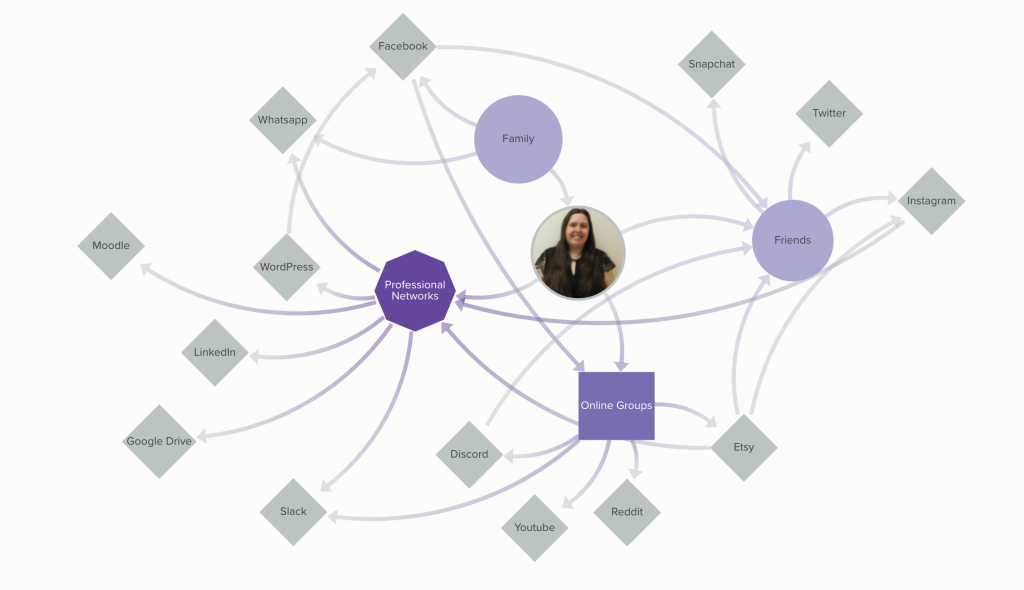
Visually Mapping my Networks

My networks mapped out

When making this visual version of my networks, it allowed me to reflect further on how these are interconnected with varying parts of my life. Using Kumu, I situated myself in the middle of the map, I decided to keep it to four categories that fanned out from the centre: family, friends, online groups, professional networks.

For the category of family, that is pretty self-explanatory, it revolves around parents, cousins, aunts, etc. This is where I use the most personal types of networks that involved instant messaging through Facebook or WhatsApp in order to stay in contact with them.For me, the circle visualizes my inner circle so to speak, that they are one of my more important networks and therefore should be seen as such with a larger circle and close to myself in the centre of the map.

Next would be the category of friends, here they are still in the shape of a circle because they are part of my day to day life. Here is where I started to see a bit of a shift of the networks on the map as we use quite a few different ones to communicate depending on the need of our conversations. We tend to use more types of social media than anything in order to get in touch with each other. I think that the reason is because we grew up with all of these different types of networks when they first started out, and we liked to experiment a bit with all of them. While I use some less than others now, it still stays the same that we do not really use phones or other forms of communication in order to connect with one another.

As we continue to go around the map, the next group is online groups. These are the people I have met through forums on discord or by joining groups in other social media websites. I felt the need to change the shape of the connection as while I have things in common with them, they are people who I have not yet to meet in person. Interestingly enough, there are still some networks that interconnected from this category into my inner circles. For example, when COVID hit my friends and I tended to use Discord in order to play games or connect online sometimes.

My final category on my map would be professional networks. This area is where I combined both my coworkers and current cohort at RRU. These are two areas that are part of my professional world and where I use various different networks in order to connect with them. Since where I work is quite small in comparison to some, it was quite easy to either communicate in person or through WhatsApp. On the other hand, being part of RRU has allowed me to expand on my use of networks to include, Slack, Moodle and more.

Once I finished my map, I took the time to look at the connections and loops made there were some connections that did not surprise me, and some that did. That is to say, there were some connections that were more interconnected into my networks than I thought they would. I am sure as this program continues this map will contain even more connections and new networks, and am looking forward to seeing it expand and grow.

Since I had some surprises, I am curious if anyone else did too? Did you have things more interconnected than you thought?

Developing my Digital Identity

This week there has been a lot of reflection upon what I want my digital identity to look like. When learning about the visitor and resident typology (White and Cronu, 2011), I found myself thinking about where I landed within digital networks, and it happened to lean towards the visitor end. I am someone who likes to use networks with a task in mind and do not comment or engage with others online when it comes to my personal networks. This brings to me to one of my goals, which is to become more of a resident within my frequented networks. More specifically, I would like to be more engaged in Facebook, Twitter, Etsy. On the other hand, I find myself a resident in my institutional networks as these are areas that engagement is needed in order to work with my fellow cohort and other course related acquaintances.

When reading the post “Who are you? Considering Issues of Web Identity” by Kelly Schryver (2013). Something that resonated with me was how Schryver (2013) discussed how we as a society must reflect on if what we show of ourselves online would match the person we are in real life. This is something I strive for, I do not like to edit myself and be someone different online compared to when I am face to face with someone, I feel like I am authentically myself. As Schryver (2013) mentioned, how there could be conversations or posts that you thought were private but were then found by other people. It is for this reason that while I am authentic online, I am also quite private and therefore do not post a lot and keep most of my personal pages set on private so only a select group of people can see my profiles and posts. Even then, I post once every few months or just send direct messages to my friends. This brings me to my second goal, I would like to post more on my pages, whether it be for school, a status to talk about a show or article I enjoyed, etc. This second goal is also one way I will try to be more engaged in my social networks, and allow myself to go from visitor to resident.

For Facebook, I plan on posting updates every few weeks instead of months. I want to show people more about my school and share my blog posts with them. So when I post a new blog, my idea is to share a link and discuss it on my feed as well. Furthermore, I am part of many different groups on Facebook, for my hobbies such as crochet and baking. I love to see other people’s pictures and give a reaction, I now will also try to comment on them with word of encouragement and even post some of my own creations.

In terms of Twitter, I have not used it a lot in terms of tweeting, but I often go to see what other people have posted. This is especially true when I look up hashtags of shows I am watching or see what my friends are saying there. How I will become a resident on Twitter is to interact with those hashtags by tweeting with the tag myself and perhaps commenting on those who I found interesting as well.

Finally for Etsy, I used to be quite the resident as I use this platform to sell some items I create from my 3D printer. I have recently stopped due to school and other priorities. My plan is to use my agenda to schedule a time within the week or month where I can become active there and start posting new products and creations and promote it using Facebook , Twitter or Instagram.

In the end, this week has allow me to sit back and reflect on my digital identity in a way I never really thought of before. These are my goals for now, but I think as this course continues, my thoughts and plans may change slightly over time. I am looking forward to continuing to develop my digital identity throughout this course and the rest of my time as a MALAT student.

References

Schryver, K. (2013, February 5). Who are you online? Considering issues of web identity. The New York Times blogs. Alternate link to the The NYT blogs site.

White, D. S., & LeCornu, A. (2011). Visitors and residents: A new typology for online engagementFirst Monday, 16(9).

My Networks Mapped Out: Digital vs Analogue

Upon reading Dave Cormier’s (2018) blog that looked further into mapping our networks with either a digital or analogue point of view it led me to further reflect on my networks and where they land. While I see myself leaning more towards digital networks, like social media, email, and other means to connect online, I find myself also still using some analogue tools. For instance, when I am in school or a work meeting, I tend to always have a paper notebook as I like to hand write my notes. I feel this allows me to remember what is being written more than when I type. On the other hand, Cormier (2018) talked about using sticky notes for his activities, and I found myself laughing as on my laptop I use digital sticky notes that stay on my desktop. So, I must think, how many analogue tools now have a digital equivalent? Should there be tasks completed through analogue means or should we completely shift to digital? These are some questions to think about as I continue on my journey as a MALAT student.

Reference

Cormier, D. (2018, March 31). Digital practices mapping – intro activity for digital literacies course. Daves Educational Blog. Retrieved April 23, 2023, from http://davecormier.com/edblog/2018/03/31/digital-practices-mapping-intro-activity-for-digital-literacies-course/

My Networks Mapped Out

Networks mapped out in four quadrants (visitor, resident, personal and institutional).
My networks mapped out according to Dave White’s (2013) Visitor and Resident typology.

When mapping out my networks, I noticed I spend a lot of time in the visitor area of typology, which according to White (2013), I look and search, but do not really post much online within these networks, in other words these are the places I visit. For instance, when searching or using Reddit and Twitter, I use these more for reading about shows I enjoy and see other people’s opinions, but do not really post my own. On the other hand, I use Facebook and Discord more as my networks to post my thoughts and interact with others. I feel that this is because I am friends with those who use these networks and feel comfortable sharing my opinions as opposed to sharing my thoughts with strangers. It has been quite interesting to map out my use of various networks and it has me reflecting in preparation for the next assignment of my digital identity. What do I want my online presence to show? This is something I will be thinking about quite a bit now as I will be having a larger digital identity as I continue this blog.

Reference

White, D. (2013, September 13). Just the mapping. YouTube. Retrieved April 22, 2023, from https://www.youtube.com/watch?v=MSK1Iw1XtwQ

Opening a Black Box

The idea of AI is something relatively new to me. This topic has piqued my interest in how it can be used in education, and I question what the implications are of using AI within an educational setting. This blog will touch upon AI and its most recent impact on learning design.

The presentation ‘AI and Learning Design in Education’ (2023) included various panellists from different education sectors and discussed AI’s impact. Clint Lalonde (as cited in Royal Roads University, 2023) called AI and ChatGPT a “black box” (14:59) and asked how we can understand what is going on within the box if we cannot see what it is inside. How is the technology getting the information it is, and what is it doing with the information we put in it? How can we use this technology in an ethical manner and without worrying about how students are using the technology?

While there are many questions when it comes to AI and how it can work within an educational setting, Hadley (as cited in Royal Roads University, 2023) mentions that there is a silver lining (24:57). That is, we can embrace this technology instead of trying to ban students from exploring it and flip what is being assessed. I agree with trying to find ways to incorporate it into the classroom. There is much potential for good when using AI, which can enhance student learning in various ways. That is not to say that students should be allowed to use it to complete assignments, but instead, use AI in terms of helping the learning process. Moreover, it is important to note that AI should be used in an exploratory manner and help make learning meaningful. The way to flip assignments and embrace the use of AI could involve multi-layered assignments. Discussing multi-staged assessments reminded me of when I completed my internship in a grade 5 class. There was never an assignment with only one part; there were always various steps needed to complete it. If we were to stick to this type of assessment, I think that this would help teachers integrate AI during one of the steps that helps the students learn but, at the same time, does not impact the educator’s learning goal.

The use of AI was compared to using a calculator in math (Wilson, as cited in Royal Roads University, 2023, 27:56) in that a calculator is a tool, but you still need the background knowledge to understand what you are doing. Thus, we, too, can use AI as a learning tool, but we must still be mindful that AI cannot do everything for us. We must still be able to explore, research and do things independently; we cannot learn if we have a machine do it for us. This is where the concern about the use of AI comes in.

Some valid concerns were brought up about how the use of AI can impact the cognitive development of children and adolescents the more AI is used when it comes to writing (Webster, as cited in Royal Roads University, 2023, 52:10). I cannot help but compare this to when cell phones became smartphones and the worry about students not knowing how to spell because of the use of shortened abbreviated words, or the use of spellcheck. Suppose we keep an open conversation with the students and set boundaries from the beginning. In that case, we can minimize the negative impact AI may have in the future on these essential skills, like writing.

In the end, this panel has taught me a lot and allowed me to reflect upon the positive impact of AI and concerns about using it. AI in education is an ongoing conversation that is constantly evolving. Suppose we are open to having these conversations. In that case, I optimistically believe that we will one day find a way to open this black box and explore what is going on inside as we continue to gain a better understanding of the use of AI in education. 

Royal Roads University. (2023, March 7). AI and Learning Design in Education [Video]. YouTube. https://www.youtube.com/watch?v=IFrAs59sDHI